Category Archives: Civil War

Bread and “miracles”

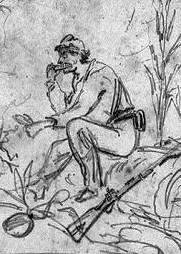
Sketch of soldier eating

Sketch of a soldier eating. Image courtesy of Library of Congress Prints and Photographs Division

(Text (c) The Provincial Archives of the Daughters of Charity and the author, Denise Gallo)

The Sisters’ accounts of events before Gettysburg often echo each other but clearly the most retold incident involved Sr. Mary Jane Stokes and the Community’s bread. On a visit back to Emmitsburg in 1886, she was asked to retell what she had witnessed during the Union encampment in 1863. “Nearly in these words,” the Annals narrator notes, she told the story: “The soldiers made their appearance here, as well as I can remember about three in the afternoon. We were going down to the barn, Sr. Camilla, the Treasurer, and I, to see about them there, when we turned around, and here was a whole pack of them at the house behind us. The poor fellows looked half-starved, lank as herrings, and barefoot. They were on their way to the Gettysburg battle. Well, the Sisters were cutting bread, and giving them to eat as fast as they came for it, all the evening, and I was afraid there would be no bread left for the Sister’s supper. However, they had supper, and plenty. After supper, I belonged to the kitchen Sisters, I went to Mother Ann Simeon, and told her I didn’t know what the Sisters would do for breakfast next morning, for they would have no bread. Then I went to see, and the baking of the day was there. I did not see it multiplied, but I saw it there.”

Two other Sisters also offered accounts of this episode. “And now occurred a singular fact,” recounted Sr. Marie Louise Caulfield, “worthy of record since it gives another instance of the sweet Providence of God even watching over, and supplying the wants of our Community when those wants grow out of the necessities of our Masters. This fact is related by Sister Stokes, the Sister then in charge of the farm. As squad after squad succeeded each other and all going away liberally supplied, she knew that the ordinary quantity of bread baked for the Community could not suffice for such a disbursement and went to the bake house to see if anything was there for the Sisters’ breakfast. To her surprise ‘the baking of the day was yet untouched.’ The Sisters had been feeding this vast concourse out of the ordinary portion prepared for themselves!”

Sr. Camilla O’Keefe noted: “An offering of refreshments to the men was very acceptable. Then the supper or a good lunch for the men was got ready by the Sisters, some set to cutting the bread, others making the coffee. Whilst the Sister in charge of the bread in serving out so much said to the others, I fear we will run short for the supper & breakfast for the house. So she ran over to the bake house to see what bread might be there and to her great surprise found they had all the baking of that day on hand. She could hardly believe her eyes and thought the bread must have multiplied.” Both Sisters were present when Sr. Mary Jane first reported the event in 1863 and also would have been in Emmitsburg when she retold it in 1886.

Examining the event today, the temptation is obvious – this unexpected appearance of bread surely must be a reiteration of the multiplication of loaves. In fact, the story is often interpreted that way. Yet Sr. Marie Louise only proposes that the bread is “another instance of the sweet Providence of God . . . supplying the wants of our Community.” Sr. Camilla merely states that Sr. Mary Jane thought the bread must have multiplied. The most cautious is Sr. Mary Jane herself who finishes her version with a carefully strong (underlined) disclaimer: “the baking of the day was there. I did not see it multiplied, but I saw it there.” None of the Sisters ever comes close to implying that there was a “miracle” and neither should we. There are many mundane explanations for how the bread came to be there (and we’ll suggest one in the next Bread blog). Insisting on a “miraculous” spin diminishes what actually happened during those days at St. Joseph’s when Vincent’s Daughters created an enveloping charity that fed certain bodies and souls on their way to an uncertain future.

Leave a comment

Filed under Civil War, Emmitsburg, Gettysburg, Provincial Annals

“Ceaseless tide of famished soldiers”

soldier with gear

[Private Albert H. Davis of Company K, 6th New Hampshire Infantry Regiment in uniform, shoulder scales, and Hardee hat with Model 1841 Mississippi rifle, sword bayonet, knapsack with bedroll, canteen, and haversack. Photo courtesy of the Library of Congress]


(Text (c) The Provincial Archives of the Daughters of Charity and the author, Denise Gallo)

Accounts of the Battle of Gettysburg in the Provincial Annuals are rife with descriptions of Sisters at St. Joseph’s Central House giving slice upon slice of freshly-baked bread to ravenous soldiers. As we researched Civil War and Gettysburg histories in preparing for our recent program, we started to wonder just how hungry the visiting troops could have been. We discovered so much information that we devoted the entire July 1 gallery talk to the topic of “Bread.”

Let’s begin with the first group of visitors, who arrived the evening of June 27, 1863: members of the Michigan Fifth and Sixth Cavalry brigades. According to James H. Kidd, one of the riders, they left headquarters in Frederick that morning “much refreshed, with horses well fed and groomed and haversacks replenished.” “Haversacks replenished” meant that each man carried enough rations for three days. This unappealing Army fare included such staples as hardtack, salt pork, and coffee. What Kidd next related is important to our question. Along the way, the Cavalrymen (among whom, we should note, was St. Joseph’s most illustrious guest, George Armstrong Custer) were greeted by local residents with “the richness and overflowing abundance of the land.” There were, he relates, “…’oceans’ of apple-butter and great loaves of snow-white bread that ‘took the cake’ over anything that came within the range of my experience…. A slice cut from one of them and smeared thick with that delicious apple-butter was a feast fit for gods and men.” Of course, there was one significant difference between this bread and the slices both Cavalry and Infantry troops would have received at St. Joseph’s: in almost all cases, the locals were selling food to the soldiers whereas the generous Sisters were giving it to them. Similar remembrances can be found in many other first-person narratives. Charles Wainwright of the First Corp wrote, “The people along the road sell everything, and at very high prices: fifty cents for a large loaf of bread, worth, say, twenty; fifteen to twenty-five cents for a canteen, three pints, of skimmed milk; how much for pies I do not know, but they were in great demand.” What is noteworthy is that food was available along the routes to Emmitsburg, and the soldiers took every occasion to get it. Wainwright offers a particularly vivid picture of one man actually dumping the rations from his haversack to fill it with newly-purchased homemade luxuries.

Were the soldiers who arrived at St. Joseph’s actually “the ceaseless tide of famished soldiers” that Sr. Marie Louise Caulfield described? Marching for miles certainly built up appetites and their visitors undoubtedly came hungry, but one cannot interpret the Annals to mean that the Sisters’ bread took care of the needs of a hungry army. Even so, had the Sisters known that the men were obtaining food from other sources, they certainly would have shared their loaves all the same.

One last question: why was bread such a particular delicacy for the men? This bread, fresh and warm from the oven, not only filled their stomachs but filled them with memories of home. For St. Vincent’s Daughters, of course, bread was always an offering, the most basic of all gifts to share with those in need.

Leave a comment

Filed under Civil War, Exhibits

Highlights from Day 6 and 7 of “Our buildings and very earth trembled”

Satterlee Military Hospital

Images of Satterlee Military Hospital, Philadelphia

Two more sites where Sisters served. Top: sketch of General Hospital in Richmond. Bottom: Patient ledger from St. Mary's Hospital Rochester, NY

Two more sites where Sisters served. Top: sketch of General Hospital in Richmond. Bottom: Patient ledger from St. Mary’s Hospital Rochester, NY

Hospitals where DCs served

Images of other hospitals where Daughters of Charity served during the Civil War: Gratiot St. Prison in St. Louis, Charity Hospital in New Orleans, and St. Mary’s Hospital in Detroit.

Manuscripts showing the history of Satterlee Military Hospital and the journey to  Gettysburg.

Manuscripts showing the history of Satterlee Military Hospital and the journey to
Gettysburg.

Coskery manuscripts

Manuscripts of Sr. Matilda Coskery’s Advices Concerning the Care of the Sick

Omnibus

A horse-drawn omnibus similar to this one transported the Sisters to Gettysburg.

Leave a comment

Filed under Civil War, Emmitsburg, Exhibits, Gettysburg