Tag Archives: New York City

The Sisters of Charity and Venerable Pierre Toussaint

There are currently six African Americans on the pathway to sainthood.  One of them, Ven. Pierre Toussaint (1766-1853), shares a connection with the early Sisters of Charity of St. Joseph’s.

Toussaint arrived in New York City from Haiti with his enslavers in 1787.  He was permitted to work and earn money for himself as a hairdresser, becoming renowned for his skill and able to command high prices from the upper classes for his work.  When his Mistress died in 1807, he was freed through her last will and testament.  His renown grew through his connections with different members of society – the upper native classes through his work, the immigrants from the Francophone world through his mother tongue, and the Black community – both free and enslaved – through his race and life experience.  Upon his freedom, he took the last name Toussaint in honor of Toussaint L’Ouverture, hero of the Haitian Revolution. 

Toussaint’s financial success and Catholic faith inspired him to give back.  Among other charities, he was a major visitor and contributor to the Roman Catholic Orphan Asylum on Prince Street, an orphan asylum that had been run by the Sisters of Charity of St. Joseph’s since 1817.  His special concern for this cause likely came from the death of his sister, after which he took in his niece to raise her.  At one time, his donations totaled one-third of all the yearly donations of the Asylum.  This is in spite of the Orphan Asylum being, at the time, for white children only.

Among the other causes that he championed, Toussaint showed particular concern for refugees, particularly those who spoke French.  He also founded the first Catholic school for Black children in New York City, located at the Parish of St. Vincent de Paul, the city’s Francophone parish at the time. 

Toussaint was known for attending daily Mass at St. Peter’s, which was Mother Seton’s parish during her New York years! 

In 1846, the Sisters in New York City and Brooklyn withdrew from Mother Seton’s community to form the Sisters of Charity of New York, who inherited the community’s history in the Metro area up until that time.  In 1850, members of the Sisters of Charity of St. Joseph’s joined with the French Daughters of Charity, and a separate group of Sisters formed the Sisters of Charity of Cincinnati.  The New York Orphan’s Asylum forms part of the core history of the Sisters of Charity of New York and therefore, of the shared history of Mother Seton’s Daughters.
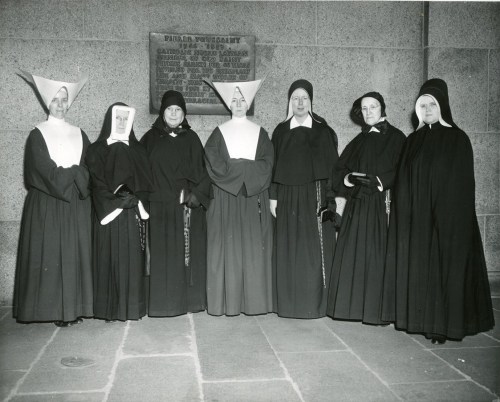
A meeting of the Sisters of Charity Federation, sometime after 1953, in front of the plaque to Pierre at Old St. Patrick’s Cathedral. 

In 1990, for his role in helping the Catholic Charities of the city survive in their early days, Toussaint was re-interred to the crypt of St. Patrick’s Cathedral.  He is the only layperson so honored.  He was declared venerable in 1996.  The Pierre Toussaint Guild and Office of Black Ministry of the New York Archdiocese actively engages in charity and sponsorship projects that they believe Toussaint would support today.

Leave a comment

Filed under African American History, Sisters of Charity Federation, Sisters of Charity of New York, Sisters of Charity of St. Joseph's

The Hamilton Letter

This is part of a yearlong series about the early days of the Sisters of Charity of St. Joseph’s commemorating the 200th anniversary of the death of Saint Elizabeth Ann Seton, foundress of the community.  In 1850, the Emmitsburg-based Sisters united with the international community of the French Daughters of Charity.

Lin-Manuel Miranda did not include Mother Seton in his smash Broadway hit Hamilton, but be assured that the two of them ran in the same New York society in the early days of the American experiment at the southern tip of Manhattan.

Many of Mother Seton’s surviving letters from this period of her life discuss the social scene, business partners, her friends, and friends and business partners of her husband, William Magee Seton.  Among these is a draft of a letter to John Wilkes, a friend and cousin-through-marriage to her husband.  Although it is undated, its subject matter reveals that it was written a short time after July 14, the day of Alexander Hamilton’s funeral.

In the heyday of William’s business, the family had lived at 27 Wall Street, a block away from Hamilton’s home and across the street from the office of The Manhattan Company, the predecessor to JPMorgan Chase Bank founded by Hamilton’s dueling partner, Aaron Burr.

At the time of Hamilton’s death, however, John and Charles Wilkes, alongside another related family, were helping Elizabeth (now a widow) and her children through a New York situation that seems highly modern – paying too high a rent on a too-small apartment.  Located on N. Moore Street, today in Tribeca, Elizabeth for the first time had to rely on her relatives’ assistance to make it by, and even pushed back on the suggestion to begin taking in boarders.

Hamilton’s funeral was at Trinity Church, at the end of the Seton’s former neighborhood on Wall Street.  Fresh from the funeral, Charles stopped by Elizabeth’s Moore Street House:

“He was quite pleased with my little House and my darlings whom he found eating their bread and milk with a very good appetite but I observed that he was really so affected at the tolling of the Bells for the death of poor Hamilton that he could scarcely command himself…how much you will be distressed at this melancholy event – the circumstances of which are really too bad to think of”

Although their paths divided significantly, Hamilton going into government and meeting an untimely demise; Burr to a treason trial, a westward land scheme, and undignified obscurity; and Seton to Catholicism and a small town in Maryland, what we refer to as the “Hamilton letter” helps show how closely Mother Seton’s world was intertwined with the world of the early U.S. government and high society.

4 Comments

Filed under Alexander Hamilton, Elizabeth Ann Seton