
In memory of Sister Mary Patricia Larabell, who died at Seton Residence, Evansville, Indiana, April 11, 2014; 82 years of age and 62 years of vocation.
May she rest in peace.
In memoriam: Sister Mary Patricia Larabell

Filed under Announcements, Deceased Sisters
A Seton in New Jersey
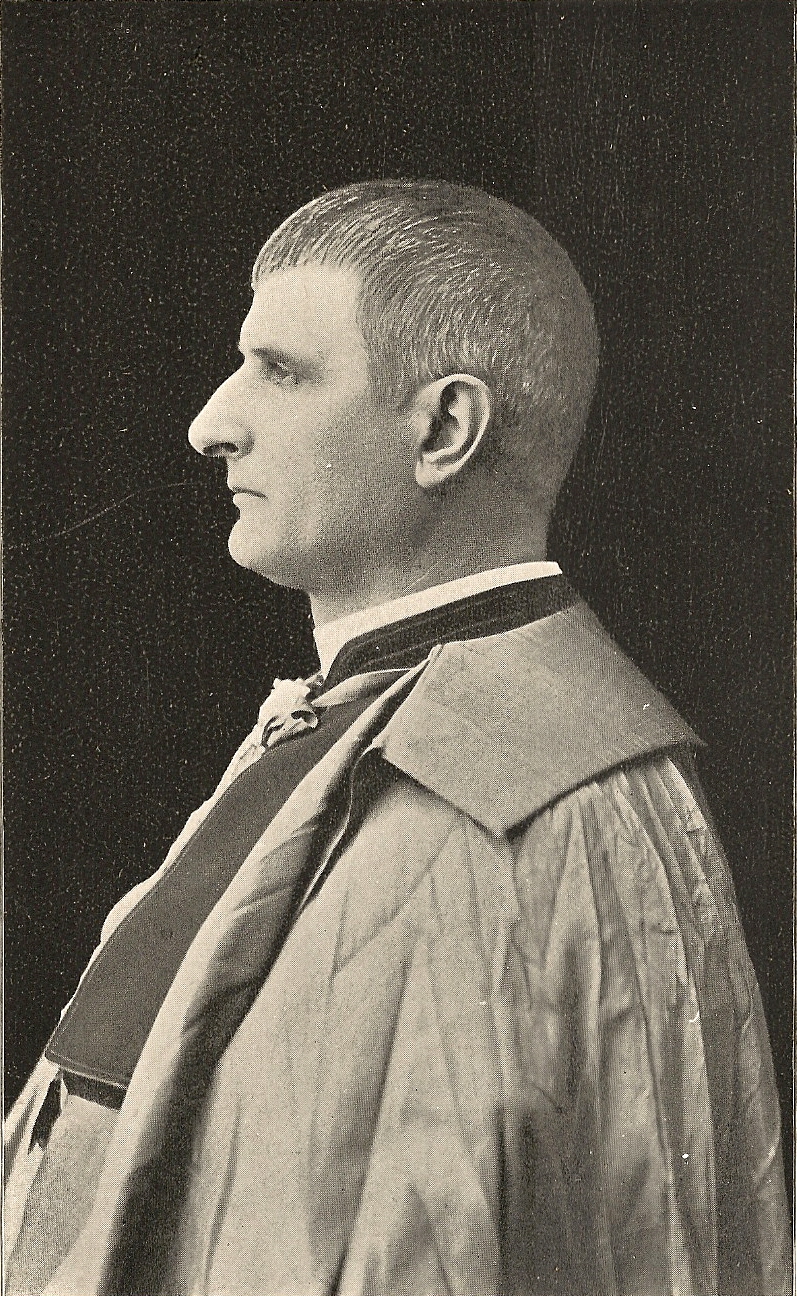
Portrait of Robert Seton (courtesy Sisters of Charity of Saint Elizabeth)
Guest post by Sister Noreen Neary, SC, Archivist, Sisters of Charity of Saint Elizabeth, Convent Station, NJ
The Sisters of Charity of Saint Elizabeth have a unique connection to Mother Seton’s family through her grandson Robert. Born in Italy in 1839, he was the fourth of William and Emily (Prime) Seton’s seven children. While he never knew his grandmother, clearly she had a strong influence on him. As a young man he studied at Mount Saint Mary’s College in Maryland, a stone’s throw from where his saintly grandmother lived, worked, died and was buried. Robert pursued his theological studies at the American College and the Academia Ecclesiastica in Rome where he was ordained to the priesthood in 1865. While in Rome he was made the Private Chamberlain to Pope Pius IX and dean of the Monsignori in the United States.
Upon his return to the U.S. Monsignor Seton was granted faculties in the Diocese of Newark, headed by Bishop James Roosevelt Bayley, Mother Seton’s cousin. Having spent two years as a curate at Saint Patrick parish in Newark – the site of the founding of the Sisters of Charity of Saint Elizabeth – he was named the chaplain at our Motherhouse in rural Morris County and served in that capacity from 1867 to 1876. Then Monsignor Seton left the countryside to work with the Sisters of Charity at Saint Joseph parish in Jersey City. He recalled later:
God favored me in letting me find a small but exemplary community of Sisters already established in the Parish and conducting a school alongside the Church. They were angels of kindness and efficiency and a comfort in my long years of trial and discomfort.
His long tenure (1876-1901) as pastor was marked by the building of the rectory, convent and parish school hall. Monsignor Seton returned to Rome in 1901 and was appointed Archbishop of the titular See of Heliopolis in Phoenicia by Pope Leo XIII in 1903.
Upon his retirement in 1921 Archbishop Seton returned to Convent Station. A student at Saint Elizabeth’s Academy recalled the elderly gentleman: “We were also honored with Archbishop Seton’s presence in his retirement years. He was a grandson of Saint Elizabeth Ann Seton. To escort his Grace on an afternoon stroll usually ended with the gift of a large red apple and a ‘thank your girls.’” (Adria Winser Walsh ’22)
Archbishop Seton wrote a number of books, including Memories of Many Years 1839-1922 (1923), Memoirs, Letters, and Journal of Elizabeth Seton (1869) and An Old Family, the Setons of Scotland and America (1899), a privately published, well researched genealogy of his father’s family.
Archbishop Seton’s generosity led him to donate his grandmother’s desk and footstool to the Sisters who cared for him until his death in 1927. Ave Maria magazine (April 2, 1927) noted that his funeral was attended by representatives of the Daughters of Charity and the Sisters of Charity from Cincinnati, New York, New Jersey and Greensburg, PA, although the Halifax, Nova Scotia, congregation was unable to send representatives in time for the service. Archbishop Seton’s body is buried in Holy Sepulchre Cemetery in Newark.

Mother Seton’s desk (courtesy Sisters of Charity of Saint Elizabeth)

Tombstone of Robert Seton (courtesy Sisters of Charity of Saint Elizabeth)
Share this:

Preservation activities: American Rule of 1812

Conservator Mary Wootton (left) and Provincial Archivist Dee Gallo examine the American Rule of 1812
(Image used with permission of Mary Wootton)
Our collections are unique and irreplaceable, and preservation measures are an ongoing activity for the Provincial Archives. Today, Dee Gallo (right) met with conservator Mary Wootton to discuss conservation treatments for one of the most historically valuable items in our collection: The Regulations for the Society of Sisters of Charity in the United States of America, commonly known as the American Rule of 1812. The American Rule is an English translation of the French rule of the Daughters of Charity, modified by Elizabeth Ann Seton and the Sulpicians for the Emmitsburg community. It was approved by Bishop John Carroll in 1812.
Conserving the American Rule will be a labor-intensive process, as each of the book’s 60 leaves will receive attention. Pages will be cleaned, existing mends will be removed, and new mends will be done with Japanese paper. The book will then receive a new binding and a custom-made box.
We are pleased to be working once again with Mary, whose efforts will ensure that the American Rule will last for many years into the future.


