Category Archives: World War 1

World War One: Account of Charles Holden

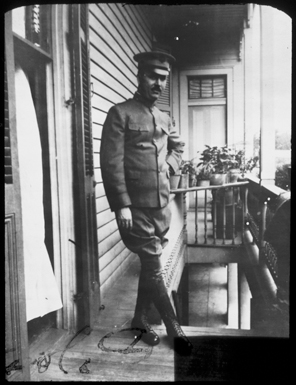
Charles Holden, as pictured in the Brooklyn Daily Eagle, November 3, 1918 (courtesy Brooklyn Daily Eagle)

Charles Holden, as pictured in the Brooklyn Daily Eagle, November 3, 1918 (courtesy Brooklyn Daily Eagle)

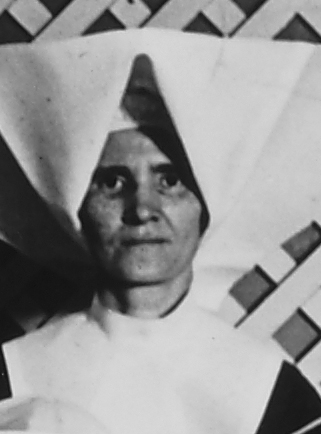
Sister Catherine Coleman, who recorded Holden's death in her diary (used with permission of Daughters of Charity Provincial Archives)

Sister Catherine Coleman, who recorded Holden’s death in her diary (used with permission of Daughters of Charity Provincial Archives)


While working with researchers, we often find that their research interests can help us shed additional light on the history found in our own collections. Recently we worked with a researcher who had done extensive study of Sisters’ nursing service in both the Spanish American War and World War I. To our delight, she shared with us information which filled in the gaps to a particularly moving story connected with our current exhibit, “Over There”. In her wartime diary, Sister Catherine Coleman eloquently recorded the death of a young solder who passed away in October 1918 at Base Hospital 102 in Vicenza, Italy. She wrote:

“An American boy from New York by the name of Holden died of Pneumonia. He leaves his parents and a brother and sister in New York. He was baptized before his death. When asked what message he would like to have sent to his people, he said that is a hard thing to have to talk about, and asked Sister what she would say. The subject was dropped for the present, and as he grew weaker, he was asked the second time and he said: Tell my people I have fought hard against death, but it must be. Tell them I am glad to die for my country. He was a lovely boy, just 21 yrs. Old. While in New York he posed for the Arrow collar for three years. Many remembered having seen his picture in the papers wearing the Arrow Collar. His Regiment took charge of the body. He was taken from the hospital to the cemetery. Six of the Sisters and a number of Nurses attended his funeral. His body lies at the foot of the Alps on a little mound, a very beautiful spot. He was buried with Military Honors. One of his comrades read the burial services at the grave. Sister Chrysostom wrote his mother a gave her an account of his death, also pressed one of the flowers from his grave and sent it in the letter.”

Our researcher shared with us articles from the Brooklyn Daily Eagle which provided a picture of Holden and verified his full name, age, rank, and hometown. Private Charles H. Holden, age 21, of Brooklyn, New York, was the son of Mr. and Mrs. Harry Holden. He had joined the Army as an ambulance driver. One of the articles quoted the complete text of the letter written by Sr. Chrysostum Moynahan to Holden’s parents after he died. We were pleased to see this letter, as it does not survive in our collection. It reads:

Somewhere in Italy
October 11, 1918
Mrs. Harry Holden, Brooklyn, NY

Sister Chrysostum Moynahan, Chief Nurse at Base Hospital 102 (used with permission of Daughters of Charity Provincial Archives)

Sister Chrysostum Moynahan, Chief Nurse at Base Hospital 102 (used with permission of Daughters of Charity Provincial Archives)

Dear Mrs. Holden and Family,
The object of this note is to tell you something of the last illness and death of your dear boy, as I am sure you will appreciate a word direct from the hospital where he passed away.

He was admitted to our base hospital on September 31 (sic) a very ill boy, having been sick with pneumonia four days previous. From the very beginning he seemed to realize that he was not going to recover. The only thing that seemed to worry him was the grief it would cause his family. He said to tell you that he loved all; parents, brother, and sister, and that he hoped to see you again. He was glad to die a soldier and for his country, and though he was most anxious to get well and fight with our boys, he was perfectly resigned to do God’s holy will.

His death on October 4 caused grief and sorrow among his comrades, who said so many lovely things about him. He was buried October 6, with all military honors. His funeral procession was formed of the officers and enlisted men of his regiment, followed by some officers and enlisted men of our unit, also six Sisters of Charity and forty nurses. Many of the inhabitants of the town also followed to pay respect to the American soldier. Some of them have passed through many bitter trials during this war, and could truly sympathize with your loss. He had many beautiful floral pieces, each design being tied with long wide streamers of our national colors.

One of the nurses who nursed him secured a piece of ribbon for you, and I took one of the flowers, which you will find enclosed. The services at the grave were performed by a minister of your own faith. After the service he spoke beautifully of your dear boy, and, judging from all that he said of him, he must certainly have been a dear good young man. Our Sister de Sales had charge of him during his illness, and he was most grateful to Sister and the nurses for any little attention he received.

Sister DeSales Loftus, who cared for Holden prior to his death (used with permission of Daughters of Charity Provincial Archives)

Sister DeSales Loftus, who cared for Holden prior to his death (used with permission of Daughters of Charity Provincial Archives)

Trusting that our dear Lord will give you and all his dear ones all the grace and strength necessary to bear up under this great trial our dear Master has been pleased to send you in the death of your darling boy, and with the heartfelt sympathy of the officers, sisters, and nurses of Base Hospital #102, I remain,

Yours respectfully,
Sister Chrysostom
Chief Nurse

Private Charles Holden no longer rests in the beautiful spot at the foot of the Alps that Sr. Catherine described in her diary. During World War I it was common practice for soldiers and Army nurses who died to be buried in temporary cemeteries near the battlefield or military hospital. After the war permanent sites were selected for cemeteries. Depending upon the wishes of the next of kin on record remains were either sent back to the US or re-interred in a permanent American cemetery. Today, Holden’s grave can be found in the American Cemetery at Suresne, France.

“Over There” is on display in the Provincial Archives through October 30.

Leave a comment

Filed under Health Care, Ministries, World War 1

Preservation Projects: Digital Initiatives

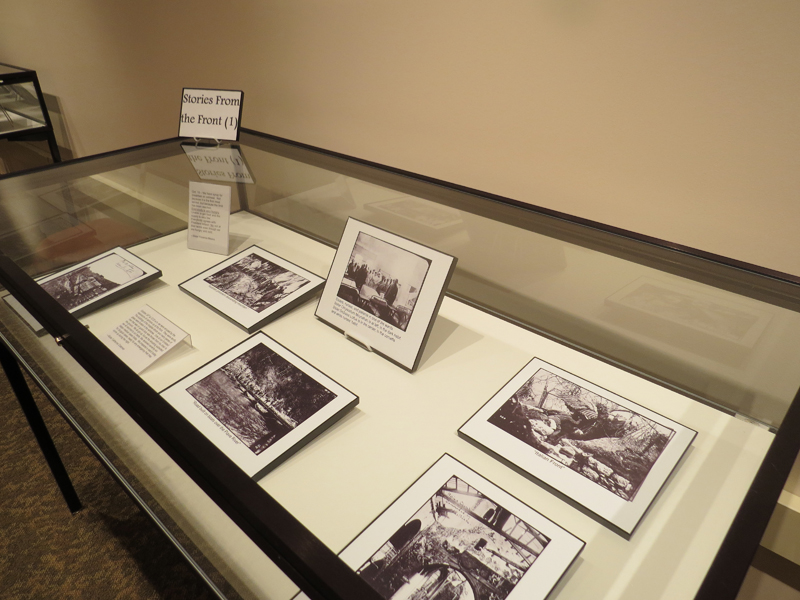
A selection of the original glass plate negatives from our World War I holdings , on display as part of the "Over There" exhibit (used with permission of the Provincial Archives)

A selection of the original glass plate negatives from our World War I holdings , on display as part of the “Over There” exhibit (used with permission of the Provincial Archives)

Digital images on display in "Over There" (used with permission of the Provincial Archives)

Digital images on display in “Over There” (used with permission of the Provincial Archives)


In our efforts to preserve the Daughters’ legacy for years to come, we have worked with a number of specialists in art, book, and paper conservation. In addition, we have worked with experts in digital technology to make high-quality reproductions of archival materials. Digital copies allow us to reduce wear and tear on fragile originals and facilitate online access over the web and social media. In addition, digital technology can make obsolete formats once again accessible to scholars and the public. Such is the case with the images now on display as part of our exhibit, “Over There:” The Daughters of Charity’s Service in the First World War. The collections of the former St. Louis Province include a set of approximately 100 glass plate negatives depicting the Sisters’ World War I service. These negatives included images of the Sisters, the lay nurses who served with them, the hospital where they served, and the fighting along the Italian Front. Because of their format they could be not be studied, and had never been exhibited. They were digitized in 2009 by Digital Preservation, of St. Louis. With Over There, the World War I images are on display for the first time. Digital images were used to create all the photos used in both the physical exhibit and the companion video. Digital technology will play an important role in future preservation efforts.

Over There will be on display through October 30.
Exhibit hours for Sisters, Associates, and volunteers on the Emmitsburg Campus: Monday-Friday, 8AM to 4:30PM
Exhibit hours for the general public: Wednesdays, 10AM to 4PM.
All exhibits are free of charge.

The Over There video may be viewed online using the links below.
Part 1:
Part 2

Leave a comment

Filed under Exhibits, Preservation, World War 1

Digital Exhibit: Daughters of Charity in the First World War

(All images used with permission of the Provincial Archives)

Seen here is a selection of images from our current exhibit, Over There: The Daughters of Charity’s Service in the First World War, now on display through April 30.

The Call to Service
“ … Dr. Danna of Charity Hospital, New Orleans has asked us for Sisters to aid him in conducting a base Hospital. … These Base Hospitals, it seems are to be located wherever they are needed … Doctor asked for five or six Sisters to be placed as Head Nurses in the different wards … the Council agreed to send six sisters when called upon.”
—Sister Eugenia Fealy (Visitatrix, St. Louis Province), letter to Mother Margaret O’Keefe (Visitatrix, Emmitsburg Province), April 21, 1917.

The call came in the summer of 1918. when the unit, formally known as Base Hospital 102, was organized and readied to go to Vicenza, Italy. The chief surgeon, Dr. Joseph Danna, was Dean of the Medical School at Loyola University in New Orleans; he had worked with the Daughters at both Charity Hospital and Hotel Dieu Hospital. Because of his ties with Loyola University, Base Hospital 102 was also known as the Loyola Unit.

Dr. Joseph A. Danna, Dean of the Medical School at Loyola University, New Orleans and chief surgeon for Base Hospital 102

Dr. Joseph A. Danna, Dean of the Medical School at Loyola University, New Orleans and chief surgeon for Base Hospital 102

Sisters and Nurses
Ten Sisters were chosen for the Loyola Unit: Sisters Valeria Dorn, Agatha Muldoon, DeSales Loftus, Mary David Ingram, Angela Drendel, Lucia Dolan, Marianna Flynn, Florence Means, Catherine Coleman, and Chrysostum Moynahan. They came from hospitals in Alabama, Louisiana, Texas, Indiana, and Missouri. They were led by Sister Chrysostum Moynahan, Chief Nurse, who brought a wealth of experience to her role, including hospital administration and service during the Spanish-American War. The Sisters supervised a staff of 90 lay nurses recruited from Daughter of Charity hospitals throughout the country. Many had graduated from Daughter of Charity nursing schools.

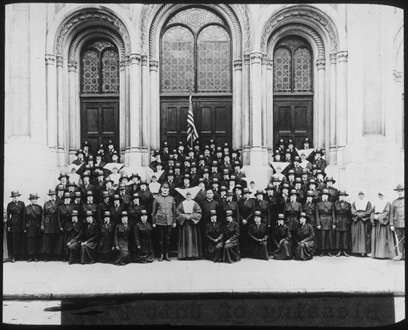
Daughters of Charity who served in Italy during World War I.

Daughters of Charity who served in Italy during World War I.

Sister Chrysostum Moynahan and nurses from St. Vincent Hospital, Birmingham

Sister Chrysostum Moynahan and nurses from St. Vincent Hospital, Birmingham

Sisters and nurses of the Loyola Unit

Sisters and nurses of the Loyola Unit


 Stories from the Front

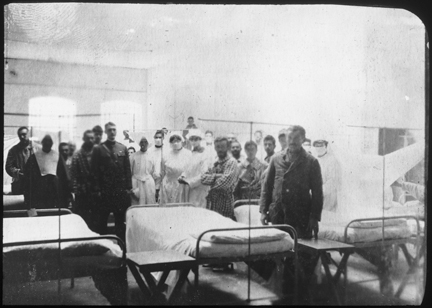
The hospital, located 15 miles from the Italian front, accepted patients beginning in late September 1918. Medical and surgical cases treated included burns from mustard gas, pneumonia, malaria, and influenza. The hospital treated approximately 3,000 patients; only 28 died.

Base Hospital 102 - one of the wards

Base Hospital 102 – one of the wards

ww1-firing-line ww1-italian-church-bombed-austrians


Diaries kept by three of the Sisters give a day-by-day account of their experiences.

Oct. 6 —There is heavy firing going on at this Front at the present time; the booming of the cannons can be heard here with not more than one or two minutes’ intermission. Shortly after the firing of the rifles over the grave, four aeroplanes appeared over us to investigate the noise. We were all glad to get so near the Front. Saw many fields prepared for a Retreat – with back trenches and barbed wire fences.

Oct. 17 – We have now about 400 patients in the hospital, nearly all sick with the Spanish Influenza. Many civilians in the city are reported dying with it.
—Sister Angela Drendel

Oct. 18 – We have syrup for breakfast on oatmeal. Not because it is the first meal served, but because the limit has been reached. Everybody is very hungry. Unable to get food and the supply is very low. Everybody agrees with President Wilson: No not at their terms even though we are hungry and cold.
–Sister Florence Means

Armistice Day, Post-War Travels, Coming Home
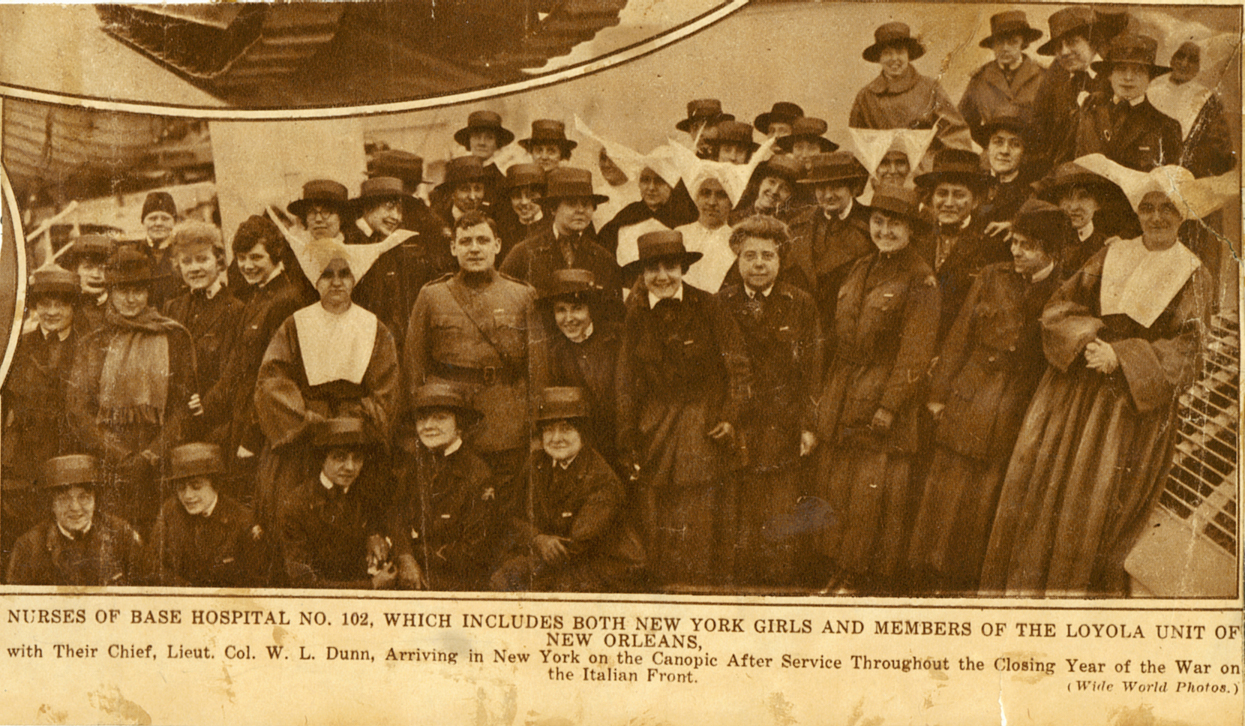
The signing of the armistice in November 1918 marked the end of the war but not the end of the Sisters’ service, as Base Hospital 102 was shut down gradually over the following months. After enduring a bitterly cold winter, the Sisters received furloughs which allowed them to travel throughout Italy and France. They saw many historic churches, had a private audience with Pope Benedict XV, and visited their Mother House in Paris. In March 1919 the Loyola Unit left Italy for America. After landing in New York, the  Sisters traveled to St. Joseph’s Central House in Emmitsburg, and from there to Marillac Seminary, their provincial house in St. Louis.

Daughters of Charity Mother House in Paris

Daughters of Charity Mother House in Paris

Pope Benedict XV, with whom the Sisters had a private audience.

Pope Benedict XV, with whom the Sisters had a private audience.

ww1-coming-home

Newsclipping showing the Sisters' arrival in New York in April of 1919.

Newsclipping showing the Sisters’ arrival in New York in April of 1919.

2 Comments

Filed under Benedict XV, Health Care, Ministries, World War 1