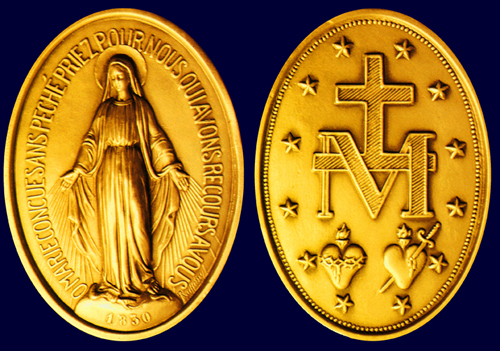
Front and back of the Miraculous Medal
June 3, 1905 marks the day that Pope Pius X formally recognized associations that had been formed for promoting the devotion popularly known as the Miraculous Medal. Today there are two Miraculous Medal Associations in the United States, one in Philadelphia and the other in Perryville, MO, just south of St. Louis.
Catherine Laboure and the Miraculous Medal
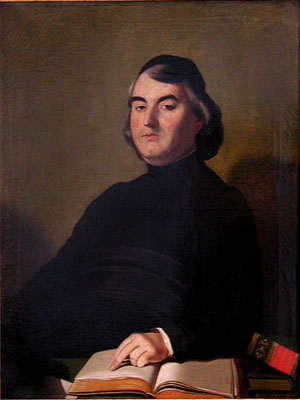
On the night of July 18-19, 1830. A child awakened Sister (now Saint) Catherine Labouré, a Seminary Sister in the community of the Daughters of Charity in Paris, and summoned her to the chapel. There she met with the Virgin Mary and spoke with her for several hours. During the conversation, Mary said to her, “My child, I am going to give you a mission.” It was the first of three apparitions Catherine received. During one of these apparitions, Mary said to Catherine, “Have a medal struck upon this model. Those who wear it will receive great graces, especially if they wear it around the neck.” Catherine told her confessor, Father Aladel, about what she had experienced, and she worked through him to carry out Mary’s instructions. Catherine told no one else about the apparitions and did not reveal that she received the Medal until just before her death.
With approval of the Church, the first medals were made in 1832 and were distributed in Paris. Almost immediately the blessings that Mary had promised began to shower down on those who wore her medal. The devotion spread quickly, and before long people were calling it the “Miraculous” Medal. In 1836, a canonical inquiry undertaken at Paris declared the apparitions to be genuine.
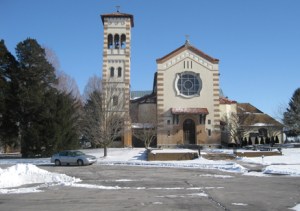
St. Mary’s of the Barrens, Perryville, MO (Image used with permission of the Daughters of Charity Provincial Archives)

Shrine to Our Lady of the Miraculous Medal at St. Mary’s of the Barrens, Perryville, MO (Image used with permission of the Daughters of Charity Provincial Archives)
Association of the Miraculous Medal, Perryville, Missouri
In order to spread devotion to Mary as our Lady of the Miraculous Medal, an association was formed shortly after the first medals were distributed. The Association was established at the motherhouse of the Congregation of the Mission in Paris. Gradually, other associations were established elsewhere in the world. Pope Pius X recognized these associations in 1905 and approved a charter in 1909.
In 1918 an Association was established by the Western Province of the Congregation of the Mission in the United States, with headquarters at St. Mary’s of the Barrens, in Perryville, Missouri. Saint Mary’s of the Barrens was founded in 1818 by the Vincentian fathers. The National Shrine of Our Lady of the Miraculous Medal was built in 1929 by the Promoters of the Association of the Miraculous Medal. Since the building of the Shrine Chapel in 1929, the church of St. Mary’s of the Barrens has served as the National Shrine of Our Lady of the Miraculous Medal. The Venerable Felix de Andreis, first superior of the Vincentians in the New World, is buried beneath its floor. Near the tomb of Felix de Andreis is the chapel housing the Shrine of Our Lady of the Miraculous Medal. Here a novena of Masses is offered each month for members of the Association. Here, too, petitions from all over the country are placed near our Lady’s Altar.
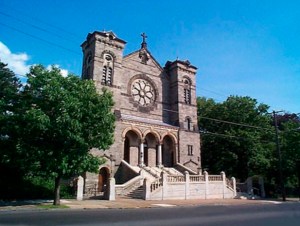
Chapel of the Immaculate Conception, Philadelphia (courtesy Central Association of the Miraculous Medal)

Miraculous Medal Shrine, Chapel of the Immaculate Conception, Philadelphia (courtesy Central Association of the Miraculous Medal)
Central Association of the Miraculous Medal, Philadelphia
In 1875 construction began for the Chapel of the Immaculate Conception in Philadelphia, Pennsylvania. The chapel was attached to St. Vincent’s Seminary and originally it was to serve as a place of worship for the seminarians and priests of the Congregation of the Mission (CM), also known as the Vincentians.
The Chapel was consecrated by Bishop Ryan, C.M. of Buffalo, N.Y. in 1879. At the request of Archbishop James F. Wood, it was built large enough to serve as a chapel of convenience for the surrounding neighborhood until 1902 when the local parish erected its own Church. In 1912, Father Joseph Skelly, C.M., received a special assignment from the Provincial of the Vincentian priests and brothers of the Eastern Province USA, which was to raise funds for the construction of a Minor Seminary in Princeton, New Jersey. Father Skelly placed a small Medal in each appeal letter that he mailed to raise funds for the Minor Semniary. So generous was the response brought through the intercession of Mary Immaculate that Father Skelly felt some special mark of gratitude to Our Lady was in order. After prayer and consultation, it was decided to form – in March of 1915 – The Central Association of the Miraculous Medal (CAMM), a society devoted to Mary’s interests, with Father Skelly as its first Director.
In 1927 Father Skelly introduced a nine-day Novena – four times a year – in the Public Chapel of the Immaculate Conception. For three years, the Chapel hosted Solemn Novenas during November (Our Lady of the Miraculous Medal), February (Our Lady of Lourdes), May (Our Lady, Help of Christians) and August (Feast of the Assumption). The devotions at the Shrine became so popular and so fruitful that the Director of the Association made another momentous and courageous decision. While retaining the Solemn Novena in preparation for the feast of the Miraculous Medal, he decided to inaugurate a weekly Novena service. After consulting local parishes about their evening activities, he chose Monday as the day for the Perpetual Novena in honor of Our Lady of the Miraculous Medal.
On Monday, December 8, l930, in order to honor the 100th Anniversary of the Apparitions of our Blessed Mother to Saint Catherine Laboure, Father Skelly himself initiated the first Monday Evening Novena Service. He used a “little Novena booklet” containing the prayers his confreres prepared especially for this Novena. In time, the number of Monday services grew to twelve. The Perpetual Novena is still alive and well today at Mary’s “Central Shrine”. Each Monday 9 Novena Services are held along with the celebrating of Masses, benediction and confession. In the Millennium Year, the Archdiocese designated the Shrine Chapel as one of six official pilgrimage sites. In 2002, the Archdiocese of Philadelphia reported that the Miraculous Medal Novena is the most popular novena devotion in its parishes.
Learn more about the Miraculous Medal devotion at the websites for these two associations.
Association of the Miraculous Medal, Perryville
Central Association of the Miraculous Medal, Philadelphia



 docarchivesblog.org