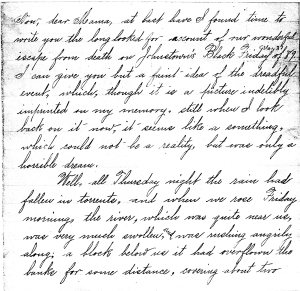
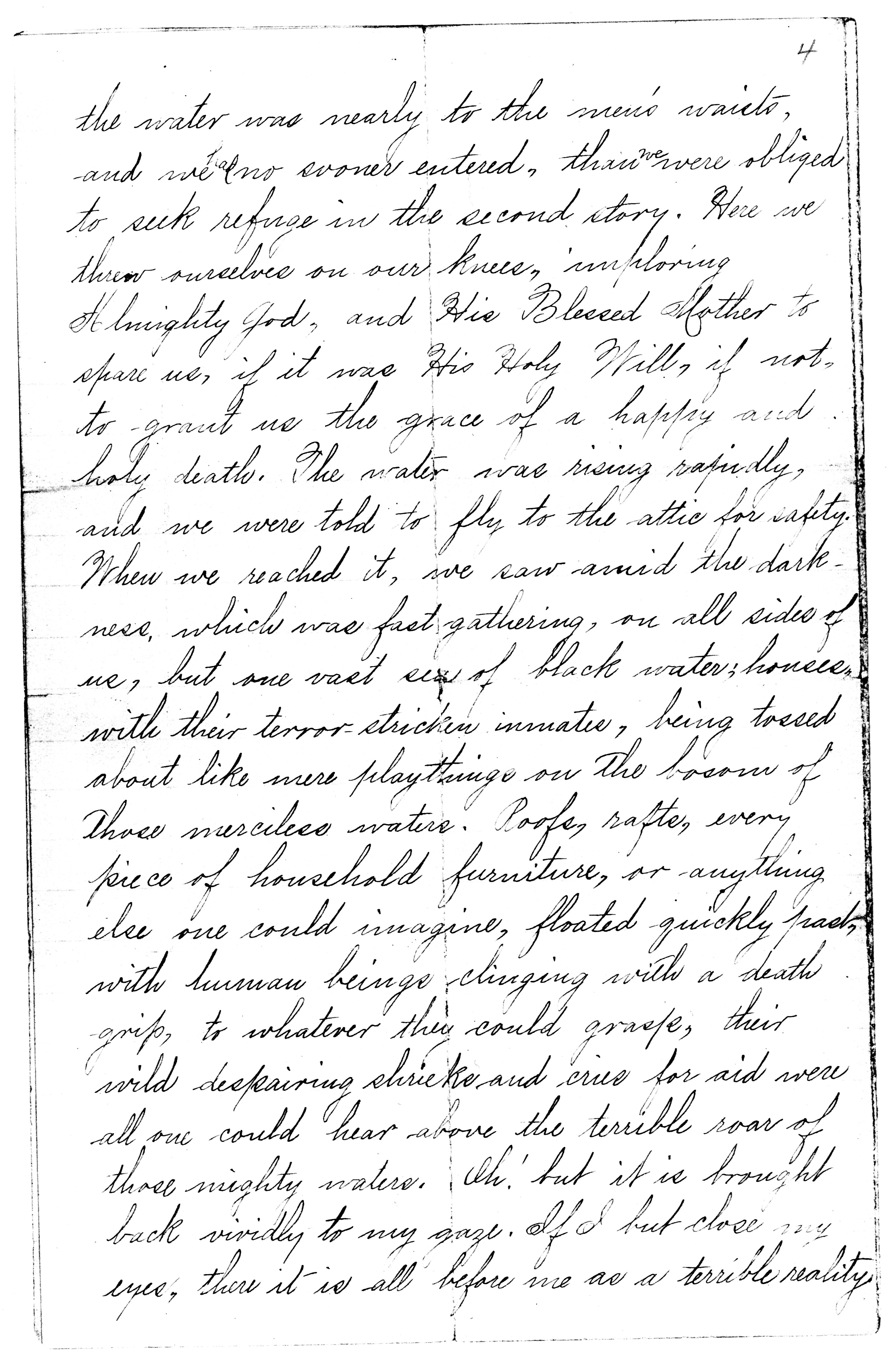
Letter of Sister Aloysius Blakely, S.C. (1 of 2) (courtesy Sisters of Charity of Seton Hill)
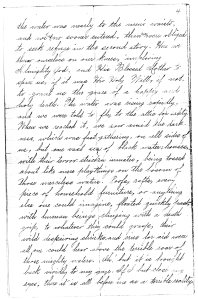
Letter of Sister Aloysius Blakely, S.C. (2 of 2) (courtesy Sisters of Charity of Seton Hill)
By Sister Louise Grundish, archivist, Sisters of Charity of Seton Hill
There were six Sisters of Charity serving at St. Columba’s parish which was six to eight miles distant from St. John’s Convent. Because of the distance from Johnstown the impact of the water was lessened but there was still very serious devastation in Cambria as well as Johnstown. One of the Sisters was Sister Aloysius Blakely who was eighteen years old at the time. When Mother Aloysia found all the sisters alive and well, she returned to Greensburg with two of the sisters who were ill at the time and also two very young sisters who were too inexperienced to be of service to the flood survivors.
Meanwhile, Sister Aloysius’ mother who was a widow was living in Eire with her father. Her grandfather set out immediately to find the fate of Sister Aloysius. When he arrived at the station where all disembarked, he was told that the only person who could enter Johnstown were those who would carry a coffin for one of the dead. He shouldered the coffin and went on foot. Fortunately his search ended with a wonderful reunion and a happy ending.
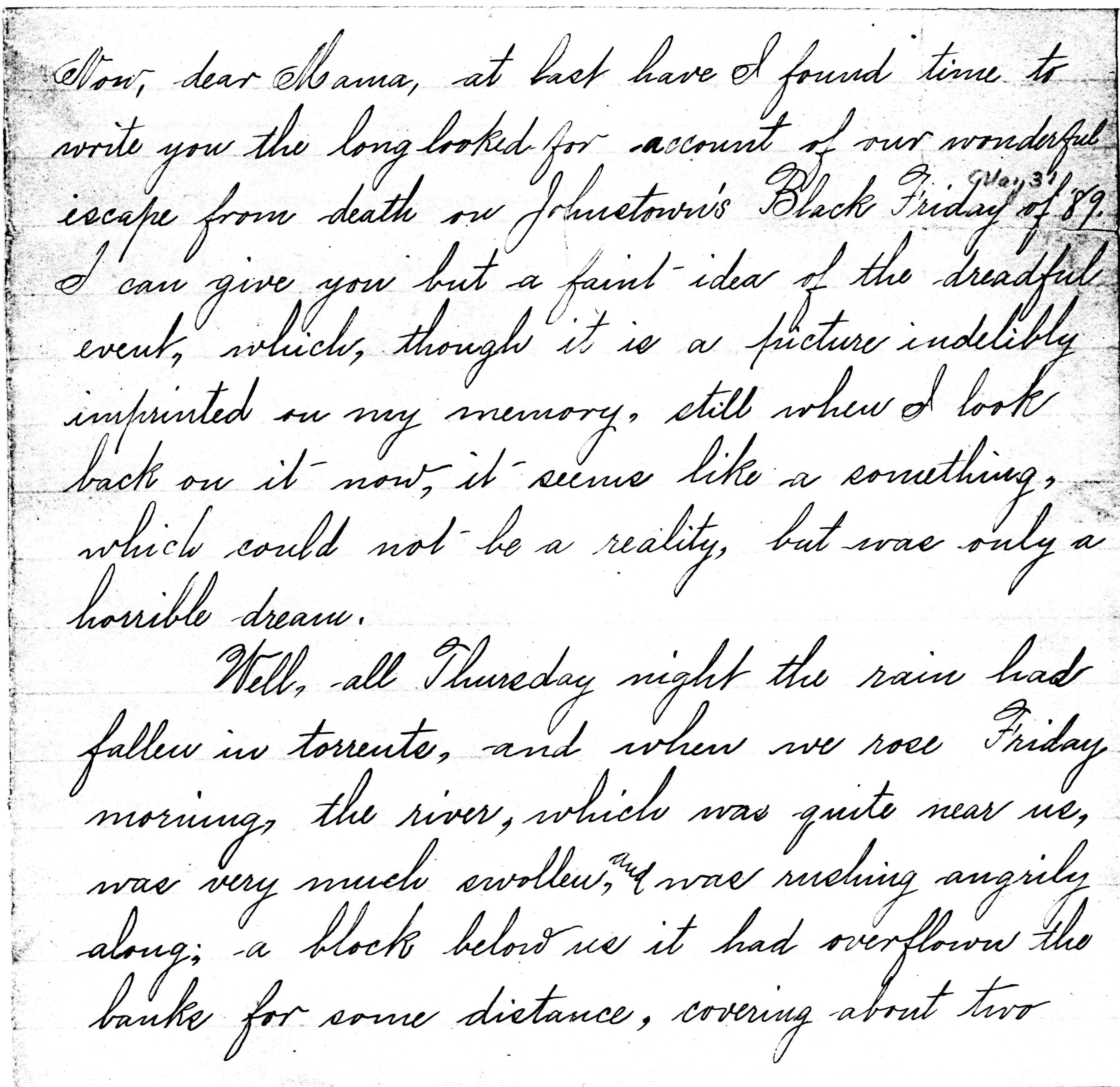
Some weeks later, Sister Aloysius wrote a letter to her mother describing “Johnstown’s Black Friday” as she called it. Her letter is preserved in her file in the Sisters of Charity of Seton Hill Archives.
The letter reads in part:
“…All Thursday night the rain had fallen in torrents and when we rose on Friday morning the river was very much swollen, and was rushing angrily along… We were not much frightened as floods in Cambria and Johnstown were yearly occurrences……
…..About ten o’clock we received work that the Toll Bridge, although heavily laden with iron, stones, etc., was swept away, and knowing that in its downward course it would take Tenacre Bridge with it…… It happened as expected. The huge iron frame of the bridge, which was also covered with stones, was tossed like a feather, and at last buried from view beneath the waves.”
Sister Aloysius describes her terrifying night spent on her knees and preparing for death as well as the relief she felt as the morning arrived and the rivers began to recede. She ends the letter with this description:
“….At last the night was over and the day dawned…Such a scene of desolation! Houses if not swept away, almost entirely ruined; heaps of debris everywhere; dead bodies scattered around; and dark figures moving quietly to and fro, trying to extricate them, place them on boards, and carried them to the church. All was silent as the grave in that vast cemetery.”
Sister Aloysius describes another false alarm which sends everyone scurrying up the hill. Then the group went out to Morrellville in the country. She comments, “Here it was dear Grandpa found me on Sunday… We remained with Mr. Rush till Monday, when we departed for Seton Hill…”




 docarchivesblog.org