Category Archives: Sisters of Charity of St. Joseph’s

Early days in Philadelphia

Mother Rose White

Mother Rose White, leader of the first group of Sisters of Charity of St. Joseph’s to serve in Philadelphia. After Elizabeth Seton’s death in 1821 Mother Rose served as the community’s superior.

(Image of Mother Rose White and passage from Mother Rose White journal used with permission of Daughters of Charity Provincial Archives)

The journal of Mother Rose White gives us a glimpse into the work of the Sisters of Charity of St. Joseph’s during their earliest days at St. Joseph Orphan Asylum in Philadelphia. Yesterday’s post provided a passage from the journal. Today, we continue with Mother Rose’s recollections.

We took possession of the Asylum on the 6th of Oct & our kind benefactress, Mrs. Montgomery, who was the President of the Lady Managers, & the true Mother of Charity towards the Orphans & Sisters. The Asylum was in debt $5,000. The subscriptions for its support were few; the embargo made goods double price, & it was often told us to reflect that the sum allowed for support was only $600 a year. They had no occasion to remind us, for our fears were so great that we would not be able to make out that for 3 months; we never ate bread for dinner, but used potatoes; no sugar in our coffee which was made of corn. As the poor children had not been accustomed to get any sugar in their morning beverage; breakfast was weak coffee & dry bread, sugar being very high. However, Rev. Mr. Hurley hearing of our not using sugar, commanded us to use it, & some was sent. We found the children lying 3 & 4 in a bed. Notwithstanding the embargo which caused such hard times, yet God in his mercy sent means, & we made out to get separate beds for the children. We had both boys and girls which we regretted much, but it was told us that it was so because no means offered for a separation, & it was with much difficulty it was effected to keep them as they were, but should means offer, the intention was to form separate establishments. The truly good lady who may be styled the Orphans’ Mother, Mrs. Montgomery, did all in her power & was always employed, whether in her chamber or her parlor sewing & knitting stockings for the orphans. She presented us the first winter with twenty seven pairs of her own work; the most of our children were small, & the boys’ stockings were short ones. The children had scarcely a 2d change. The Ladies Society had just been formed to assist the Managers, & it was they who paid the traveling expenses of the Sisters to Phila., & pd the salary of each Sister – $36 a year, & found them in shoes. We were going on with many fears that the sum allowed wd not suffice & then both Sisters & children had barely necessaries. When we wd go to market, much time was spent in trying to procure the cheapest articles. It appeared that a merchant on the same street as the market, who had been watching us, wrote us a letter, begging us not to be so sparing in our purchases; that if at the end of the year we found the sum allowed by the trustees would not meet our expenses, we might call on him for any reason able sum which he would cheerfully give, & begged us to go on with our arduous task. He had not signed his letter, but told us by applying to Miss Cauffman, one of our lady managers, wd tell us who to apply to. We found out afterwards the name of this good gentleman was Mr. Springer who at the end of the year pd a grocery bill of $8, though we had not expended the $600. Sometimes when we wd return from early Mass during the week & wd find a barrels of flour at our kitchen door; sometimes the kitchen table strewn with the produce of the market. Some of our kind friends would leave us to guess which of them it was. Mr. Ashley was one of the most liberal. When we first arrived in the city, finding us clothed in heavy, thick flannel … he went to Miss Cauffman & put five gold pieces in her hand & begged her to go & purchase bombazette & have it made up for us, that it would never do for us to wear such clothing. Happily before Miss C purchased the stuff, she spoke to us. We told her it would never be accepted by us & begged she would not put Mr. Ashley to so useless an expense. Finding they could not prevail, they begged Mr. Cooper who was in the city, to write to our Suprs. to insist on our wearing bombazette. Our Mother answered the letter thanking them, yet assuring them that our dress could not be altered so they said no more.

During this first year we were afraid to call on the Managers & continued to beg alms for the orphans, knowing the house to be in debt. We lived mostly on potatoes, & our fires were mostly of tan from the tan yard. One morning we had but 12 2 cents in the house. We sent one of the orphans to market to beg a shin of beef, if she could get one; it was washing day & we could not go ourselves. In about two or three hours, little Maurice returned with a large piece of beef, her 12 ½ cents, & a half dollar besides, telling us that a little old woman who kept a butcher’s stall asked her if she was not one of the orphans from near Trinity Church. On her answering yes, she gave her the above & told her whenever we were in want to send to her. We made good use of her kind offer & recd large pieces of good meat for the Asylum. One day, in the octave of Corpus Christi the blessed Sacrament was exposed, one of the Sisters was making her fervent supplications for help, as we were told it was likely the sheriff would come & sell the house over our heads. When we returned from church we found our kind little benefactress, who gave us the meat, seated in the parlor. It was the first time she had visited us, renewed her friendly offer, and gave us ten dollars. This was a great help. Soon after this the embargo was raised, the city illuminated [p29] & the public rejoicing was followed by an overflow of business, & the market glutted. The time to give in our account came, & to our great joy we found we had called but for $400. The $200 remaining, we claimed as our due, in case the next year we could not make out with the $600. allowed. The Managers much pleased; the money remained in their hands. What with our cash donations, charity box donations & eatables, we had made out with the above sum.

Leave a comment

Filed under Ministries, Sisters of Charity Federation, Sisters of Charity of St. Joseph's, Social Work

Sisters of Charity of St. Joseph’s, mission to Philadelphia, 1814

Mother Rose White - page from journal

Page from journal of Mother Rose White, with her account of the journey to Philadelphia

(Image and excerpt from the diary of Mother Rose White used with permission of the Daughters of Charity Provincial Archives)

Preparations are well under way for our next exhibit, which will highlight the 200th anniversary of the start of the Sisters’ mission in Philadelphia, the first mission begun by Elizabeth Ann Seton outside of Emmitsburg. The first Sisters of Charity of St. Joseph’s to go to Philadephia were Mother Rose White, Sister Susan Clossy, and Sister Theresa Conroy. Mother Rose White’s journal provides an account of the journey of the first Sisters to Philadelphia. A passage from the diary is below.

Philadelphia application having been made by the trustees of the Orphan Asylum of St. Joseph’s, Philadelphia for Sisters to take charge of the Asylum, allowing $600 a year for the support of Sisters and orphans, the traveling expenses to be paid of the Sisters by the trustees. The call had been submitted to the Archbishop, who desired much that the Sisters should be sent, though it was at the time of the embargo, and the sum offered for the support was small as provisions were high. Yet, there was an opening and it was thought we ought not to refuse on account of difficulties, so it was agreed to accept the proposal and send on three Sisters, as three only had been asked for. As it was not safe to go by the packets, as the English were still in the Bay, a private carriage was hired, and Sisters sent by way of Little York and Lancaster with directions to beg hospitality on the way so as to lessen the expense. It was then that a small half flannel shawl was given us to wear, the first worn by the Sisters. One trunk contained all our baggage. We set out September 29, 1814. The good Superior accompanied us as far as Taneytown, giving us lessons of economy all the way.

At Taneytown we parted, he continued his journey to Baltimore and we to Philadelphia. We begged hospitality as far as Lancaster, as we stopped at Catholic families who received us kindly, and would have done the same at Lancaster, but arrived late and felt a delicacy in disturbing a family to whom we were directed, and whom we would have had to find out the best we could as we were all strangers to the place. We stopped at a hotel and had only to complain of the fine accommodations. Next morning very early we set off for Philadelphia and arrived there in the evening; had to inquire our way as we moved through the streets as we knew not even in what street we were. Frequently the driver, who was a friend of our neighbor Mr. Livers, would give us the reins to hold and would get down from his seat and ask at several houses if they could tell us where St. Joseph’s Asylum was. No one seemed to understand him. He became a little tried and one of the Sisters asking him if he had any information to guide him, “O, no,” said he, “you might as well ask a pig about a holy day as to ask those people where St. Joseph’s Asylum is.”

We drove on without knowing where we were going, but our good angel was with us, for wearied with going up one street and down another when the driver stopped and thought he would ask again, when behold! we were before the door of Trinity Church which was next to the Asylum. The carriage being closed. the housekeeper of the priest, a good French woman named Justine, approached the carriage thinking it was a corpse brought to be buried, when she lifted the curtain as if by inspiration, she said: “Are you not from St. Joseph’s?”

“Yes, who are you?”

“Rev. Mr. Hurley’s housekeeper.”

“Will you tell us where the Asylum is?”

“Yes, you are at its door. Will you get out of the carriage?”

“Yes, if you will tell us where the Rev. Mr. Hurley lives; we have a letter for him.”

“O, you are at a very great distance, but give me the letter; I will take it to him.”

So, off she went with the letter and we entered the Church. With gratitude and love we made our acts of adoration and remained an hour. By this time, Rev. Mr. Hurley arrived, took us to the asylum where the good old matron was making every preparation to leave the house, and we could not enter before she left the furniture being hers, we had to wait until things were provided. The children looked poor and miserable; were going to a free school and running the streets like so many little ragged beggars.

4 Comments

Filed under Elizabeth Ann Seton, Exhibits, Ministries, Sisters of Charity of St. Joseph's, Social Work

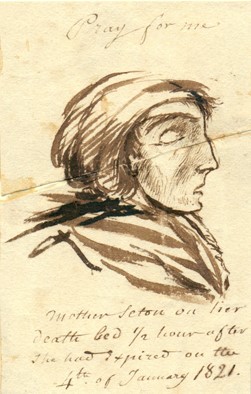
Death of Elizabeth Ann Seton, January 4, 1821

Sketch of Elizabeth Ann Seton

Sketch of Elizabeth Ann Seton by Simon Gabriel Bruté. Handwritten text at the top reads, “Pray for me.” Handwritten text at the bottom reads, “Mother Seton on her death bed 1/2 hour after she had expired on the 4th of January 1821.” Image and all text used with permission of the Daughters of Charity Province of St. Louise Archives.

Account of Simon Bruté taken from Mother Seton: Notes by Rev. Simon Gabriel Bruté (Bishop of Vincennes) (Emmitsburg, 1884), p.29-32.

January 4, 1821. “Ask Heaven to praise and love Him” my last words to Mother, at four o’clock in the afternoon, were my last indeed, and of any priest on earth to her, to day, at two after midnight she removed to her eternal Home.

They had called Sister Mary Xavier, the Assistant some time before, as she seemed dying. She was wholly conscious but so often deceived, seemed not to believe it was yet the time. However, after she had welcome in a pleasant manner Sister Mary Xavier, by: “Is it you Xavier?” she united with their prayers, which they repeated by intervals, and it being manifest she was dying, her poor daughter Josephine began to cry aloud in a distressing manner, and could not restrain herself, but rather had such convulsions as made the Sisters afraid she would die before her mother. So they sent for me, as much for her as for Mother, whom they considered so long and fully prepared.

The dying mother must have well noticed that exceeding grief of her daughter, but happily seemed not to be disturbed by it, being we hope long tried and strengthened that side [sic]. She soon could not breathe and ceased to live.

I arrived quarter of an hour after she had expired.

Towards midnight, one of the nurses tells me, offering her a drink she refused a moment, “in hope,” she said, “that on the morning she might be granted one Communion more,” – (like her Anina) – The night of Sunday last, after the Viaticum of Saturday, being extremely thirsty towards midnight the same nurse, Sister Susan, urged her to drink.

“O, no!” she said. “Eternity, let us mind that,” and she kept on for one communion more.
Last night, amidst the various prayers said for her she began the prayer of Pius VII – “May the most just, the most high, and the most amiable will of God be accomplished forever!” …

… She had about an hour of hard agony, then, ending sweetly — When Sister Xavier said: “Our Lord calls you!” she asked “Who?” as if not actually sensible of that call. Then she lowered her breathing, and died very gently, “as if to sleep,” said Sister Anastasia: and not a struggle or gasp afterword.

3 Comments

Filed under Elizabeth Ann Seton, Simon Brute, Sisters of Charity of St. Joseph's