Category Archives: Popes

Sister Formation Movement and Marillac College, St. Louis

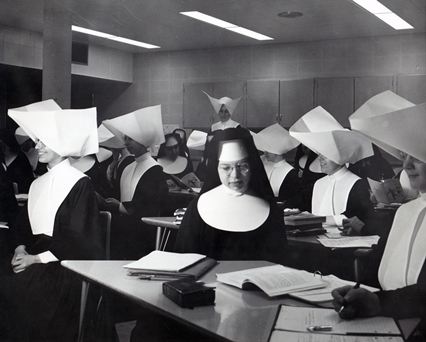
Marillac College students in class, 1960. Some twenty-five communities sent Sisters to Marillac and all took classes together (used with permission of Daughters of Charity Provincial Archives)

Marillac College students in class, 1960. Some twenty-five communities sent Sisters to Marillac and all took classes together (used with permission of Daughters of Charity Provincial Archives)

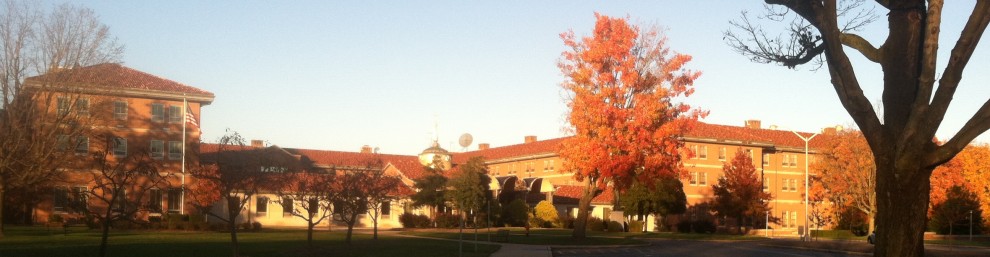
Forty years ago, Marillac College in St. Louis closed its doors and graduated its last class of Sister students. Marillac, begun in the late 1950s and located on the grounds of the provincial house of the former St. Louis Province, was unique in that it was a Sister Formation College. It combined a liberal arts education with the spiritual formation of young Sisters. A 1963 article in The SIGN Magazine described Marillac as:

“a nun’s place, a shining, modern $5.5 million place on a 180-acre estate where college life is lived to its fullest in a nun’s habit. In this sense Marillac is a college like any other, but it is also unique because of its position at the forefront of the Sister Formation Movement, which aims at improved training of nuns. Ultimately, some 170,000 U.S. nuns are involved in the consequences of the movement, as well as six million students in Catholic elementary and high schools who come under the influence of nuns in the classroom.

Marillac, aware of the stake and its role, prizes its sudden success as a new college whose first degrees were awarded only four years ago. Yet, it already has achieved accreditation with highest commendation from the North Central Association of Secondary Schools and Colleges, the same prestige accreditation accorded undergraduate studies at Chicago or Saint Louis Universities. Moreover, the Sacred Congregation for Religious in Rome has singled out the college for special praise.

Both accolades stem from Marillac’s pursuit of excellence under the aegis of the Sister Formation Movement, which came to the fore in the past ten years in response to directives from Pope Pius XII stressing the best possible training tailored for religious. Many orders established special college programs for their members, but the Daughters of Charity of St. Louis Province went a few giant steps further. They not only built Marillac for their own members but opened its classroom doors – free of charge – to religious communities throughout the country. Besides the 25 orders represented in the student body of 350, a cross-section of 15 different orders have members on the faculty.

… For Daughters of Charity, who comprise about two-thirds of the student body, Marillac provides a five-year program, with the novitiate year coming between freshman and sophomore years in the college. Students from other orders normally enter in sophomore year and live off campus in their own juniorates under the direction of a mistress. This enables the young nuns to maintain the distinctive spirit of their orders. Moreover, Marillac turns the nuns over to the rules of their respective orders every day between noon and three o’clock, producing a kaleidoscopic round of religious life, manifested in twenty-five different ways.”

After the College closed, the College grounds and buildings were sold to the University of Missouri-St. Louis. They are now used primarily for studies in the health sciences.

3 Comments

Filed under Education, Formation, Ministries, Pius XII

Miraculous Medal Shrines, Philadelphia, PA and Perryville, MO

Miraculous Medal

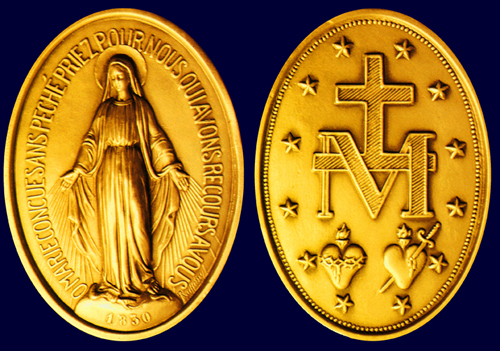
Front and back of the Miraculous Medal

June 3, 1905 marks the day that Pope Pius X formally recognized associations that had been formed for promoting the devotion popularly known as the Miraculous Medal. Today there are two Miraculous Medal Associations in the United States, one in Philadelphia and the other in Perryville, MO, just south of St. Louis.

Catherine Laboure and the Miraculous Medal
On the night of July 18-19, 1830. A child awakened Sister (now Saint) Catherine Labouré, a Seminary Sister in the community of the Daughters of Charity in Paris, and summoned her to the chapel. There she met with the Virgin Mary and spoke with her for several hours. During the conversation, Mary said to her, “My child, I am going to give you a mission.” It was the first of three apparitions Catherine received. During one of these apparitions, Mary said to Catherine, “Have a medal struck upon this model. Those who wear it will receive great graces, especially if they wear it around the neck.” Catherine told her confessor, Father Aladel, about what she had experienced, and she worked through him to carry out Mary’s instructions. Catherine told no one else about the apparitions and did not reveal that she received the Medal until just before her death.

With approval of the Church, the first medals were made in 1832 and were distributed in Paris. Almost immediately the blessings that Mary had promised began to shower down on those who wore her medal. The devotion spread quickly, and before long people were calling it the “Miraculous” Medal. In 1836, a canonical inquiry undertaken at Paris declared the apparitions to be genuine.
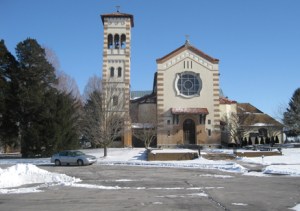
St. Mary's of the Barrens, Perryville, MO

St. Mary’s of the Barrens, Perryville, MO (Image used with permission of the Daughters of Charity Provincial Archives)

Miraculous Medal Shrine in Perryville, MO

Shrine to Our Lady of the Miraculous Medal at St. Mary’s of the Barrens, Perryville, MO (Image used with permission of the Daughters of Charity Provincial Archives)


Association of the Miraculous Medal, Perryville, Missouri
In order to spread devotion to Mary as our Lady of the Miraculous Medal, an association was formed shortly after the first medals were distributed. The Association was established at the motherhouse of the Congregation of the Mission in Paris. Gradually, other associations were established elsewhere in the world. Pope Pius X recognized these associations in 1905 and approved a charter in 1909.

In 1918 an Association was established by the Western Province of the Congregation of the Mission in the United States, with headquarters at St. Mary’s of the Barrens, in Perryville, Missouri. Saint Mary’s of the Barrens was founded in 1818 by the Vincentian fathers. The National Shrine of Our Lady of the Miraculous Medal was built in 1929 by the Promoters of the Association of the Miraculous Medal. Since the building of the Shrine Chapel in 1929, the church of St. Mary’s of the Barrens has served as the National Shrine of Our Lady of the Miraculous Medal. The Venerable Felix de Andreis, first superior of the Vincentians in the New World, is buried beneath its floor. Near the tomb of Felix de Andreis is the chapel housing the Shrine of Our Lady of the Miraculous Medal. Here a novena of Masses is offered each month for members of the Association. Here, too, petitions from all over the country are placed near our Lady’s Altar.
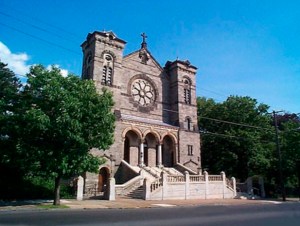
Philadelphia - Chapel of the Immaculate Conception

Chapel of the Immaculate Conception, Philadelphia (courtesy Central Association of the Miraculous Medal)

Miraculous Medal Shrine, Chapel of the Immaculate Conception, Philadelphia (courtesy Central Association of the Miraculous Medal)

Miraculous Medal Shrine, Chapel of the Immaculate Conception, Philadelphia (courtesy Central Association of the Miraculous Medal)


Central Association of the Miraculous Medal, Philadelphia
In 1875 construction began for the Chapel of the Immaculate Conception in Philadelphia, Pennsylvania. The chapel was attached to St. Vincent’s Seminary and originally it was to serve as a place of worship for the seminarians and priests of the Congregation of the Mission (CM), also known as the Vincentians.

The Chapel was consecrated by Bishop Ryan, C.M. of Buffalo, N.Y. in 1879. At the request of Archbishop James F. Wood, it was built large enough to serve as a chapel of convenience for the surrounding neighborhood until 1902 when the local parish erected its own Church. In 1912, Father Joseph Skelly, C.M., received a special assignment from the Provincial of the Vincentian priests and brothers of the Eastern Province USA, which was to raise funds for the construction of a Minor Seminary in Princeton, New Jersey. Father Skelly placed a small Medal in each appeal letter that he mailed to raise funds for the Minor Semniary. So generous was the response brought through the intercession of Mary Immaculate that Father Skelly felt some special mark of gratitude to Our Lady was in order. After prayer and consultation, it was decided to form – in March of 1915 – The Central Association of the Miraculous Medal (CAMM), a society devoted to Mary’s interests, with Father Skelly as its first Director.

In 1927 Father Skelly introduced a nine-day Novena – four times a year – in the Public Chapel of the Immaculate Conception. For three years, the Chapel hosted Solemn Novenas during November (Our Lady of the Miraculous Medal), February (Our Lady of Lourdes), May (Our Lady, Help of Christians) and August (Feast of the Assumption). The devotions at the Shrine became so popular and so fruitful that the Director of the Association made another momentous and courageous decision. While retaining the Solemn Novena in preparation for the feast of the Miraculous Medal, he decided to inaugurate a weekly Novena service. After consulting local parishes about their evening activities, he chose Monday as the day for the Perpetual Novena in honor of Our Lady of the Miraculous Medal.

On Monday, December 8, l930, in order to honor the 100th Anniversary of the Apparitions of our Blessed Mother to Saint Catherine Laboure, Father Skelly himself initiated the first Monday Evening Novena Service. He used a “little Novena booklet” containing the prayers his confreres prepared especially for this Novena. In time, the number of Monday services grew to twelve. The Perpetual Novena is still alive and well today at Mary’s “Central Shrine”. Each Monday 9 Novena Services are held along with the celebrating of Masses, benediction and confession. In the Millennium Year, the Archdiocese designated the Shrine Chapel as one of six official pilgrimage sites. In 2002, the Archdiocese of Philadelphia reported that the Miraculous Medal Novena is the most popular novena devotion in its parishes.

Learn more about the Miraculous Medal devotion at the websites for these two associations.
Association of the Miraculous Medal, Perryville

Central Association of the Miraculous Medal, Philadelphia
2 Comments

Filed under Catherine Laboure, Miraculous Medal, Pius X, Vincentians

Beatification of Louise de Marillac – DC pilgrimmage to Rome, May 1920 (part 3)

Louise de Marillac

Louise de Marillac, 1591-1660 (Image courtesy of Vincent de Paul Image Archive, DePaul University)

(Account of Sister Margaret O’Keefe from the Provincial Annals used with permission of the Daughters of Charity Provincial Archives)

May 9 – Sunday. Went to St. Peter’s at 8 the High Mass commenced at 10 – even though we had tickets it was necessary to be there early on account of the great crowd. Tribunes were erected for the occasion. Sister Eugenia [Sister Eugenia Fealy, Visitatrix of the St. Louis Province] and I were in the one next to our M[ost] H[onored] Mother and we sat on red velvet chairs; the draperies were red and gold. High up over the altars a magnificent gold frame of very elaborate design the picture veiled was in the centre. The procession was the grandest of course I ever saw – the long lines of Bishops and Cardinals the officiating Bishop minister with his retinue. When all were seated an ecclesiastic read from a pulpit a long document in which the names of St. Vincent and Louise Legras occurred frequently. When this was finished the Bishop removed the veil from the reliquary which was place on the altar on a throne at the same moment the curtain fell and all the Cardinals and prelates knelt to venerate the relic. Then the glorious Te Deum burst forth. the missionaries, our brothers were directly below us and they joined in the singing, every other verse was Gregorian. then came the Solemn High Mass only the Introit and anthems were Gregorian, the Gloria and Credo etc. were Perosi and very beautiful, in four parts with Bass, Tenor and Soprano, solos interspersed there was no repetition – and the Amen was long drawn out and died away in a soft sweet note. Cardinal Merry Del Val with his retinue came in after the celebrant and was the last in the procession.

We finished dinner at twenty minutes before two – at half past Two we started for St. Peter’s the doors were to open at 3 and the ceremony to take place at 5.30. The crush outside the door was indescribable, a lady fainted and had to be taken out by the soldiers – there were several of the latter about but they could not control the jam. At last we reached our places in the tribune and waited patiently until the silver trumpets announced the entrance of the Holy Father [Pope Benedict XV] – the long procession as in the morning, followed by the Swiss Guard the Pope’s Guard and the Vicar of Christ blessing the people as he passed thro the Church. We had Benediction – the procession, in front of the Pope was borne the relic given by O.M.H Mother and behind it a large pyramid of flowers. It was all a grand sight and a great manifestation of faith, people were standing even on top of the confessionals handkerchiefs waves as he passed then the crowd came before the altar to venerate the relic, and we left.

Leave a comment

Filed under Benedict XV, Church History, Louise de Marillac, Popes, Provincial Annals