Category Archives: Popes

Feast of the Immaculate Conception

Today the Catholic Church celebrates the Feast of the Immaculate Conception. The dogma of the Immaculate Conception was proclaimed by Pope Pius IX on December 8, 1854, and the event was noted in the Provincial Annals for that year.

1854. A great year in the annals of Holy Mother Church! A great, consoling year for every Catholic heart, for it was on the 8th of December of this year, our Holy Father, Pius the ninth, gloriously reigning, proclaimed the dogma of the Immaculate Conception of Mary, our beautiful Mother, our Queen. We had never doubted this glorious privilege of our Mother, but new we have the merit of believing it as an article of faith.

Read the English text of Ineffabilis Deus, Apostolic Constitution of Pope Pius IX, December 8, 1854, proclaiming the dogma of the Immaculate Conception (from http://www.papalencyclicals.net)

Leave a comment

Filed under Church History, Popes

Why Did the Daughters of Charity Change Their Habit?

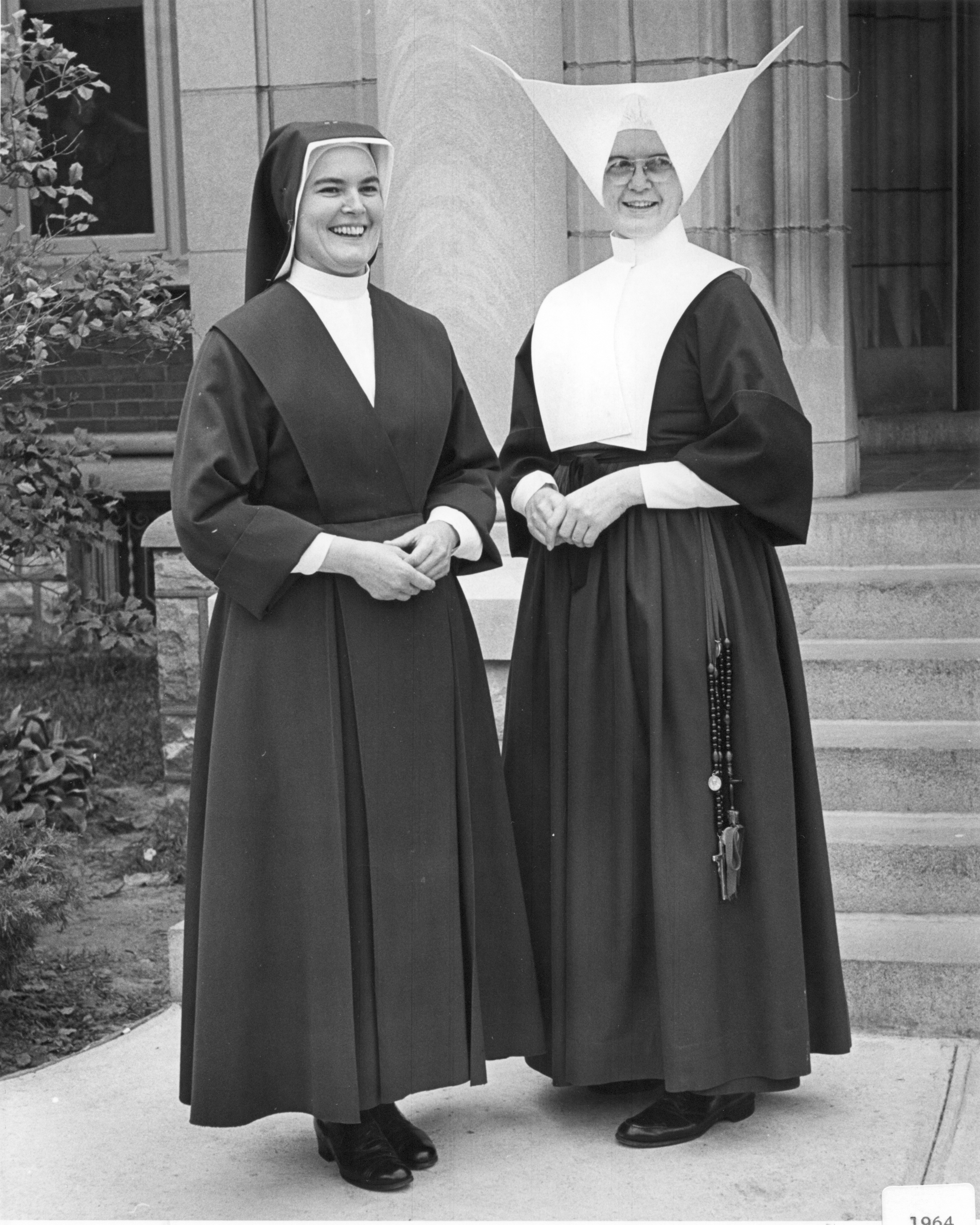
Old and new habits of the Daughters of Charity

Sr. Regina Priller models the 1964 habit; Sr. Mary Rose McPhee models the cornette habit (used with permission of Daughters of Charity Provincial Archives)

Our upcoming exhibit, Swan Song, opening next week, looks back at the change in the Daughters of Charity’s traditional habit, which occurred 50 years ago this September and the experiences of the Sisters who experienced it. As we look back on the change, an important question to ponder is: why? Why did the habit change at all and why did it change at this particular time?

The change of habit was one of many major changes to religious life that happened in response to the Church’s call to change that began with Pope Pius XII and continued through John XXIII and Paul VI and the work of the Second Vatican Council. As Sr. Kieran Kneaves, D.C. has written, “in June 1962 Sr. Suzanne Guillemin was elected our Superioress General and in October, Pope John XXIII opened the Vatican Council. And so, we were called to begin the journey to renewal. And our lives have never been the same.”

Our library collection holds many editions of the documents from the Second Vatican Council. From these we can see the strong focus on re-examination and renewal which characterized the Council’s work. It wasn’t just the habit that changed. A whole way of life changed, as religious communities, both women and men, were directed to take a fresh look at the spirit and charism of their founders, to cast off practices and traditions which had become outmoded, to rewrite constitutions and common rules, and to simplify their attire. At the same time dramatic changes took place in the liturgy and lay people’s participation in it. Decrees on Ecumenism and on the Church’s Missionary Activity drew religious communities into new ministries and gave a new focus on issues of social justice.

In keeping with these directives, the Daughters of Charity’s Constitutions, Common Rules, and Book of Customs were extensively re-written and updated. And it was in the 1960s that Louise de Marillac’s contributions as a co-founder of the Daughters of Charity first received greater attention and recognition.

A few representative quotations from Vatican II documents are below. The documents of Vatican II are available online; print copies are also available for study in the Provincial Archives.

“[The Church] is preparing to welcome the Fathers of the Second Vatican Ecumenical Council … This is a solemn hour for the history of the Church. It involves, therefore, increasing the fervor of its efforts for spiritual renewal, which are always at work, in order to give new impetus to the works and institutions of its millennial life …”
Pope John XXII, Letter to Women Religious
July 2, 1962


The most important work of the General Chapters is the studied accommodation of the rules of their Institute to the changed conditions of the times … Religious Institutes will flourish and prosper so long as the integral spirit of their Founder continues to inspire their rule of life and
apostolic works.”
Pope Paul VI, To All Religious, May 23, 1964


“The religious habit, being a sign of consecration to God, should be simple and modest, poor and at the same time becoming. In addition it should meet the requirements of health and be suited to the circumstances of time and place and to the needs of the ministry. The habit of both men and women Religious which does not conform to these norms is to be changed.”
Pope Paul VI, On the Adaptation and Renewal of the Religious Life (Perfectae Caritatis), October 28, 1965


“You hear rising up, more pressing than ever from their personal distress and collective misery, ‘the cry of the poor’ … It calls for the conversion of hearts, for liberation from all temporal encumbrances. It is a call to love.”
Pope Paul VI, On the Renewal of the Religious Life According to the Teachings of the Second Vatican Council (Evangelica Testificatio), June 29, 1971


“We believe that the day has come when the life of women Religious has to be given greater honor and be made more effective, and that this can be done by perfecting the bonds that unite it to the life of the whole Church … We have given orders that some devout qualified ladies are to attend as auditors several of the solemn ceremonies and several of the General Congregations of the coming third session of the Second Vatican Council; what we have in mind are those Congregations that will discuss matters of particular importance to the lives of women.”
Pope Paul VI, New Horizons for the Women Religious, September 8, 1964

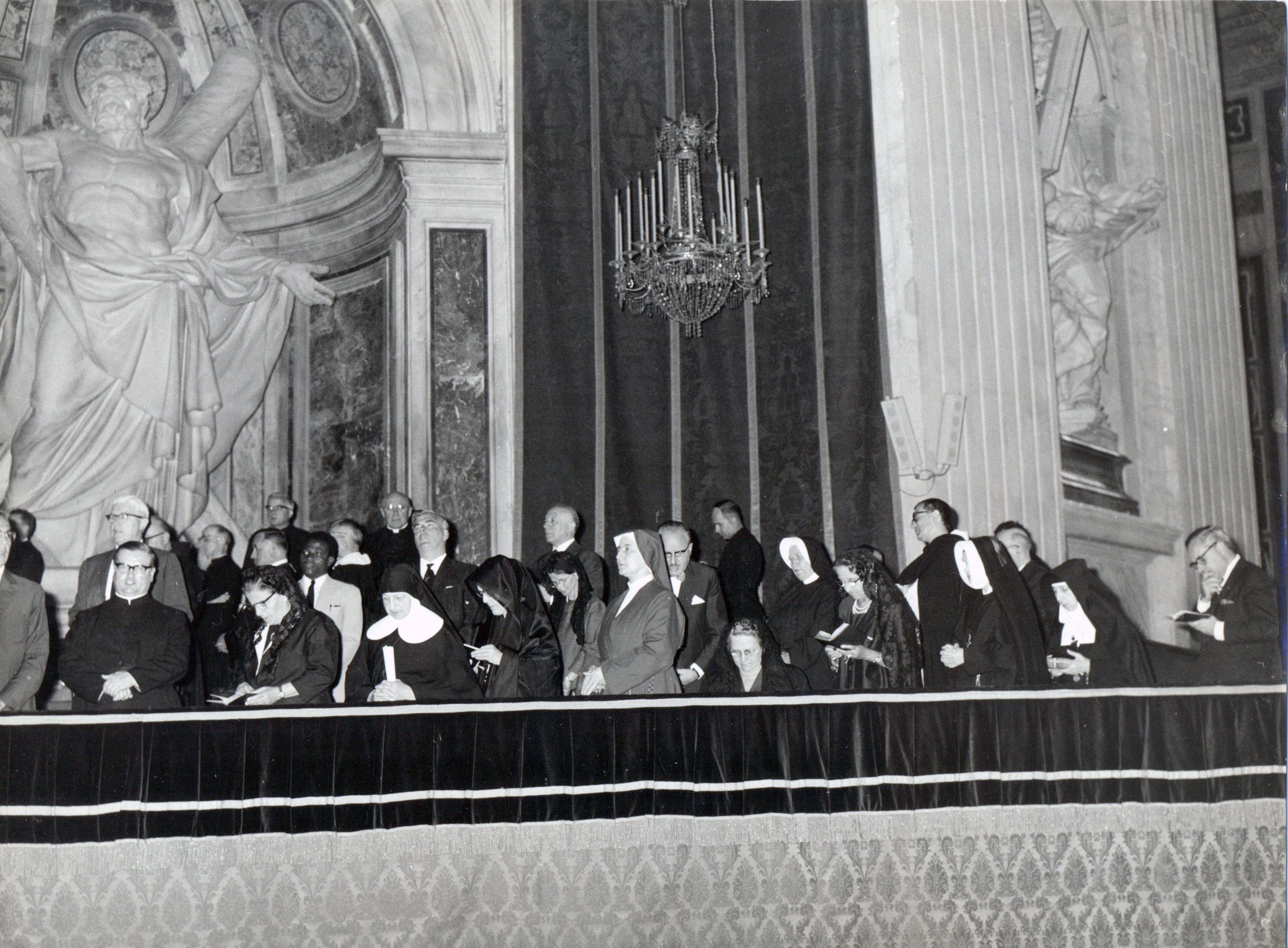
Vatican 2 auditors

Mother Suzanne Guillemin, D.C., then-Superioress General of the Daughters of Charity, was one of the women chosen to be an auditor at Vatican II. Seen here are Mother Guillemin and the other auditors (Photo credit: Fotografia Pontificia Giordani, Rome)

For more information, see Sr. Doris Gottemoeller, RSM “Vatican II: The Call to Religious Change”, an informative post found on the blog of the US Conference of Catholic Bishops.

3 Comments

Filed under Exhibits, Habit, John XXIII, Vatican 2

Sister Formation Movement and Marillac College, St. Louis

Marillac College students in class, 1960. Some twenty-five communities sent Sisters to Marillac and all took classes together (used with permission of Daughters of Charity Provincial Archives)

Marillac College students in class, 1960. Some twenty-five communities sent Sisters to Marillac and all took classes together (used with permission of Daughters of Charity Provincial Archives)

Forty years ago, Marillac College in St. Louis closed its doors and graduated its last class of Sister students. Marillac, begun in the late 1950s and located on the grounds of the provincial house of the former St. Louis Province, was unique in that it was a Sister Formation College. It combined a liberal arts education with the spiritual formation of young Sisters. A 1963 article in The SIGN Magazine described Marillac as:

“a nun’s place, a shining, modern $5.5 million place on a 180-acre estate where college life is lived to its fullest in a nun’s habit. In this sense Marillac is a college like any other, but it is also unique because of its position at the forefront of the Sister Formation Movement, which aims at improved training of nuns. Ultimately, some 170,000 U.S. nuns are involved in the consequences of the movement, as well as six million students in Catholic elementary and high schools who come under the influence of nuns in the classroom.

Marillac, aware of the stake and its role, prizes its sudden success as a new college whose first degrees were awarded only four years ago. Yet, it already has achieved accreditation with highest commendation from the North Central Association of Secondary Schools and Colleges, the same prestige accreditation accorded undergraduate studies at Chicago or Saint Louis Universities. Moreover, the Sacred Congregation for Religious in Rome has singled out the college for special praise.

Both accolades stem from Marillac’s pursuit of excellence under the aegis of the Sister Formation Movement, which came to the fore in the past ten years in response to directives from Pope Pius XII stressing the best possible training tailored for religious. Many orders established special college programs for their members, but the Daughters of Charity of St. Louis Province went a few giant steps further. They not only built Marillac for their own members but opened its classroom doors – free of charge – to religious communities throughout the country. Besides the 25 orders represented in the student body of 350, a cross-section of 15 different orders have members on the faculty.

… For Daughters of Charity, who comprise about two-thirds of the student body, Marillac provides a five-year program, with the novitiate year coming between freshman and sophomore years in the college. Students from other orders normally enter in sophomore year and live off campus in their own juniorates under the direction of a mistress. This enables the young nuns to maintain the distinctive spirit of their orders. Moreover, Marillac turns the nuns over to the rules of their respective orders every day between noon and three o’clock, producing a kaleidoscopic round of religious life, manifested in twenty-five different ways.”

After the College closed, the College grounds and buildings were sold to the University of Missouri-St. Louis. They are now used primarily for studies in the health sciences.

3 Comments

Filed under Education, Formation, Ministries, Pius XII