Category Archives: Health Care

New acquisition and two special visitors

Bryan and Anna Russell examine the architect's drawing of the Villa St. Michael Baltimore with Provincial Archivist Dee Gallo

Bryan and Anna Russell examine the architect’s drawing of the Villa St. Michael in Baltimore with Provincial Archivist Dee Gallo (used with permission of the Lynch and Russell families and the Daughers of Charity Provincial Archives)

The Provincial Archives had two very special visitors yesterday: Bryan and Anna Russell, the great grandchildren of William J. Lynch, Jr., a Construction Consultant for many of the building projects that housed the work of the Daughters of Charity across the United States. Bryan and Anna brought with them the architects’ drawing of the former Villa Saint Michael in Baltimore, a retirement facility for senior sisters until 1972 when that ministry was transferred to the current Villa Saint Michael here on the campus in Emmitsburg. Together with Provincial Archivist Dee Gallo, Bryan and Anna carefully studied the details of the drawing; of special interest were the cars and the trees! The Provincial Archives thanks the Lynch family for their generous donation of the rendering. Archives will put it to good use as we continue to document the legacy of the Daughters of Charity in the United States.

Another view of the architect's rendering of the Villa St. Michael in Baltimore (used with permission of Daughters of Charity Provincial Archives)

Another view of the architect’s rendering of the Villa St. Michael in Baltimore (used with permission of Daughters of Charity Provincial Archives)

Leave a comment

Filed under Baltimore, Emmitsburg, Health Care, Ministries

Lincoln Assassination, April 14, 1865

List of Sisters at Lincoln General Hospital April 1865

List of Sisters serving at Lincoln General Hospital in April of 1865 (used with permission of Daughters of Charity Provincial Archives)

On April 14, 1865, Abraham Lincoln was assassinated at Ford’s Theater in Washington. We have no first-hand accounts of Lincoln’s death, but two items in our collection do relate to it in an indirect way.

The first, seen above, is a list of the Daughters of Charity who were on mission at Lincoln General Hospital in Washington in April of 1865.

Lincoln General Hospital

Lincoln General Hospital, Washington, D.C. Lithograph by Chas. Magnus, ca. 1864. (Courtesy of Library of Congress Prints and Photographs Division,
Washington, D.C.)

Lincoln General was the largest of the military hospitals in the area built by the Army to take care of the Civil War casualties. Lincoln General was not located near either the White House or Ford’s Theater. It was located on Capitol Hill, 15 blocks east of the Capitol building, in an area known today as Lincoln Park. The hospital complex included 20 pavilions and 25 tent wards, which provided altogether a bed capacity of 2,575. The hospital also included a kitchen and dining rooms, officers quarters, quarters for Sisters who provided nursing service, barracks, guard house, separate quarters for contrabands, and service facilities such as water tank, laundry, barber shop, carpenter shop, stables and a morgue (“Dead House”). Lincoln General was taken down shortly after the Civil War. Nothing remains of Lincoln General Hospital; the area once occupied by the hospital is now a residental district.

The hospital opened in December 1862; the first Daughters of Charity were sent there in January of 1863. By the end of the war 25 Sisters were serving in the hospital. None of the Sisters left any accounts or recollections concerning Lincoln’s death, nor it is recorded in our Provincial Annals.

For more information on Lincoln General Hospital see the National Library of Medicine’s website: Historic Medical Sites in the Washington DC area

See also: Civil War Washington


Southern Almanac 1865

The Southern Almanac, 1865 (used with permission of the Daughters of Charity Provincial Archives)

The seond item is The Southern Almanac for 1865. This slim volume contains basic information concerning the Confederate government and official tallies of Confederate losses during the Civil War through the year 1864. In relation to Lincoln, the most interesting aspect of this volume is the seal found on the cover, in particular the words SIC SEMPER TYRANNIS, or “Thus ever to tyrants”, the motto of the state of Virginia. John Wilkes Booth is said to have uttered the words “Sic Semper Tyrannis” as he leaped from the presidential box to the stage of Ford’s Theater after he shot President Lincoln.

Today, Ford’s Theater is a National Historic Site and museum, as well as a working theater. See the
Ford’s Theater website for more about Lincoln and the history of the theater.

Leave a comment

Filed under Abraham Lincoln, Civil War, Health Care, Ministries, U.S. Presidents

DCs and Presidents – Theodore Roosevelt at St. Vincent Hospital, Indianapolis, 1902

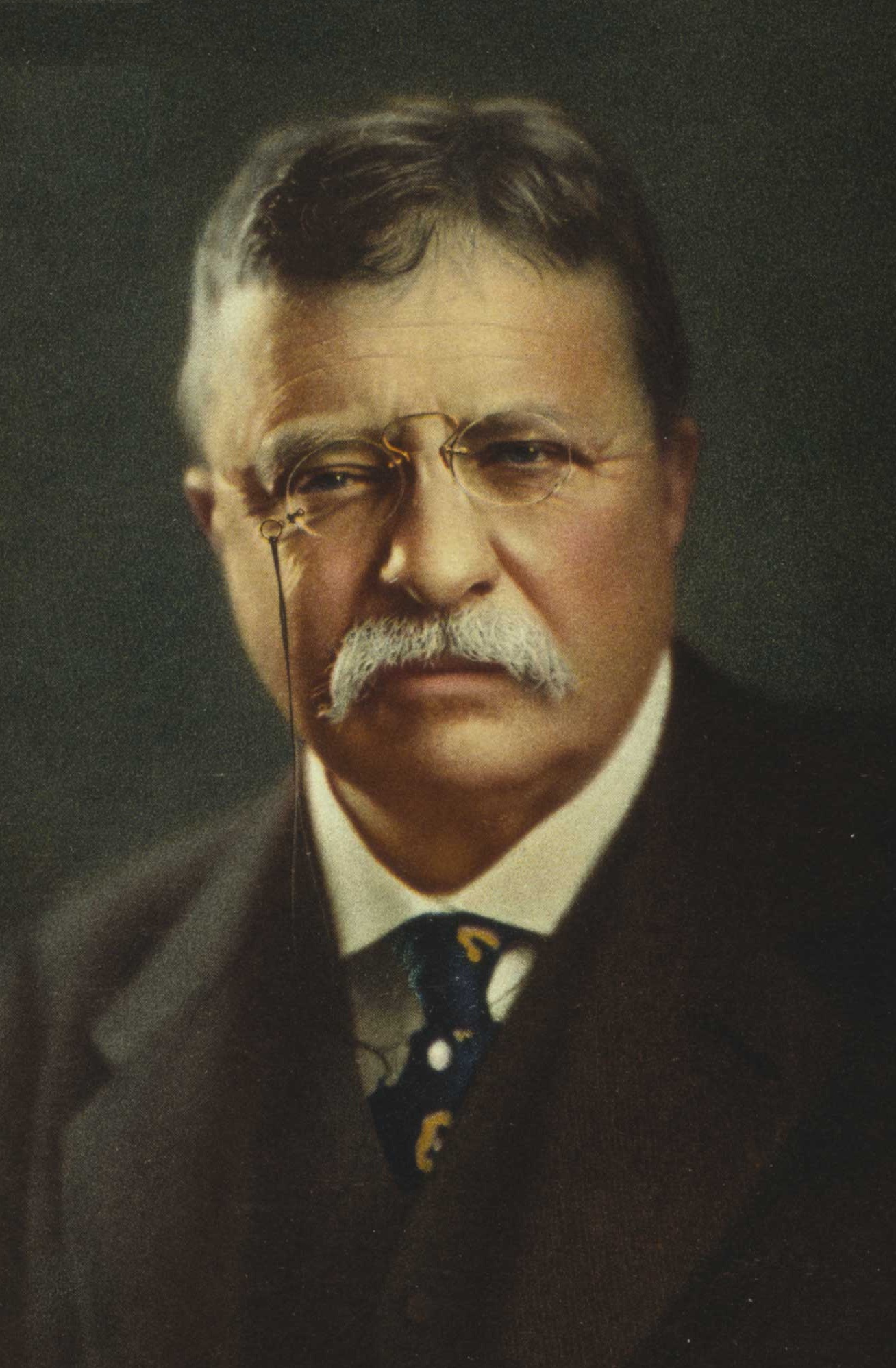
Theodore Roosevelt

Theodore Roosevelt, President, 1901-1909

Our last presidential blog featured William McKinley’s visit to Camp Wikoff, Long Island, where the Daughters of Charity served as nurses following the Spanish-American War. Teddy Roosevelt and his Rough Riders were among the soldiers stationed at Camp Wikoff. Serving as McKinley’s Vice President, Roosevelt became President after McKinley was assassinated in 1901. The following year Roosevelt and the Daughters crossed paths for the second time when Roosevelt entered St. Vincent Hospital in Indianapolis for minor surgery. The photo below shows the banner headline from the September 24, 1902 Indianapolis Sentinel. Our records of St. Vincent Hospital contain a number of newspaper clippings which give the details of Roosevelt’s time at the hospital.
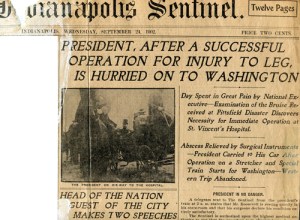
Indianapolis Sentinel

Indianapolis Sentinel, September 24, 1902 (Daughters of Charity Provincial Archives)

In the Fall of 1902 Roosevelt embarked on a national speaking tour to promote Republican candidates in the upcoming midterm elections. On September 3, while in Pittsfield, Massachusetts, a speeding trolley car crashed into the presidential carriage, killing one of Roosevelt’s Secret Service agents. Roosevelt himself was thrown from the carriage and seriously injured. Despite his injuries he continued the speaking tour. One injury, a bruise on his leg, began to swell and developed into a small abcess. By the time he reached Indianapolis he had a noticeable limp, and his doctors advised that he should undergo a minor operation, to lance and drain the wound. When the presidential train reached Indianapolis the procedure was performed at St. Vincent Hospital by Dr. John Oliver, a surgeon on the hospital’s medical staff. Dr. Oliver said in a statement to the press, “The operation was performed successfully, but it really was not a serious one. The fear was that if the serum had been allowed to remain, blood poisoning might set in, but I believe there is no further cause for apprehension. The swelling in the President’s leg was about as big as an open hand laid on the leg. The operation only took a short time and in no way affected the physical condition of the President. He is the same today as any other well man, outside of the sore place on his leg.”

The newspapers also reported on the Sisters’ preparations for receiving their distinguished patient.

“Sister Stella has had long experience in hospital work and is known for her coolness and forethought in times of emergency. Within a few minutes the necessary steps were being taken to receive the patient. Room No. 52, a cozy apartment on the fourth floor and fronting on South Street, was quickly got in readiness. White-capped nurses hurried here and there under the direction of the sisters. The private operating room on the fifth floor was made ready …

… A sentry was stationed just inside the outer enrance to the hospital and other guards took up positions outside. While the operation was being performed, Governor Durbin and Senators Fairbanks and Beveridge sat in the north parlor of the hospital waiting for news from the operating room. No one was allowed to go into this parlor. In the south parlor representatives of press associations waited. It was difficult to get any news from above stairs. Perhaps it was about 5 o’clock when the Sister Superior came into the south parlor and announced that the operation was over and that the President had been moved to his room.

‘The President is in a fine humor and is talking and joking,’ the sister said … ”

According to the newspaper accounts, Roosevelt’s nurse in the operating room was Sr. Mary Joseph. The nurse assigned to his private room was Sr. Regina, one of the nurses he had met at Camp Wikoff when the Rough Riders were stationed there.

Roosevelt’s doctors prescribed ten days to two weeks of rest to recuperate from the procedure. The remainder of Roosevelt’s tour was cancelled and he returned to Washington.

For the political context of Roosevelt’s speaking tour, see Doris Kearns Goodwin, The Bully Pulpit: Theodore Roosevelt, William Howard Taft, and the Golden Age of Journalism (New York: Simon and Schuster, 2013), p.305-310.

Learn more about Theodore Roosevelt

Leave a comment

Filed under Health Care, Ministries, Theodore Roosevelt, U.S. Presidents