Category Archives: Education

DC mission in Virginia City, Nevada

Virginia City - walking Virginia City - Wagon


By Sister Margaret Ann Gainey, archivist, Daughters of Charity Province of the West, Los Altos Hills, CA. Images courtesy of Sister Estela Morales, D.C.

In October 1864, Sisters Frederica McGrath, Elizabeth Russell and Xavier Schauer left San Francisco and journeyed by steamer, train and stage to Virginia City, Nevada Territory. Sisters arrived in Virginia City five years after silver was first discovered and it was amid this young mining community that they opened St. Mary’s School and Orphan Asylum (and later, St. Mary’s Hospital).

It was with fondness that the Sisters remembered their days in Virginia City and with a sense of history that they preserved them for future generations through their writings. It is with gratitude and pride that we share an excerpt from the Annals describing the Sisters’ journey to Virginia City:

“On the fifth of October 1864, Sisters Frederica, Xavier and M. Elizabeth were missioned to Virginia City, Nevada Territory. . . . To describe the trip hither would exhaust more wit than I have at my command. Eastward from Sacramento there was then but thirty miles of the Central Pacific Rail Road complete, so that the principal part of the journey was made in stages. Our coach was a great swinging and swaging stage drawn by six handsome horses. Our journey was a remarkably safe one, for once only did the axle-tree snap in twain; and well for us it occurred on the level road, for had we been on or near the summit of the Sierras, we might never have seen Virginia City. It was nothing unusual in those days to hear of stages and their occupants being precipitated from the dizzy heights, hundreds of feet below.

When we reached Strawberry Station in California, we were obliged to remain there three hours in a dilapidated cabin. And passing from its entrance to the rear some two yards to partake of some refreshments, we stepped over three men who were sleeping soundly on the softest plank in the floor, wrapped up in their blankets. It gave us no very pleasant anticipations of mining life at our destined home!

We got into Virginia City about two o’clock. . . . . Virginia City is situated midway up the steep side of Mount Davidson, seven thousand two hundred feet above the level of the sea and in the clear Nevada atmosphere is visible for many miles. At the time of our arrival it claimed a population of some fifteen thousand; and all day long half or nearly half swarmed the streets, whilst the remainder was down among the drifts and tunnels of the Comstock hundreds of feet down. And often have we heard the faint boom of a blast down in the bowels of the earth.” . . . .

Over fifty Sisters served the people of Virginia City between 1864 and 1897. They were loved and respected in this mining community where they taught the children of the miners, nursed the men who were wounded in the mines and cared for the orphaned children when the miners died. Through the years, miners and their families generously supported the orphanage, school and hospital.

Virginia City - Rocks

3 Comments

Filed under Education, Health Care, Ministries, Sisters of Charity Federation

Sister Formation Movement and Marillac College, St. Louis

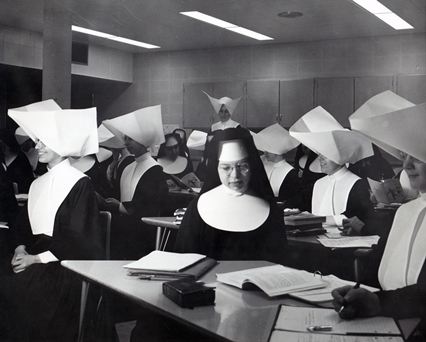
Marillac College students in class, 1960. Some twenty-five communities sent Sisters to Marillac and all took classes together (used with permission of Daughters of Charity Provincial Archives)

Marillac College students in class, 1960. Some twenty-five communities sent Sisters to Marillac and all took classes together (used with permission of Daughters of Charity Provincial Archives)

Forty years ago, Marillac College in St. Louis closed its doors and graduated its last class of Sister students. Marillac, begun in the late 1950s and located on the grounds of the provincial house of the former St. Louis Province, was unique in that it was a Sister Formation College. It combined a liberal arts education with the spiritual formation of young Sisters. A 1963 article in The SIGN Magazine described Marillac as:

“a nun’s place, a shining, modern $5.5 million place on a 180-acre estate where college life is lived to its fullest in a nun’s habit. In this sense Marillac is a college like any other, but it is also unique because of its position at the forefront of the Sister Formation Movement, which aims at improved training of nuns. Ultimately, some 170,000 U.S. nuns are involved in the consequences of the movement, as well as six million students in Catholic elementary and high schools who come under the influence of nuns in the classroom.

Marillac, aware of the stake and its role, prizes its sudden success as a new college whose first degrees were awarded only four years ago. Yet, it already has achieved accreditation with highest commendation from the North Central Association of Secondary Schools and Colleges, the same prestige accreditation accorded undergraduate studies at Chicago or Saint Louis Universities. Moreover, the Sacred Congregation for Religious in Rome has singled out the college for special praise.

Both accolades stem from Marillac’s pursuit of excellence under the aegis of the Sister Formation Movement, which came to the fore in the past ten years in response to directives from Pope Pius XII stressing the best possible training tailored for religious. Many orders established special college programs for their members, but the Daughters of Charity of St. Louis Province went a few giant steps further. They not only built Marillac for their own members but opened its classroom doors – free of charge – to religious communities throughout the country. Besides the 25 orders represented in the student body of 350, a cross-section of 15 different orders have members on the faculty.

… For Daughters of Charity, who comprise about two-thirds of the student body, Marillac provides a five-year program, with the novitiate year coming between freshman and sophomore years in the college. Students from other orders normally enter in sophomore year and live off campus in their own juniorates under the direction of a mistress. This enables the young nuns to maintain the distinctive spirit of their orders. Moreover, Marillac turns the nuns over to the rules of their respective orders every day between noon and three o’clock, producing a kaleidoscopic round of religious life, manifested in twenty-five different ways.”

After the College closed, the College grounds and buildings were sold to the University of Missouri-St. Louis. They are now used primarily for studies in the health sciences.

3 Comments

Filed under Education, Formation, Ministries, Pius XII

They don’t teach penmanship anymore …

“For centuries, cursive handwriting has been an art. To a growing number of young people, it is a mystery. The sinuous letters of the cursive alphabet, swirled on countless love letters, credit card slips and banners above elementary school chalk boards are going the way of the quill and inkwell.”.
–Katie Zezima, “The Case for Cursive”. New York Times, April 27, 2011

The Times story shows the dramatic change from the 19th and 20th centuries, when cursive handwriting (also known as penmanship) was a standard part of the school curriculum and a variety of methods existed to teach good penmanship. Our library collection includes four such manuals; their covers can be seen below. All of these manuals were donations; we do not know if they were used in Daughter of Charity schools. However, manuals such as these were widely used, and they are an important link to writing and recordkeeping systems from earlier times.

(Images used with permission of the Daughters of Charity Provincial Archives)

Baltimore Business College Method of Penmanship (Baltimore, MD: Baltimore Business College, 1907)

Baltimore Business College Method of Penmanship (Baltimore, MD: Baltimore Business College, 1907)

Edward C. Mills, Business Penmanship (New York: American Book Company, 1916)

Edward C. Mills, Business Penmanship (New York: American Book Company, 1916)

Zaner Manual

Zaner Method: Arm Movement Writing, Manual 144 (Zaner & Bloser Company, Columbus, OH, 1915)

A.N. Palmer, Advanced Edition, Palmer Method of Business Writing (New York: A.N. Palmer Company, 1929)

A.N. Palmer, Advanced Edition, Palmer Method of Business Writing (New York: A.N. Palmer Company, 1929)

2 Comments

Filed under Education, Ministries