Category Archives: Habit

The Daughters of Charity Cornette – Part 3

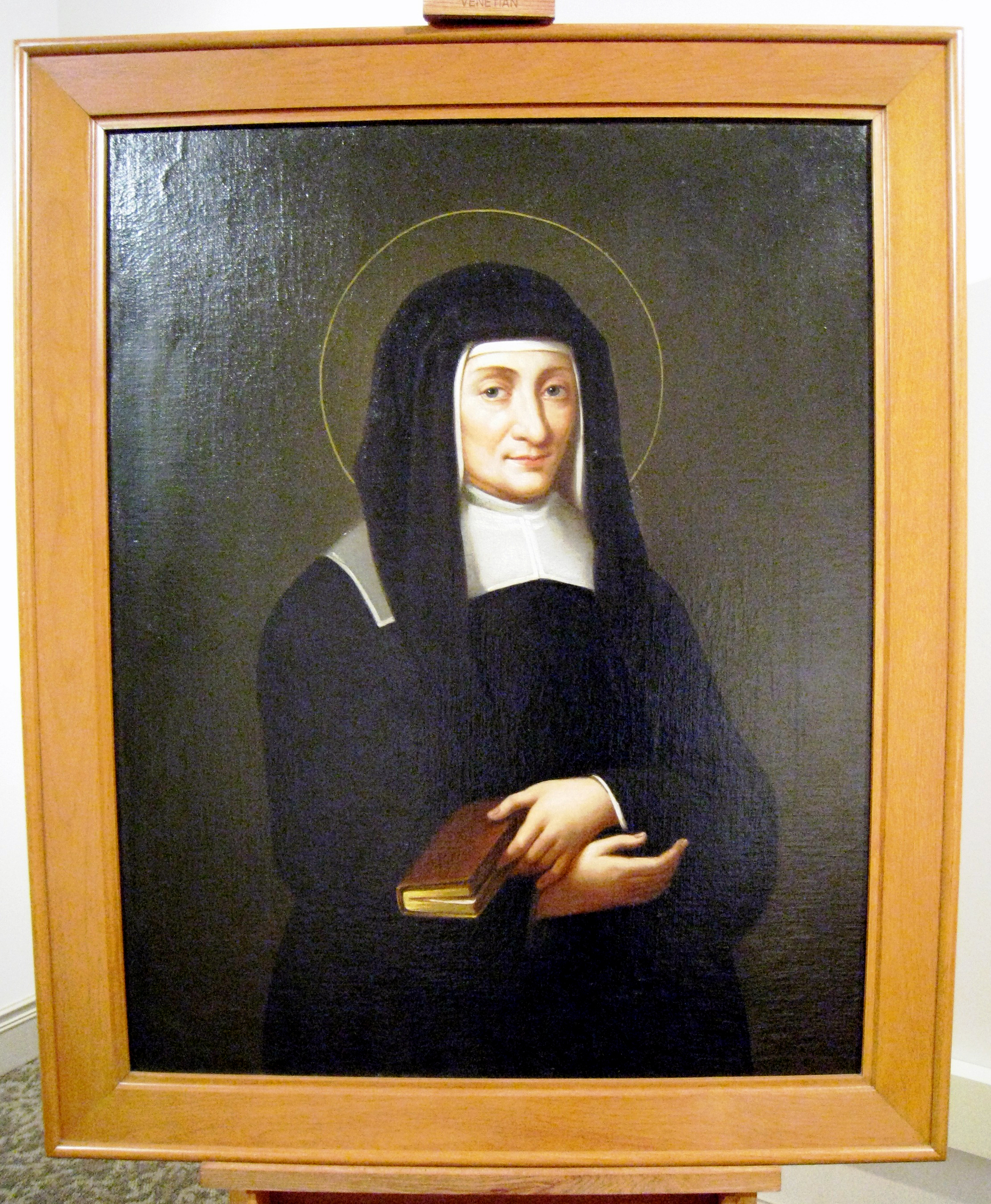
(Image used with permission of the Daughters of Charity Provincial Archives)

Mother Mathurine Guerin

Mother Mathurine Guerin, 3rd Superioress General of the Daughters of Charity

Both Vincent de Paul and Louise de Marillac died in 1660. The photo shows Mother Mathurine Guerin, 3rd Superioress General of the Daughters of Charity. The original portrait, along with portraits of all the community’s major superiors, hangs at the Daughters of Charity’s Mother House in Paris; the image seen here comes from a photograph in the Provincial Archives. We are especially indebted to Sister Elisabeth Charpy, D.C. for the content of this post, which is based heavily on her series of articles on Mother Mathurine Guerin in Echoes of the Company, 1986.

During Mother Mathurine Guerin’s 21 years as Superioress General of the Daughters of Charity, the community saw a great increase in the number of Sisters, the opening of more than 100 houses, and the opening of a second Seminary in Normandy. Also during her tenure, Father Rene Almeras, the first successor to Vincent de Paul as Superior General of the Congregation of the Mission and Daughters of Charity, arranged the community’s common rules into chapters. The community’s common rules, as arranged by Father Almeras and published in 1672, were used by the Daughters from the 17th century to the time of Vatican II.

The cornette originated as a simple covering for the head which would protect the Sisters from heat and cold. However, during Vincent and Louise’s time, the wearing of the cornette was not a universal practice. On July 26, 1685, Mother Mathurine sent a circular letter to all the community’s houses which addressed the issue of clothing, in particular the wearing of the cornette by all Sisters.

“The object of this Circular is to inform you that Father Jolly, our Most Honoured Father, having been informed that many of our Sisters were under the necessity of wearing the cornette, on account of the inconveniences they experience from the great cold in winter and the heat in summer, in serving the sick, which often obliged them to wear it for a time, thus causing a dissimilarity, some being able to do without it , and others not; all this having been considered, with the opinions of many persons of piety who found fault with the want of modesty of our head-dress, [Father Jolly] has permitted all to wear it on condition that it shall not be of finer quality than our other linen, for fear that what is allowed through necessity, may become an occasion of vanity.”

In the words of Sister Elisabeth Charpy:

“The guiding principle behind such a decision was the service of the Poor. But Mathurine knew the dangers of feminine vanity. In certain regions of France, cornettes, also called coiffes, were made of fine material and ornamented with lace. Therefore she stressed the necessity of moderation required from servants of the Poor.”

In Mother Mathurine’s time, the cornette fell loosely to the shoulders, as seen in the photo. Over time it was modified. Starch was used to stiffen it, and its edges were raised to form wide-spread wings. Over the centuries, the wings became progressively higher. By the end of the 19th century, the cornette had taken on the appearance that has become familiar to many.

In Part 4, we will discuss the union of the community founded by St. Elizabeth Ann Seton with the Daughters of Charity in 1850, and the change from Mother Seton’s “black cap” to the Daughters of Charity’s cornette.

1 Comment

Filed under Habit, Louise de Marillac, Vatican 2

The Daughters of Charity Cornette – Part 2

The earliest attire of the Daughters of Charity was modeled on the peasant dress of 17th century France. Vincent de Paul insisted by the Sisters’ clothing be uniform everywhere, and he addressed the subject often in his letters and in his conferences to the Sisters.

One concern of Vincent’s was the potential for a lack of unity within the Company. In 1656 a Sister wrote to Louise asking to wear a serge headdress, which was a local custom. Louise shared the letter with Vincent. In his response, Vincent noted it was typical for persons in consecrated life to wear the same attire; the Daughters of Charity should be no different.

“Furthermore you would cause division in your Company, which should be uniform everywhere; for, if in Arras the women wear one sort of headdress, in Poland-or even in France itself-will wear another, If, then, you follow these fashions, diversity will be the result. Do not the Capuchins and Recollects go everywhere dressed in the same way? Does the difference of their habits from the ordinary dress of the people where they live, or the shame of wearing such coarse fabric, or of going barefoot, as they do, cause them to change what they wear? The Church itself is so exact in wanting priests to be dressed suitably at all times that, if a priest lays aside his cassock, she declares him an apostate of the habit.” [note 1]

For Vincent, the lack of unity was something to be avoided because of the potential for envy within the Community that it would cause. In his conference of August 5, 1657, Vincent noted that cloistered nuns do not have any choice in how they dress; the order makes the attire and provides the nuns with everything they need. While the Daughters were not nuns, Vincent advises the Sisters to

“admire the guidance of Providence, which has established this holy custom among you that you do not purchase your own clothes or have any different from the others; for you can’t imagine the envy that’s caused when a Sister is seen dressed differently from the others … That’s why you must thank God, the Author of all your Rules and of this one in particular, which obliges you to have nothing for your own use but what the Superioress, or the Siter whose duty it is to make provision for poverty, gives you”. [note 2]

Vincent devotes his conference of June 24, 1654 to the subject of envy. In it, he warns the Sisters that disunity within the Company of the Daughters of Charity will breed envy, and that envy will ultimately tear down the community:

… the opposite of charity is envy. A Sister who has this spirit, instead of being the daughter of God that she was, becomes a daughter of the demon, a daughter of perdition. What a misfortune to become the daughter of the devil! You see, the executioner of the Daughters of Charity is envy, which causes us to be angry when we see our Sister better cared for during her illness, or sought after in a parish because she does so much good, or better dressed than we are. For that’s what envy does. As soon as a Sister reaches that point, say, ‘She’s no longer a Daughter of Charity; she’s divested of the interior habit, which is the love of God and of the neighbor.’ Ah! but we have our attire! Poor Sister, it’s not the dress that makes you a Daughter of Charity; it’s the interior habit of the soul.” [note 3]

In addition to the dangers of disunity and envy, another reason for Vincent’s insistence on uniform attire is that, if the community provides what a Daughter of Charity needs, the Sister is then freed of attachments. Sisters must be completely given to God and to serving the poor. Whatever a Sister is attached to, whether it is an article of clothing, a person, or even a place where she is serving, detracts from total devotion to God and service to God in the person of the poor. Vincent addressed this in his conference of June 6, 1656

“Here, in the words of Our Lord, is another reason for not having any attachment: ‘Where your treasure is, there is your heart. ‘ So, according to that, your dress or the shoes to which your heart is attached is your treasure. You may say, ‘But it’s only a headdress, a dress, or a parish for which I feel an affection.’ No matter! The Sister who is attached to something in the way we’ve just mentioned has her treasure there. She thinks of it often; it’s her delight to be in this place; she desires nothing else than to keep what she possesses; so much so that her treasure is there, and her heart is with her treasure, from which it can’t be detached without a very special grace.” [note 4]

The rules expressed by Vincent concerning the Sisters’ clothing, like everything Vincent and Louise did, had the ultimate purpose of preparing the Sisters to go out and serve the poor. The cornette, however, was not a standardized part of the Sisters’ attire until 1685. This change will be the subject of Part 3.

Notes
note 1. Vincent de Paul, Letter #2160, To Sister Marguerite Chetif, Sister Servant, in Arras, October 21, 1656. CCD v.6, p.129
note 2. Vincent de Paul, Conference #82: The Use of Things Placed at the Disposal of the Sisters (Common Rules, Art. 9). August 5, 1657. CCD v.10, p.240
note 3. Vincent de Paul, Conference # 60: Envy. June 24, 1654. CCD v.9 p.552.
note 4. Vincent de Paul, Conference # 73 Indifference (Common Rules, Art. 5). June 6, 1656. CCD v.10 p.139.

1 Comment

Filed under Habit, Louise de Marillac, Vincent de Paul

The Daughters of Charity Cornette – Part 1

(Images used with permission of the Daughters of Charity Provincial Archives)

Louise de Marillac

Louise de Marillac

Vincent de Paul

Vincent de Paul

In the 1960s, one Pope was quoted as saying that the Daughters of Charity cornette was an “international symbol of Charity, even as the cross is the international symbol of Faith” (note 1). The Daughters of Charity stopped wearing the cornette habit in 1964 but to this day, no aspect of Daughter of Charity history garners more interest than their traditional attire with its distinctive wide-winged headpiece. Over the next few posts we will delve into the history of the cornette habit: how it originated, how it changed over time, and its relationship to the charism of the Daughters of Charity as envisioned by the founders, Vincent de Paul and Louise de Marillac. Special thanks go to Sister Marie Poole, D.C., for her comments and suggestions about this post.

The Daughters of Charity were founded in 1633. From the beginning the Daughters were a new kind of consecrated life for women. They were not confined to the cloister. Rather the Daughters would serve the poor by going into homes, into hospitals, into the streets, and into parishes. Wherever the poor were to be found, Daughters of Charity would go as well. Writing in 1658, Louise de Marillac said:

“The girls from Saint-Fargeau, who are asking to enter the Company of the Daughters of Charity, must be informed that it is not a religious house; nor is it a hospital from which they will never be moved. Rather they must continuously go to seek out the sick poor, in various places, in any kind of weather and at predetermined times.” [note 2]

Vincent de Paul, also writing in 1658, specified that young women wishing to become a Daughter, that Daughters of Charity needed to “understand very clearly the following things:

(1) that your Company is not a religious Order, nor your house a hospital from which they must not budge, but rather a Society of Sisters who come and go constantly to various places and at definite times for the assistance of the sick poor, regardless of the weather;
(2) that since the Daughters of Charity are servants of the poor, they too are poorly dressed and fed and may not change their white headdress or clothing;
(3) that they must have no other intention in coming to the Company than that of the service of God and the poor …” [note 3]

In addition to being an active form of consecrated life, many of the Daughters of Charity’s earliest members came from a different stratum of society – for the most part they were not from the upper class. Neither Vincent nor Louise describes in detail what the earliest attire looked like. However we know that the earliest attire of the Daughters of Charity was that of the village girls of the Ile de France. The first Daughters of Charity, almost all natives of the environs of Paris, wore the attire they were wearing when they presented themselves to Saint Louise to become members of the Community. Those who came from farther away dressed, for the sake of uniformity, like the village women of the area surrounding Paris.

In a letter to Louise from 1641, Vincent wrote, concerning one of the Sisters, “I don’t know what to tell you about little Jeanne, except that something must be said to her about the temptation of that kerchief. “ [note 4].

In 1646, Vincent wrote to a priest of the Congregation of the Mission,

“I do not approve, any more than you do, of their little ways of arranging their clothing, and it will be a good idea for you to have them moderate this, especially with regard to the veil they wear, unless that is the way it is ordinarily worn by women of the people. I will talk this over with Mademoiselle Le Gras.” [note 5]

The result of Vincent and Louise’s discussion is recorded in a letter from Louise written in August 1646. In the letter Louise wrote that she had suggested, and Vincent had approved, the wearing of a cornette, so that the face could be protected from extreme cold and heat. [note 6]. It took until 1685, 25 years after the deaths of Vincent and Louise, for the cornette to become a standard part of the Daughters of Charity attire and, as we’ll see in Part 3, the earliest cornette did not have wings.

Vincent de Paul insisted on complete uniformity in how the Sisters dressed. The reasons for this insistence on uniformity will be the subject of Part 2.

Notes
References to “CCD” refer to: Vincent de Paul, Correspondence, Conferences, and Documents, edited and translated by Sr. Marie Poole, D.C. and others. (New City Press, 1983-2009)
References to “Spiritual Writings” refer to: Spiritual Writings of Louise de Marillac, edited and translated from the French by Sr. Louise Sullivan, D.C. (New City Press, 1991)

note 1. Sr. Catherine Sullivan, “Swan Song”. Daughter of Charity Magazine, Fall 1964
note 2. Louise de Marillac to Brother Ducourneau. L.561, January 1658. Spiritual Writings, p.583
note 3. Vincent de Paul to the Sister Servant, in Saint-Fargeau. Letter # 2511 [January 1658] CCD, v.7, p.64-66
note 4. Vincent de Paul to Louise de Marillac. Letter # 534, [1641]. CCD: v.2, p.206.
note 5. Vincent de Paul to Antoine Portail. Letter #827, July 25, 1646. CCD v.2, p.675. “Mademoiselle LeGras” refers to Louise de Marillac
note 6. Louise de Marillac to Monsieur Portail. L.148, August 13, 1646. Spiritual Writings, p.162-163.

3 Comments

Filed under Habit, Louise de Marillac, Vincent de Paul