Category Archives: Elizabeth Ann Seton

Conference of Mother Seton’s Daughters, October 28-29, 1947 – part 1

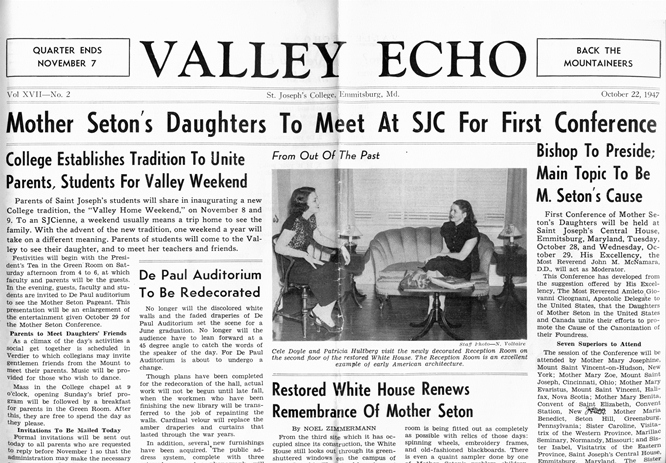
St. Joseph's College newspaper October 22, 1947

St. Joseph’s College VALLEY ECHO, October 22, 1947, announcing the first meeting of the Conference of Mother Seton’s Daughters.


(Image from the St. Joseph’s College Valley Echo, October 22, 1947, used with permission of the Daughters of Charity Provincial Archives)

On October 24-26, 2013 the Provincial Archives will host a meeting of archivists from Sisters of Charity Federation member communities. As we prepare to welcome our colleagues from the Federation, it is appropriate to look back at the Federation’s origins. The photo above shows the October 22, 1947 issue of the St. Joseph’s College newspaper, the Valley Echo, which includes a banner headline announcing the First Conference of Mother Seton’s Daughters. “Conference of Mother Seton’s Daughters” is the original name of what is now known as the Sisters of Charity Federation. The first meeting, held in Emmitsburg on October 28 and 29, 1947, arose out a suggestion by the Most Reverend Amleto Giovanni Cicognani, Apostolic Delegate to the United States, that the American communities which traced their roots to Elizabeth Ann Seton should unite in their efforts to promote Mother Seton’s cause for canonization.

In 1947 the property just to the south of our current building, now occupied by FEMA, housed both the Central House for the Daughters of Charity Emmitsburg Province and the campus of St. Joseph’s College, a liberal arts college for women operated by the Daughters of Charity until the early 1970s.

Elizabeth Ann Seton was beatified in 1963 and canonized in 1975.

1 Comment

Filed under Elizabeth Ann Seton, Sisters of Charity Federation

Mother Seton, Patroness of the Sea Services

Carville aerial view

Aerial view of the U.S. Public Service Hospital at Carville, Louisiana

Over the weekend our friends at the National Shrine of Saint Elizabeth Ann Seton held their annual Pilgrimage for the Sea Services. The Pilgrimage, held every year on the first Sunday in October, is a special Mass in honor of Saint Elizabeth Ann Seton as Patroness of the Sea Services. Mother Seton’s son William served in the United States Navy from 1818 to 1834. Her son Richard served, as a civilian, as a captain’s clerk on the U.S.S. Cyane from June of 1822 until his death on June 26, 1823. Richard was buried at sea. Shortly after Mother Seton’s canonization in 1975, then-Chief of Navy Chaplains, Monsignor John J. O’Connor (later John Cardinal O’Connor, Archbishop of New York) took the initiative to proclaim Mother Seton “Patroness of the Sea Services” – the Navy, the Marine Corps, the Coast Guard, the Merchant Marine, and the U.S. Public Health Service.

The U.S. Public Health Service traces its history back to 1798 when it was established by Congress to provide health care to sick and injured merchant seamen. In 1870 the Marine Hospital Service was recognized as a national hospital system with centralized administration under a medical officer, the Supervising Surgeon, who was later given the title of Surgeon General. Mother Seton has a connection with public health as well. Her father, Dr. Richard Bayley, was the first public health officer for the Port of New York as a result of his work on the yellow fever epidemic in the late 18th century.

The Daughters of Charity have a special connection with the Public Health Service. From 1896 to 2005 the Daughters ministered to patients with Hansen’s disease (formerly known as leprosy) at what is today known as the National Hansen’s Disease Programs, located in Carville, Louisiana. The hospital in Carville was founded in 1894 as the Louisiana Leper Home. The Daughters began their ministry at Carville in 1896. In 1921 the hospital was taken over by the US Public Health Service and became known as U.S. Marine Hospital #66. The Carville site is no longer used for patient care. In the 1990s it was returned to the State of Louisiana, and today it is home to the Louisiana National Guard. The site is also a National Historic District and the home of the National Hansen’s Disease Museum.

1 Comment

Filed under Elizabeth Ann Seton, Health Care, Ministries

Anniversary of Seton canonization, part 2

Seton canonization program cover

Cover of the program from Elizabeth Ann Seton’s canonization in Rome, September 14, 1975

(Exerpt from THE SETON CAUSEWAY, December 1975 and cover image from Elizabeth Seton canonization program, 1975 used with permission of the Daughters of Charity Provincial Archives)

Below are exerpts from THE SETON CAUSEWAY describing Elizabeth Seton’s canonization ceremony in Rome on September 14, 1975.
——————————————————
The enthusiastic response of Canadians and especially Americans forced the moving of the canonization Mass and ceremony for St. Elizabeth Ann Seton out of St. Peter’s Basilica into the Square. Weeks in advance, seven American cardinals, 80 members of the hierarchy and some 16,000 priests, religious, and laity had signified their intention to be present. Under the direction of Sister Eleanor McNabb, assisted by Sisters Helen Marie Law and Mary Ellen Sheldon, requests for tickets were processed beginning the end of May.

There was no disappointment, either in weather or crowd. The great Sunday dawned clear and beautiful, with lots of bright sunshine and just enough clouds to temper it and stir up pleasant airs. There were various estimates of the size of the crowd, ranging from 150 to 250 thousand. No matter, the seemingly limitless expanse of St. Peter’s Square was filled …

After the Kyrie, the Pope seated himself in front of the altar facing the people and the canonization ceremony began. In a break with tradition four womenh approached the Holy Father, in turn, to petition for Elizabeth Ann Seton’s canonization. These women represented four stages of the new saint-to-be’s life: the young girl, the wife, the widow, and the religious foundress. The petitions were made in French by Ines Amanrich, young daughter of the French ambassador to the Vatican; in Spanish by Lidice Maria Gomez de Carriquiry of Ecuador, in Italian by Gina Faggino of Italy, and in English by Sister Kathleen O’Toole, S.C., mother general of the Sisters of Charity of Halifax. Archbishop Bafile, pro-prefect of the Sacred Congregation for the Canonization of Saints, accompanied by Father William W. Sheldon, C.M. postulator general of the Cause, then formally petitioned the Holy Father for the canonization in light of the facts presented by the four women.

After prayer, including the litany of the saints … the Holy Father infallibly pronounced Elizabeth Ann Seton a saint in the following words:

“For the honor of the Most Holy Trinity, for the exaltation of the Catholic Faith and the increase of the Christian life, by the authority of Our Lord Jesus Christ, of the holy Apostles Peter and Paul and by Our authority, after mature deliberation and most frequent prayer for divine assistance having obtained the counsel of many of our brother bishops, we declare and we define that Blessed Elizabeth Ann Bayley Seton is a saint, and we inscribe her name in the calendar of saints, and mandate that she should be devoutly honored among the saints in the Universal Church”.

Still another landmark ‘first’ took place when Sister Hildegarde Marie Mahoney, S.C., general superior of the Sisters of Charity of St. Elizabeth, Convent Station, J.J., read the first lesson of the Mass, the first time a woman had participated in the liturgy of a papal Mass …

The Triduum of Masses of thanksgiving was held at the Major Basilica of St. Paul’s Outside the Walls on three successive days beginning Tuesday September 16 at 6PM. Cardinal Shehan was the principal celebrant that evening, and Archbishop Borders preached the Homily. The next morning, Wednesday, September 17, Cardinal Cooke was principal celebrant and Father J. Carroll McHugh, S.S. provincial treasurer of the American Sulpicians, preached the homily. On the final evening, Thursday, September 18, Archbishop Bernardin was the principal celebrant and Father Dirvin was the homilist. A large number of bishops and priests concelebrated at these Masses.

It was indeed a memorable week, one which neither the Americans nor the Romans will ever forget.

Leave a comment

Filed under Elizabeth Ann Seton