
In this post, we’d like to highlight two small oddities in the Archives, relatively simple records of the Sisters and an awkward accommodation with the government.
The first comes from a small, now defunct government office called the Bureau of Industrial Alcohol.
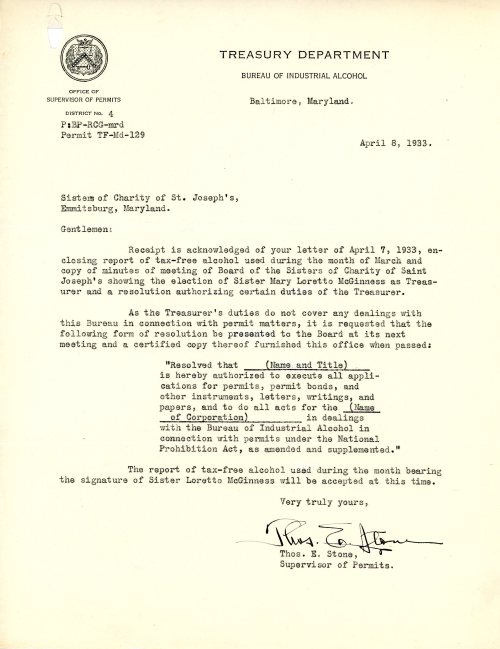
The document itself is located within a folder named “Various Corporate Certificates,” containing letters, approvals, and resolutions that, while necessary to conduct the business of the Sisters, are relatively mundane. The association with a government office such as the Bureau of Industrial Alcohol is the first thing that is peculiar.
This is explained when you look at the date, April 8, 1933. Through December of 1933, Prohibition in the United States was still in effect, placing Sisters, priests, and many Catholics in a theological bind – How were Catholics to partake in Communion when wine was illegal?
The Volstead Act of 1920 had carved out exemptions for alcohol used for medicinal purposes and specifically for wine “for sacramental purposes or like religious rites,” but this required a permit from a commissioner to do so. Thus, a letter in the official documents governing the province from a minor government office in Baltimore.
It is also worth noting that the letter addresses the Sisters as “Gentlemen” in its greeting, as the assumption of the time was that only men would be serving on a corporate board.
The letter, however, brings up a problem. The government office had received their permit application, but the Treasurer of the community was not a recognized agent to work with the Bureau. Prohibition was in its thirteenth and final year of enactment in the United States; this was not a new rule the Sisters were complying with at this point.
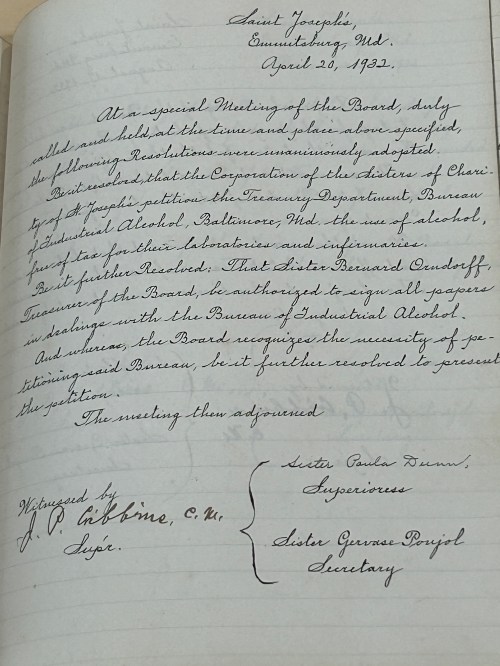
A hint for this comes when looking at the Treasurers of the Community. Sister Bernard Orndorff had served as Treasurer for the Eastern Province for over 30 years, from 1901 to 1933, but had to abruptly resign for health reasons in February. Indeed, just the year before, the corporate minutes of the Province show that the Sisters had petitioned for the very same form (although the alcohol was not for liturgical purposes, but “for their laboratories and infirmaries,” presumably at St. Joseph College in Emmitsburg).
Succeeding Sister Bernard as Treasurer was Sister Mary Loretta McGinness. The helpful permitting agent pointed out, though, that Sister Bernard was still the authorized agent to work with the Bureau. Thus, he advised the Sisters to pass a resolution authorizing their new Treasurer to be named as the official person to work with the Bureau, which the Sisters then did.
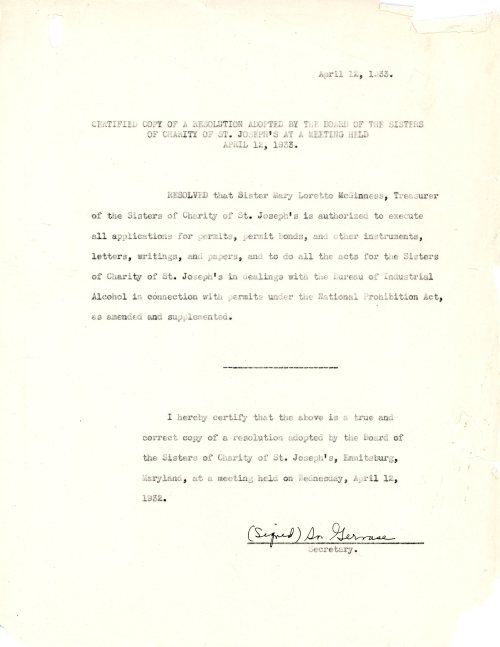
This process would soon be rendered moot when the 21st Amendment was ratified in December of 1933, essentially abolishing the government departments meant to enforce Prohibition and leading to the consolidation of the remaining ones into the Bureau of Alcohol, Tobacco, Firearms and Explosives. A month before this letter was sent, President Franklin Roosevelt had signed the Cullen-Harrison Act, which defined drinks with alcohol content up to 3.2% as not legally alcoholic for the purposes of the Volstead Act. The agent seems very lenient with the requirements for the permit from the Sisters – it is a mere act of their board and a piece of paperwork that is missing, and the permit would be granted.
Prohibition is a curiosity of an era in American history, possibly from its coinciding with the Roaring 1920s, possibly from its constitutional oddity and the shortness of its enaction. Nonetheless, it had a wide effect on American life during its 13-year national lifespan, with a few bureaucratic records showing that the lives of the Sisters were no exception.

 docarchivesblog.org