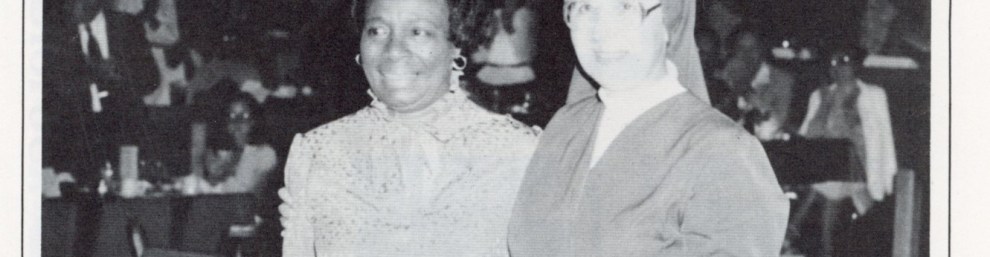
Today we would like to highlight a pioneer at one of the Daughters largest and longest-lived institutions, Providence Hospital in Washington, D.C. When Estelle Howard arrived at Providence to begin her career as a nurse, she became one of the first two Black nurses to work at the hospital. She would spend the next 43 years at Providence, garnering a number of other pioneering firsts during her time there.
It was 1947 when Sister Rita Voss called the Freedman’s Hospital Nursing School and asked for the best two students in the graduating nursing class. No white hospital had ever made such a request of Freedman’s before.
Expecting an interview, the two nurses were hired on the spot and asked if they were ready to work. In 1951, Ms. Howard became head of a segregated ward, but as units desegregated, she became the first Black head nurse of an integrated unit. She later rose to the ranks of Assistant Director of Nursing and Control Coordinator of the Emergency Unit.
Among her other accomplishments, roles, and titles at the job were those of a reporter for the employee newsletter and leadership positions in the District of Columbia’s Nurses Association.

In 1982, for her pioneering role and years of dedicated service, Ms. Howard was the inaugural winner of the Sr. Anne Robb Award, given to those who have shown dedication to Providence Hospital, above average performance and achievements, and perseverance in the face of difficulties. Even after this lifetime achievement award, she served for another eight years at the hospital. In her presentation of the award, Sister Irene Kraus called her “a model of a person who focuses on the good in life and people and refuses to be embittered or to respond in kind when she meets unkindness … Miss Howard has the unique ability over the years to be loyal and supportive of those she has worked with at every level.”

Estelle Howard retired after exactly 43 years at Providence on April 23, 1990. The hospital proclaimed it Estelle Louise Howard Day. Her work made it possible for many others to pursue their career as they desired and to make nursing and the Hospital better for its administrators, doctors, nurses, and patients. Even after her retirement, she continued to volunteer at the hospital.

Estelle Howard’s story is documented in the Archives through the various employee newsletters, photo collections, and a profile written about her in 1990, but we are also fortunate enough to have a copy of a life story that she wrote “And Now My Time at Bat Remembering” in 1999. Although it is but a few brief pages, it allows her to tell her story in her own words and as she wished to, with deep reverence for her immediate and extended family and for the elder family members who can preserve and pass on Black family history. It documents her ancestors’ leaving Alabama during the Great Migration and the forces growing up that shaped her life, including the town library, the Great Depression, and stories of family history in Louisiana.

 docarchivesblog.org