
One of the communities of priests that influenced the development of the Catholic Church in the colonial United States was the Order of St. Augustine, or Augustinians. Working and living in the same time period and parts of the country as Mother Seton, it was natural that their paths should cross. Although the Daughters archive does not explicitly talk about Augustinian business, figures and events from their early history in the United States are peppered throughout the records within the collection.
The Augustinians were founded in the 1200s in Italy with a charism based upon the rule of St. Augustine of Hippo. The order arrived in the United States in 1796 with the Irish Fathers John Carr and Matthew Rosseter. Matthew Hurley, also an Irishman by birth, was the first to join the American community, and after the deaths of Rosseter and Carr in 1812 and 1820, he was the only Augustinian in the country.

Elizabeth met Father Hurley in 1805 during her years in New York City, after she had converted to Catholicism but before she founded her community, when Hurley was at St. Peter’s Church. Although there are only three surviving drafts of letters from Mother Seton to Hurley and two from Hurley to Mother Seton, mentions of him in her correspondence are numerous, as Hurley very much fulfilled the role of spiritual advisor early in her time as a Catholic. It was Hurley who gave Elizabeth the confirmation name Mary and performed the honor of receiving her sister-in-law Cecilia and daughter Anna Maria into the Church.


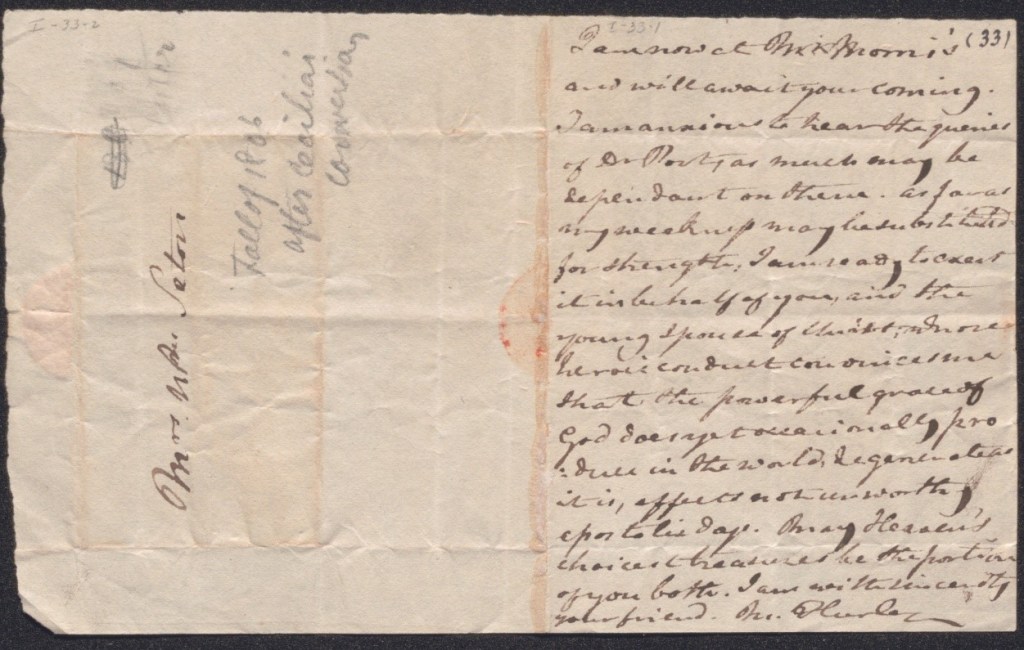
In 1807, Father Hurley was recalled in ill health to Philadelphia by Father Carr, where he went on to become pastor at St. Augustine Church. There, he formed part of a Catholic circle that remained in contact with Mother Seton, including Mathew Carey, who published the first American English-language Catholic Bible; Matthias O’Conway, a translator and early donor to the community; his daughter Cecilia, who was the first to join Mother Seton’s community; and Rachel Montgomery. Montgomery formed the lay board of St. Joseph’s orphan asylum, who, along with Hurley, urged Mother Seton to send Sisters for the first time out from their spiritual home in Emmitsburg, Maryland. Sister Rose White led the band of Sisters to St. Joseph’s in 1814 and would later become Mother Seton’s successor as leader of the community.
Despite his influence, no letters received by Hurley from Mother Seton survive. Indirectly, the community records provide the reason for this in the accounts of Sister Mary Gonzaga Grace and the Philadelphia Know-Nothing riots of 1844. Here, anti-Catholic and anti-immigrant mobs sacked churches, burning most of the Augustinian library, including Mother Seton’s letters.

Among the other Augustinian effects on Mother Seton and the community include some of the Augustinian spiritual tradition. Likely at the recommendation of Father Hurley, the Archives is still in possession of Elizabeth’s copy of The Sufferings of Our Lord Jesus Christ, a spiritual work of Father Thomas of Jesus, member of the Order of the Hermits of St. Augustine.
Even with the loss of Mother Seton’s letters to the early Augustinians, tragic as it may be, the materials in the collection document the spiritual growth and development of Mother Seton. Even if she ultimately based her community on the tradition of Saints Vincent de Paul and Louise de Marillac, she built upon the traditions that surrounded her and the inherited tradition of (at that time) 1,800 years of spiritual growth and development. The Augustinians today operate three provinces in the United States, as well as one university, Villanova, in Philadelphia.

 docarchivesblog.org
Thank you for this informative post about Fr. Michael Hurley and the Augustinian influence on St. Elizabeth Seton. She read and absorbed the writings of many great spiritual guides – most notably, Sts. Vincent de Paul and Louise de Marillac, of course – whose wisdom shaped her spirituality and that of the community that she began.
LikeLike