
The year 2020 marks 100 years since women in the United States won the right to vote. This is the first of a three-part series on the Daughters and their relationship with the suffrage movement throughout the 1910s, leading up to the election of 1920. Part 2 will run in October. Part 3 will run in November.
One of the longest movements in American history was that of women’s suffrage, which reached its greatest triumph with the passage of the 19th Amendment. Having received passage by Congress on June 4, 1919 and ratification by the states on August 18, 1920, women voted for the first time in every state in the November elections of that year.
Despite the movement’s status in American history, the Daughters’ archives remain largely silent on the rising women’s suffrage movement throughout the 1910s and 1920s. After thoroughly searching, we have found no record of Daughters of Charity advocating for their own right to vote in any city, nor offering their support to the movement prior to 1918.
There is, however, an individual that makes repeated appearances before this time in the Annals of the Province, the record of day-to-day life at the Daughters of Charity Provincial House on the campus of St. Joseph College in Emmitsburg, Maryland – James Cardinal Gibbons of Baltimore.

Gibbons, with the benefit of hindsight and remembrance, has a mixed and complicated historical legacy. He became Archbishop of Baltimore in 1877 and served in the position for 44 years. Prior to this position, he had been Apostolic Vicar for North Carolina, a position he accepted at age 34, making him the youngest bishop in the United States and one of the youngest in the world. His long service introduced him to many political and cultural figures, and he was a strong unofficial advisor on the Catholic community in the United States to (Protestant) President Teddy Roosevelt. A statue of him stands outside the Shine of the Sacred Heart in Washington, D.C., erected by the Knights of Columbus in recognition of his service when the two cities were one Archdiocese. The James Cardinal Gibbons Medal is still awarded by the Catholic University of America, of which Gibbons was the founder and first Chancellor.

As early as the 1880s, Gibbons made it a priority to support, collect, fund, and fundraise for African-American parishes in his archdiocese, as well as the parishes with new immigrant populations from Ireland and Germany, and Eastern Europe. His support never extended to support for desegregation during his tenure, but he believed that allowing ethnic and racial communities their own traditions under the church would ensure their continued adherence to the faith, and, particularly as related to newly-arrived immigrant groups, a gradual Americanization.[3] Even when newer immigrant groups began to arrive from Eastern Europe and Latin America – which faced even greater hostility from nativist groups stemming from the belief in their perpetual “otherness” – Gibbons considered them merely a new phase of American immigration deserving of respect just like those from the earlier phase.[4]
On the issue of race, however, he believed a certain level of African-American education was required before talk of rights could begin; when pressed by black Catholics on this matter throughout his career, he continued to kick this can down the road.[5] Nevertheless, after 1909, Gibbons opposed any measures in the state of Maryland to bar African-Americans from the ballot box, and throughout his time as Archbishop, he could be seen walking the streets with individuals of all races.[6]
Gibbons was most outspoken on the rights of labor. While he decried the violence of anarchist groups and of the Haymarket Square Bombing in 1887, he came to the defense of the Knights of Labor, and of the necessity of unions to secure a decent living for its members in the face of uncaring industrial business. This particularly extended to the immigrant communities that worked under poor conditions in the late 19th century.[7]
From his position in America, he advocated for the righteousness of the separation of church and state long before Vatican II endorsed his beliefs.[8] He stood against the war hawks calling for American involvement in World War I but navigated the political debate without losing friends. At the same time, Gibbons catastrophically – even with the level of public knowledge of the events at the time – underestimated the destruction of King Leopold and defended his atrocities in the Belgian Congo.[9]
Cardinal Gibbons was a frequent guest and speaker on the campus of St. Joseph College and Academy, the Daughters-run institution founded by Mother Seton. Gibbons served as a commencement speaker in 1911, 1913, 1916, and 1917.[10] In the accounts of his talk in 1911, the annals describe him making the arguments that were common at the time that women already had the vote – through their husbands, fathers, and sons.[11]

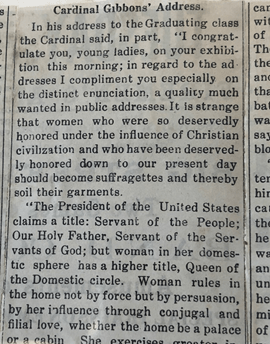
In his 1916 address, he called it “strange that women who were so deservedly honored under the influence of Christian civilization and who have been deservedly honored down to our present day should become suffragettes and thereby soil their garments.”[12]
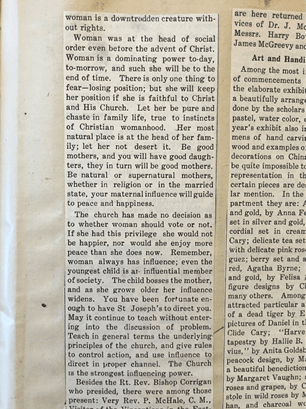
Gibbons was influential in both the American and global Church, but his beliefs on the subject were not solely his. During the 1912 graduation, Archbishop Corrigan of Buffalo, who decried that “Women are making a great stir in Chicago,” calling for society to “Let her be pure and chaste in family life, true to instincts of Christian womanhood. Her most natural place is at the head of her family; let her not desert it.” At the same time as he acknowledge that the Church had not made a decision on the matter, he also stated that “If she had this privilege she would not be happier, nor would she enjoy more peach than she does now.”[13]

In this same year, Father Patrick McHale Provincial of the Eastern Province of the Vincentians, seemed to try and split the difference, praising an accomplished woman as a mathematician and chairholder at a university, while also praising in the same sentence “the true woman [who] fulfills her mission and returns home.” Ultimately, his assessment of the cause seems to land on “The tendency today is to take woman from her position; “Woman Suffrage” for example. A word here will suffice. If there is need to vote, let woman cast the ballot and then return where she belongs.”[14]

Commencement of 1917 was the last time Cardinal Gibbons gave the commencement at St. Joseph’s College. Beginning in 1918, however, the Provincial Annals begin to show a more positive turn towards the idea of women’s suffrage, along with a turn the Cardinal himself made on the issue. Stay tuned for part 2 of this story in October!
[1] Cardinal James Gibbons, -1921. , ca. 1917. Oct. 18. Photograph. https://www.loc.gov/item/2004670749/.
[2] Theodore Roosevelt and Cardinal James Gibbons in a friendly exchange. ca. 1921. Photograph. https://www.loc.gov/item/2009633765/.
[3] John Tracy Ellis, The Life of James Cardinal Gibbons, ed. Francis L. Broderick, Popular ed. (Milwaukee: The Bruce Publishing Company, 1963), 63; Thomas W. Spalding, The Premier See: A History of the Archdiocese of Baltimore, 1789-1989 (Baltimore: Johns Hopkins University Press, 1989), 252.
[4] Spalding, 269-271.
[5] Spalding, 288.
[6] Thomas J. Shelly, “Biography and Autobiography: James Cardinal Gibbons and John Tracy Ellis,” U.S. Catholic Historian 21 (2), Spring 2003, 41.
[7] Ellis, Life of James Cardinal Gibbons, 80-90.
[8] John Tracy Ellis, “James Gibbons of Baltimore,” in Patterns of Episcopal Leadership, ed. Gerald P. Fogarty, S.J. (New York: Macmillan Publishing Company, 1989), 137.
[9] Ellis, Life of James Cardinal Gibbons, 294-295.
[10] Provincial Annals, 1911, 60; 1913, 39-40; 1916, 102; 1917, 87, Emmitsburg, MD – St. Joseph’s Provincial House [Hereafter “Prov. House”], Boxes 241 and 243, Daughters of Charity Archives, Province of St. Louise, Emmitsburg, MD [Hereafter APSL].
[11] Provincial Annals, 1911, 60.
[12] Provincial Annals, 1916, 102.
[13] Provincial Annals, 1912, Prov. House, Box 241, APSL, 102-103.
[14] Provincial Annals, 1912, 105.



 docarchivesblog.org