International Day of Prayer and Awareness Against Human Trafficking

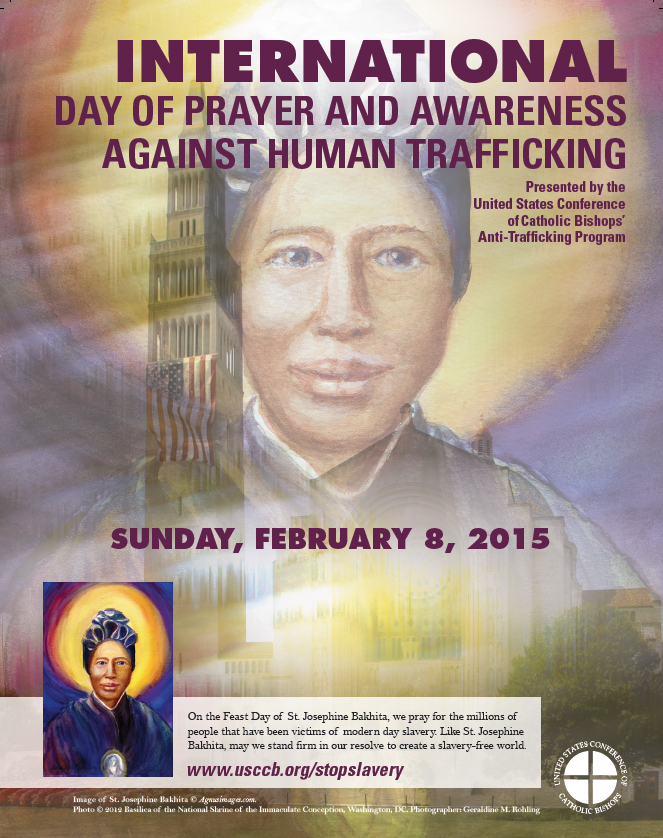
International Day of Prayer and Awareness Against Human Trafficking (image courtesy of U.S. Conference of Catholic Bishops)

International Day of Prayer and Awareness Against Human Trafficking (image courtesy of U.S. Conference of Catholic Bishops)

February 8 marked the Feast of St. Josephine Bakhita and the first International Day of Prayer and Awareness Against Human Trafficking. The Daughters of Charity, along with many other communities of women religious, have taken a corporate stance against human trafficking. The text below comes from the Stop Trafficking Newsletter and the Vatican News Service

The day is intended to raise awareness and to encourage reflection on “the violence and injustice that affect” the numerous victims of trafficking, according to a Nov. 25 press release from the Pontifical Council for Migrants and Travelers.

Trafficking victims “have no voice, do not count, and are no one. They are simply slaves,” the council said.

The observance also is designed to seek solutions and promote concrete action to stop trafficking.

The organizers underlined the need to ensure the rights, freedom and dignity of all trafficked people and to denounce the criminal organizations involved in human trafficking, as well as those who “use and abuse” the victims as “goods for pleasure and gain.”

On his flight back to Rome from Strasbourg, France, Nov. 25, Pope Francis told reporters “slavery is a reality inserted in the social fabric today, and has been for some time: slave labor, the trafficking of persons, the sale of children — it’s a drama. Let’s not close our eyes to this. Slavery is a reality today, the exploitation of persons,” he explained.

The new observance is being promoted for all dioceses, parishes and church groups by the council for migrants, the Pontifical Council for Justice and Peace and the international unions of superiors general of men’s and women’s religious orders.

Several other Catholic organizations are supporting the initiative, including the Pontifical Academy for Social Sciences, Caritas Internationalis, World Union of Catholic Women’s Organizations and Jesuit Refugee Service.

St. Josephine Bakhita was born in Sudan in 1869 and enslaved as a child. Eventually she was sold to an Italian diplomat and taken to Italy, where she was later brought to freedome through the help of the Canossian Daughters of Charity. Through their guidance, she learned about God and served him faithfully until her death in 1947.

In October 2000 Pope John Paul II canonized Bakhita, noting, “In St. Josephine Bakhita we find a shining advocate of genuine emancipation. The history of her life inspires not passive acceptance but the firm resolve to work effecrtively to free girls and women from oppression and violence, and to return them to their dignity in the full exercise of their rights”.

Additional resources:
“Turn On a Light Against Human Trafficking” – from FAMVIN.org

U.S. Conference of Catholic Bishops, Anti-Trafficking Program

Leave a comment

Filed under Human Trafficking, Social Justice

Feast of Rosalie Rendu

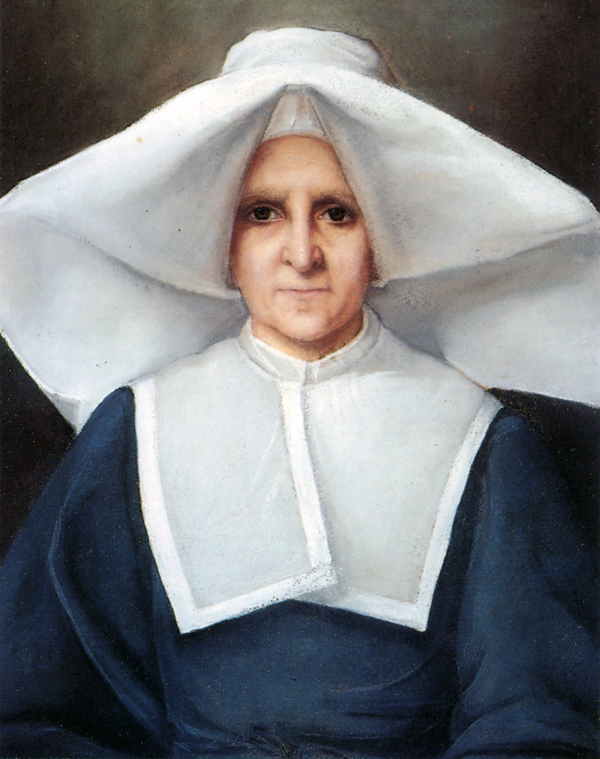
Rosalie Rendu

Blessed Sister Rosalie Rendu, D.C. (used with permission of the Provincial Archives)

February 7 marks the feast day of Blessed Sister Rosalie Rendu. The text below is taken from the Vatican’s website.

Jeanne Marie Rendu was born in 1786 and entered the Daughters of Charity in 1802. She was sent to the house of the Daughters of Charity in the Mouffetard District, where she remained for the next 54 years. At the time, it was the most impoverished district of the quickly expanding capital. Jeanne Marie, who received the name Sr. Rosalie, made her accompanied Sisters visiting the sick and the poor and taught catechism and reading to little girls accepted at the free school. In 1807, Sr. Rosalie made vows for the first time.

In 1815 Sr. Rosalie became Superior of the her local community. To assist all the suffering, she opened a free clinic, a pharmacy, a school, an orphanage, a child‑care center, a youth club for young workers and a home for the elderly without resources. Soon a whole network of charitable services was established to counter poverty.

Superiors sent her postulants and young Sisters to be formed. They put in her house, for a period of time, Sisters who were somewhat difficult or fragile. To one of her Sisters in crisis, she gave this advice one day, which is the secret of her life: “If you want someone to love you, you must be the first to love; and if you have nothing to give, give yourself.” As the number of Sisters increased, the charity office became a house of charity, with a clinic and a school.

Her reputation quickly grew in all the districts of the capital and also beyond to the towns in the region. Sr. Rosalie knew how to surround herself with many efficient and dedicated collaborators. Students of law, medicine, science, technology, engineering, teacher‑training, and all the other important schools came seeking from Sr. Rosalie information and recommendations. Or, before performing a good work, they asked her at which door they should knock. Among these, Blessed Frédéric Ozanam, cofounder of the “Society of St. Vincent de Paul,” and the Venerable Jean Léon Le Prevost, future founder of the Religious of St. Vincent de Paul, knew well the road to her office. They came, with their other friends, to Sr. Rosalie seeking advice for undertaking their projects. She was the center of a charitable movement that characterized Paris and France in the first half of the 19th century. Sr. Rosalie’s experience was priceless for these young people. She directed their apostolate, guided their coming and going in the suburbs, and gave them addresses of families in need, choosing them with care.

Hardships were not lacking in the Mouffetard District. Epidemics of cholera followed one after another. Lack of hygiene and poverty fostered its virulence. Most particularly in 1832 and 1846, the dedication shown and risks taken by Sr. Rosalie and her Sisters were beyond imagination. She herself was seen picking up dead bodies in the streets. During the uprisings of July 1830 and February 1848, barricades and bloody battles were the marks of the opposition of the working class stirred up against the powerful. Archbishop Affre, Archbishop of Paris, was killed trying to intervene between the fighting factions. Sr. Rosalie was deeply grieved. She herself climbed the barricades to try and help the wounded fighters irrespective of the side they were fighting on. Without any fear, she risked her life in these confrontations. Her courage and sense of freedom commanded the admiration of all.

In 1852, Napoleon III decided to give her the Cross of the Legion of Honor. She was ready to refuse this individual honor but Fr. Jean-Baptiste Étienne, Superior General of the Priests of the Mission and the Daughters of Charity, prevailed up her to accept it.

She died on 7 February 1856 after a brief acute illness.

The official newspaper of the Empire, le Moniteur, praised the kindly actions of this Sister: “Funeral honors were given to Sr. Rosalie with unusual splendor. For more than fifty years this holy woman was a friend to others in a district where there are many unfortunate people to care for and all these grateful people accompanied her remains to the church and to the cemetery. A guard of honor was part of the cortege.”

Numerous visitors flocked to the Montparnasse Cemetery. They went to meditate at the tomb of the one who was their salvation. But it was difficult to find the gravesite reserved for the Daughters of Charity. The body was then moved to a more accessible site, close to the entrance of the cemetery. On the simple tomb surmounted by a large Cross are engraved these words: “To Sister Rosalie, from her grateful friends, the rich and the poor.” Anonymous hands brought flowers and continue to bring flowers to this gravesite: a lasting yet discreet homage to this humble Daughter of St. Vincent de Paul.

Sister Rosalie Rendu was beatified in 2003.

Leave a comment

Filed under Feast Days, Rosalie Rendu

Digital Exhibit: Daughters of Charity in the First World War

(All images used with permission of the Provincial Archives)

Seen here is a selection of images from our current exhibit, Over There: The Daughters of Charity’s Service in the First World War, now on display through April 30.

The Call to Service
“ … Dr. Danna of Charity Hospital, New Orleans has asked us for Sisters to aid him in conducting a base Hospital. … These Base Hospitals, it seems are to be located wherever they are needed … Doctor asked for five or six Sisters to be placed as Head Nurses in the different wards … the Council agreed to send six sisters when called upon.”
—Sister Eugenia Fealy (Visitatrix, St. Louis Province), letter to Mother Margaret O’Keefe (Visitatrix, Emmitsburg Province), April 21, 1917.

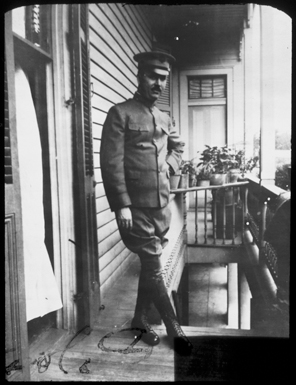
The call came in the summer of 1918. when the unit, formally known as Base Hospital 102, was organized and readied to go to Vicenza, Italy. The chief surgeon, Dr. Joseph Danna, was Dean of the Medical School at Loyola University in New Orleans; he had worked with the Daughters at both Charity Hospital and Hotel Dieu Hospital. Because of his ties with Loyola University, Base Hospital 102 was also known as the Loyola Unit.

Dr. Joseph A. Danna, Dean of the Medical School at Loyola University, New Orleans and chief surgeon for Base Hospital 102

Dr. Joseph A. Danna, Dean of the Medical School at Loyola University, New Orleans and chief surgeon for Base Hospital 102

Sisters and Nurses
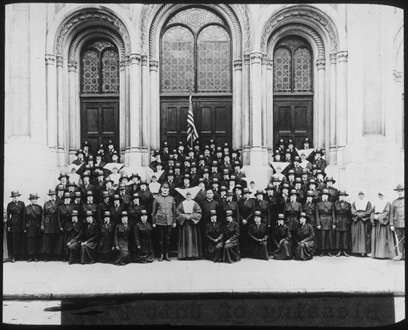
Ten Sisters were chosen for the Loyola Unit: Sisters Valeria Dorn, Agatha Muldoon, DeSales Loftus, Mary David Ingram, Angela Drendel, Lucia Dolan, Marianna Flynn, Florence Means, Catherine Coleman, and Chrysostum Moynahan. They came from hospitals in Alabama, Louisiana, Texas, Indiana, and Missouri. They were led by Sister Chrysostum Moynahan, Chief Nurse, who brought a wealth of experience to her role, including hospital administration and service during the Spanish-American War. The Sisters supervised a staff of 90 lay nurses recruited from Daughter of Charity hospitals throughout the country. Many had graduated from Daughter of Charity nursing schools.

Daughters of Charity who served in Italy during World War I.

Daughters of Charity who served in Italy during World War I.

Sister Chrysostum Moynahan and nurses from St. Vincent Hospital, Birmingham

Sister Chrysostum Moynahan and nurses from St. Vincent Hospital, Birmingham

Sisters and nurses of the Loyola Unit

Sisters and nurses of the Loyola Unit


 Stories from the Front

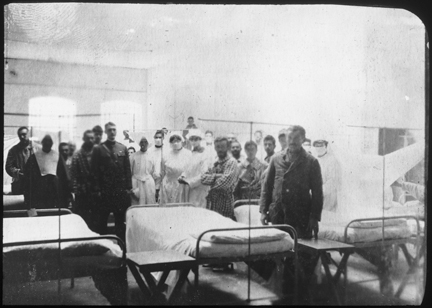
The hospital, located 15 miles from the Italian front, accepted patients beginning in late September 1918. Medical and surgical cases treated included burns from mustard gas, pneumonia, malaria, and influenza. The hospital treated approximately 3,000 patients; only 28 died.

Base Hospital 102 - one of the wards

Base Hospital 102 – one of the wards

ww1-firing-line ww1-italian-church-bombed-austrians


Diaries kept by three of the Sisters give a day-by-day account of their experiences.

Oct. 6 —There is heavy firing going on at this Front at the present time; the booming of the cannons can be heard here with not more than one or two minutes’ intermission. Shortly after the firing of the rifles over the grave, four aeroplanes appeared over us to investigate the noise. We were all glad to get so near the Front. Saw many fields prepared for a Retreat – with back trenches and barbed wire fences.

Oct. 17 – We have now about 400 patients in the hospital, nearly all sick with the Spanish Influenza. Many civilians in the city are reported dying with it.
—Sister Angela Drendel

Oct. 18 – We have syrup for breakfast on oatmeal. Not because it is the first meal served, but because the limit has been reached. Everybody is very hungry. Unable to get food and the supply is very low. Everybody agrees with President Wilson: No not at their terms even though we are hungry and cold.
–Sister Florence Means

Armistice Day, Post-War Travels, Coming Home
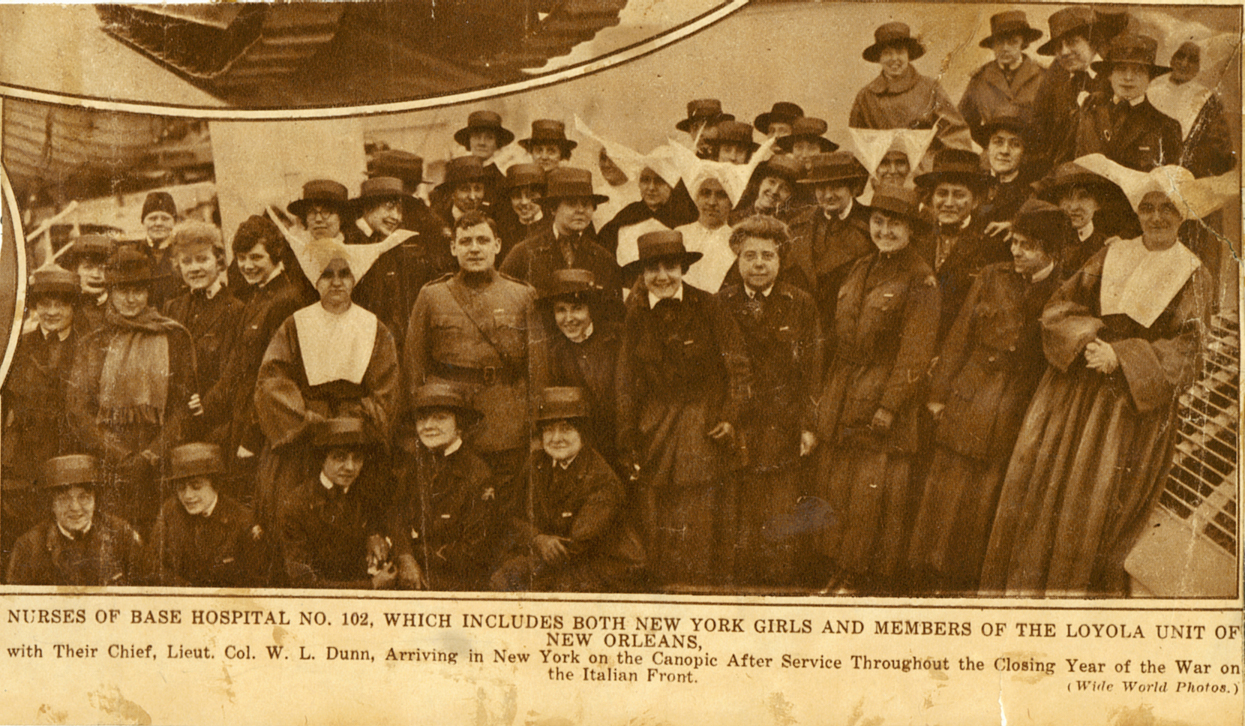
The signing of the armistice in November 1918 marked the end of the war but not the end of the Sisters’ service, as Base Hospital 102 was shut down gradually over the following months. After enduring a bitterly cold winter, the Sisters received furloughs which allowed them to travel throughout Italy and France. They saw many historic churches, had a private audience with Pope Benedict XV, and visited their Mother House in Paris. In March 1919 the Loyola Unit left Italy for America. After landing in New York, the  Sisters traveled to St. Joseph’s Central House in Emmitsburg, and from there to Marillac Seminary, their provincial house in St. Louis.

Daughters of Charity Mother House in Paris

Daughters of Charity Mother House in Paris

Pope Benedict XV, with whom the Sisters had a private audience.

Pope Benedict XV, with whom the Sisters had a private audience.

ww1-coming-home

Newsclipping showing the Sisters' arrival in New York in April of 1919.

Newsclipping showing the Sisters’ arrival in New York in April of 1919.

2 Comments

Filed under Benedict XV, Health Care, Ministries, World War 1