
By Nathaniel Bentz, Mt. St. Mary’s University Class of 2020, Archives Intern/Guest Contributor
My name is Nathaniel Bentz and I am a senior undergraduate student of Mount St. Mary’s University with a history major and English minor; this is my second semester interning at the Daughters of Charity Provincial Archives. During my first project of this Spring 2020 semester, I am processing and numerically labeling documents from Sisters during their service in World War One. I have come across a report about a daring battle and recovery from a German submarine attack. The document transcribes reports of crew members from the attacked oil tanker, known as the S.S. O.B. Jennings, mentioning the first signs of the attack, maneuvers and actions taken to escape the torpedoes and get the crew onto the life boats, interactions with the enemy after the surprise attack, and the events occurring after their rescue and safe return to ally territory.
The Sisters’ service was predominantly on the Italian front of the war. The creation of this report is interesting because—even though the report was typed around late August. The entire document is typed by the captain of the steamboat, S.S. Umbria, Capt. Thomas C. Myers M.R.C., which rescued the soldiers from the bombarded oil tanker. Following Capt. Myers’ transcribed reports of the S.S. O.B. Jennings crew members, he offers an extensive summary about the trip before and after they encountered and rescued those of the S.S. O.B. Jennings; the summary broke down the events day-by-day with some broken down into exact hours. The first crew member of the S.S. O.B. Jennings interviewed is Thomas McCarthy and his statement contains some interesting details about the attack itself, “The first thing [sic] noticed was a torpedo which passed 5 feet astern. A battle ensued continuing two and one half hours with submarine out of sight range 9 miles. Exchange fire, hit the Jennings 15 to 20 times, an explosive shell striking the engine room and causing surrender at 11:15 A.M.”.
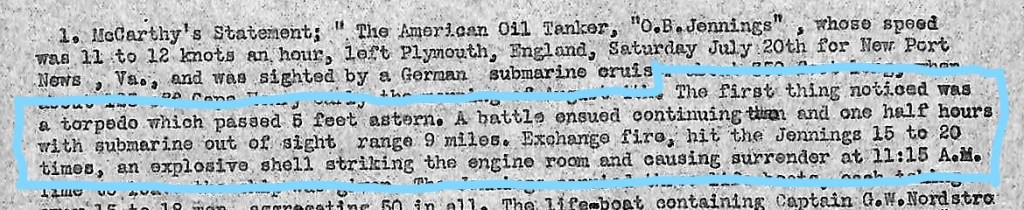
Such a siege made by the German submarine sounded impressive—but fortunately there was only one fatality.
The events that occurred next were suspenseful: the Captain of the defeated S.S. O.B. Jennings was able to narrowly escape capture by the German soldiers by disguising himself as a civilian. According to the report, “As the submarine came alongside the German officer asked for the Captain of the Jennings, but was told that he was dead, the Captain having donned civilian attire”.

This daring opportunity for escape did not seem like it would work too well, given that the crew of the S.S. O.B. Jennings was cornered in the sea by their armed enemy with only lifeboats as safety. McCarthy’s report concluded bittersweet; the German submarine decided to record the condition of the S.S. O.B. Jennings following up with more torpedo-firing as the crew of the S.S. O.B Jennings were being rescued by the S.S. Umbria.
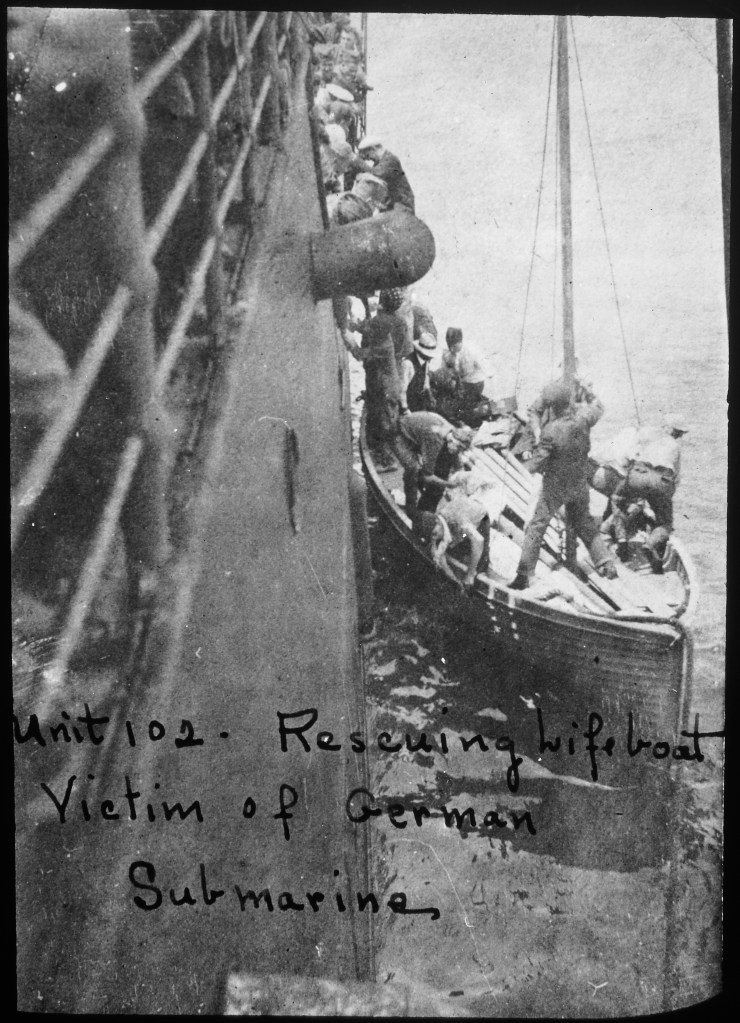
The next report was told by a soldier by the name of Fred Lebern, who offered a similar report in comparison to McCarthy’s, but with the addition of, “I, being in charge at the time, ordered the helm a starboard, which brought the vessel parallel to the course of the torpedo, causing to pass 5 feet astern”.

This extra detail is fascinating in knowing how close of a call the S.S. O.B Jennings was in at the beginning of the surprise attack by the German submarine. Lebern’s quick thinking was able to both alarm the S.S. O.B. Jennings of an attack while also alarming others to maneuverer the vessel just to the point of barely dodging the power of a torpedo. The other details before and after this command were the same as McCarthy’s report.
The final portion of this typewritten document is a report by a crew member of the S.S. Umbria (presumably by Capt. Myers himself). The detail is strong, covering main moments of the vessel’s whole trip from the state of New York to their destination in Italy. Near the very beginning of this report is the detail about discovering the stranded men of the S.S. O.B. Jennings, hearing their stories and examining their injuries before they were shipped back to the United States. What caught my attention was a small detail in this portion of the report, before the ship sailed it is reported that “Officers and Enlisted men of Unit 102 came from Gen. Hospital No. 2 Baltimore [along with] …the Nurses and Sisters of Charity”.

Even before they arrived in Italy, the nurses were witnessing war and seeing, firsthand, the power of their enemy. After this highlight, the rest of the report goes into detail about the drills they were running, which islands they saw, and which allied ships they sailed near. One of the more interesting details involves seeing allied ships, “we were told [it] was Spain and that we could soon enter the harbor of Gibraltar. It was indeed a beautiful sight. The harbor was filled with ships from all nations of the Allied and Neutral powers, ships of all kinds”.

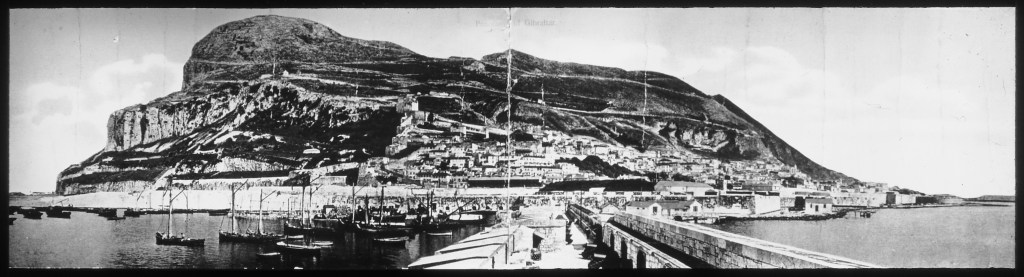
In the middle of day-to-day life in a Nurse Corps, full of rule changes and regulations, such a sight to describe helps in showcasing how different this document is in comparison to the rest of the invaluable documents of 1918: telegrams and letters regarding pertinent rule changes and enlistments. All documents of this collection are important because they allow researchers to recognize the routines and responsibilities of roles in World War One that most do not initially think of: the role of the nurse. Also, this collection highlights an important moment in world history, and given this, it emphasizes the dedication the Daughters of Charity has on their mission of caring for others in need no matter the setting.








 docarchivesblog.org