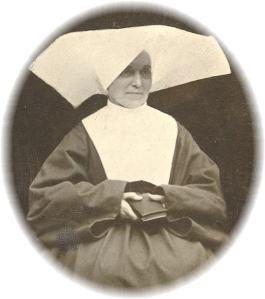
(Exerpt from Life of Mother Mariana Flynn and image of Mother Mariana Flynn used with permission of the Daughters of Charity Provincial Archives)
Mother Mariana Flynn was Visitarix (superior) of the US Province of the Daughters of Charity from 1887 to 1901. One of Mother Mariana’s first missions was at St. Joseph’s Asylum in Richmond, VA. She was serving in Richmond when the Civil War broke out and served there throughout the war. A biography of Mother Mariana written after her death provides details about the asylum and about Richmond at the start of the Civil War.
———————————————————————————————-
In 1861, our young Sister was transferred to St. Joseph’s Asylum, Richmond, Va.
This mission was established in response to a formal application made to Mother Rose White, of happy memory, by Father Timothy O’Brien, a holy and zealous priest: a man of superior administrative ability, tireless zeal, and ardent piety, to whom Catholicity in Richmond owes more than to any other individual. On the feast of St. Cecelia, November 22, 1834, three Sisters left St. Joseph’s to commence the Richmond mission – Sr. Margaret George being named Sister-Servant of the little band. It is a singular coincidence that this Sister was recalled to the Central-House 1837 to fill the office of Treasurer. Sr. Margaret never lost interest in the Virginia foundation; and as a member of the Council, warmly seconded any measures conducive to its welfare. Thus under the kind patronage of Father O’Brien, who proved himself true to his promise to Mother Rose, “that while he had anything , the Sisters should have the greater half,” this humble beginning slowly but steadily progressed, until we find ourselves at the sad and ever memorable epoch of the Civil War when our dear Mother is introduced to this favored mission …
Sr. Blanche Rooney, a woman of extraordinary business talent, and one well fitted to cope with the emergencies crowding upon the country in the shape of a Civil War, was the Sister-Servant at this time. Richmond became the Capital of the Confederacy, and all interest centered there, causing the works of the Asylum to be more prosperous than ever. The school was largely attended; public and sectarian schools had closed, but the boarding and day school of the Asylum enjoyed the most liberal patronage: Methodists, Baptists, all creeds, flocked to the Sisters’ school. The Asylum in addition to its accustomed work, became, during the war, a sort of Central-House or head-quarters, to the Sisters operating in the ambulances and moving with the army of Northern Virginia. At the first approach of suffering, consequent upon war, the devoted and generous Sister Blanche could hardly delay until the Sisters’ services should be solicited by the military authorities; she had already provided herself with the requisite permission from Superiors, and it was not long before the desired summons came. The surgeon of the General Hospital called at the Asylum and earnestly requested that the Sisters should take the direction of this hospital. Sr. Blanche gladly consented and the Sisters commenced their noble work July 26, 1861.




 docarchivesblog.org