
We pray for the repose of the soul of Sister Mary Patrick Collins, who died on May 11 at Seton Residence, in Evansville, IN; 91 years of age and 73 years of vocation. May she rest in peace!

Digitization brings document back to life

Mother Mathilde Inchelin letter to U.S. Sisters, March 15, 1924 – before
So what do you do when you find, as we recently did, two fragments from a document inserted into the pages of one your library books? In this case, the document was a letter sent by Mother Mathilde Inchelin, Superioress General of the Daughters of Charity from 1922 to 1928, to the Sisters in the United States, announcing her intention to visit the U.S. Above is the “before” – the two fragments as we found them. The page seen here is the first of 3 pages. Fortunately for us, the pieces fit well together. No text would be lost if we could bring the pieces together. However, because the paper had been folded many times as well as being torn in two, traditional paper repair was not possible. Careful scanning and Photoshop Elements allowed us to do what traditional paper repair could not – put the pieces of the letter back together so that the entire text could once again be read. The original pieces were scanned at 600 dpi and saved as uncompressed TIFF files. These are the archival masters. Once the two separate pieces were in place, a new file was created and Photoshop’s layering function was used to edit each piece independently, including moving the pieces into position so that the edges lined up. The “levels” controls were used to color balance the final image so that there was a good visual match with the original paper items. The digitally restored pages were also saved as TIFF files. Derivatives such as the files seen in this post are in JPEG format. The files seen here are 150 dpi JPEG.
Here is the “after” – the top and the bottom halves of page 1 digitally stitched together.
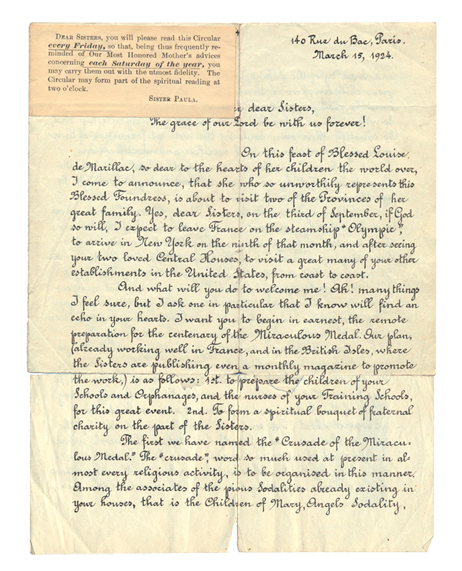
Mother Mathilde Inchelin letter to U.S. Sisters, March 15, 1924, p.1 – after
Restored page 2:
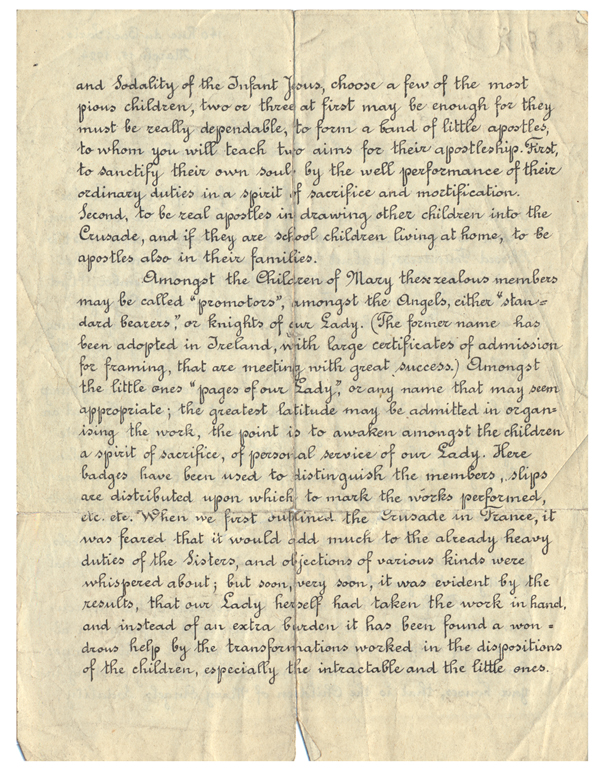
Mother Mathilde Inchelin letter to US Sisters, March 15, 1924, page 2 – after
Restored page 3:

Mother Mathilde Inchelin letter to U.S. Sisters, March 15, 1924, page 3 – after
Did we save the originals? Yes, we did.
And what about Mother Inchelin and the trip to the US? After we restored the letter we did some research into the trip itself and sadly, the planned trip was not made. Political circumstances in France, combined with bad health, forced her to cancel her journey and she never made it to the U.S. Mother Inchelin died in 1928. Mother Inchelin’s successor, Mother Marie Lebrun, was the first Superioress General to make the trip from France to the United States, in 1929.
Share this:

Filed under Digitized Collections, Preservation
New resources added to Bibliography page
Links to some new resources have been added to the “Bibliography” page.
All Things Vincentian
Research portal bringing together digital Vincentian source material, journal articles, image collections, archives, exhibits and online conversation.
Charpy, Elisabeth D.C. (2010) “A Challenge to Napoleon: The Defiance of the Daughters of Charity,” Vincentian Heritage Journal: Vol. 30: Iss. 2, Article 3.
Metz, Judith S.C. (1999) “By What Authority? The Founding of the Sisters of Charity of Cincinnati,” Vincentian Heritage Journal: Vol.
20: Iss. 1, Article 4.
Poole, Marie D.C. (1999) “Vincent In Translation,” Vincentian Heritage Journal: Vol. 20: Iss. 2, Article 1.
Vincent dePaul Image Archive
Vincentian History Research Network
An online forum designed for researchers and scholars on Vincentian topics broadly considered. This is a place to learn about Vincentian resources, share current research projects, ask questions about possible archival and bibliographic resources, announce publications or participation in conferences, and seek grant funding. Members of the VHRN can share in other ways that will support a community of “Vincentian” scholars.
Share this:
Filed under Announcements, Guides

