(Account of Chicago Fire used with permission of Daughters of Charity Provincial Archives)
October 8-10, 1871 witnessed one of the defining events in the history of the city of Chicago, the Great Fire of 1871. The Daughters of Charity were ministering in Chicago at the time, and one of the Sisters’ ministries, School of the Holy Name, was destroyed in the fire. Below are first-hand accounts of the fire, taken from the records of Holy Name School and a history of DC ministries in Chicago written by Sister Bernice Brennan.
—————————————————————————————
Saturday October 7, 1871
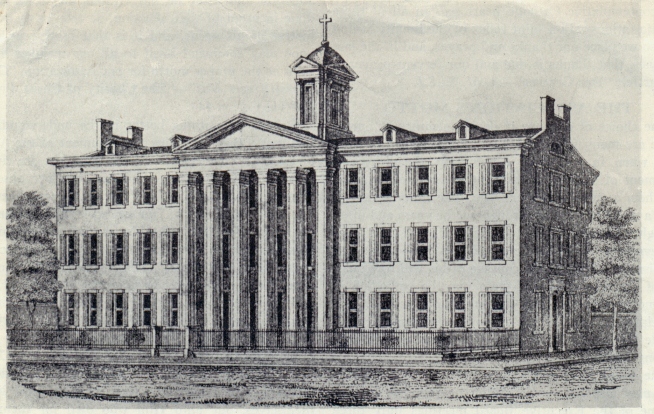
On the evening of this day commended the terrible fire which devastated and crumbled into ashes the city of Chicago. Some accounts of what then transpired will here be given which were written by Sisters who passed through the frightful ordeal. Two of our houses were consumed by the flames; The School of the Holy Name, of which Sister Mary McCarty was Sister Servant and the House of Providence, Sister Angeline Carrigan, Sister Servant.
Chicago, Illinois
The grace of our Lord be with us forever!
How shall I correspond with your wishes and send an account of that dreadful fire which desolated our city! No descriptions can give a true idea of the rapidity with which it passed from block to block; the whirling, about of the blazing wood by an irresistible wind; the crowd hurrying along, they hardly knew whither, only to be out of the reach of the hungry flames, in some reason being dethroned by the appalling catastrophe; all this and much more would have to be seen, to be realized!
The fire had raged about twenty four hours, and though kept somewhat under control, yet refusing to be extinguished when the water works took fire and the defenceless [sic] city was at the mercy of the element. You have heard of that early Communion, which to some of us, at least, seemed almost like a viaticum, so little hope was there that anything could survive; then how our dear Sister Mary, having sent all but on companion as far as possible from the danger, refused to leave the house until it was actually on fire; and how she finally followed, bearing the precious ciborium containing the Blessed Sacrament confided to her by our worthy pastor, he fearing to take it into danger to which he was obliged to expose himself; and lastly, the anxiety caused by some not being assured of the safety of others, until at last, all were reunited at St. Patrick’s School.
There we were found by our dear Mother Euphemia [Mother Euphemia Blenkinsop, Provincial Superior in 1871] who saw something of the necessity for the relief so generously extended by other cities, and saw too how those who knew the Sisters flocked to them to pour into the deeply sympathetic heart of our dear Sister Mary their state of suffering, those who, a few days before, had been independent and those always poor, alike in need of shelter, food and raiment. Truly, it is rare to meet one “who wept with those that weep”, as she did! How it gratified her when she could relieve the distressed! and on the other hand, how she suffered when powerless to give the needed succor!
Though out of the district in which the fire prevailed, the Sisters at the Hospital, alarmed by the reports that the fire was tending that way, removed to the woods such of their sick as could bear removal, Sister Walburga herself remaining with the others, resolving to dies with them, if she could not save them. Late in the evening of the second day, rain commenced and the fire ceased, after laying waste over three square miles of the city, and making nearly 100,000 people homeless.
The number of lives lost has never been truly estimated; some have missed friends ever since that fearful night; many, it is supposed, were smothered in their beds, having no warning of their peril, and many others striving to avoid it, ran into danger and perished. Some rushed to the shipping in the Lake, but even the vessels took fire; others board the out going trains, and left their families in agonizing grief, before tidings could be brought of them.
How then did we all escape? God only knows. May we even prove worthy children of that Blessed Father who so strongly inculcated both by his words and example a steady trust in Divine Providence; and by our unbounded confidence in the same, may we every where rejoice in Its protection.
SCHOOL OF THE HOLY NAME
“The Chicago Fire” commenced on the evening of Saturday, October 7, in a barn belonging to a woman named Mrs. O’Leary. It has been said that the cow while being milked upset a kerosene lamp, hence Mrs. O’Leary’s cow was considered the originator of the “Chicago Fire”. Those however who witnessed it could regard it only as a punishment sent in mercy to a guilty city.
No human agency could produce such a fire. Saturday night and Sunday, through the exertions of the firemen, it was kept under control pretty well. Sunday night, a terrific wind blew up, then the fire baffled all efforts to extinguish it. During Sunday, the Sister in charge of our dormitory broke a pane of glass in the window near by bed; the wind blowing upon this made such an unearthly noise, that it woke me up, then the dormitory was all lit up from the reflection of the fire still miles away. I got up and woke the other Sisters in the dormitory; it must then have been about 10 o’clock. We went up in the belfry to watch the fire; the flames seemed to jump from house to house with the rapidity almost of lightning, the sparks were as thick as snow flakes in a storm. While the wind carried them eastward to Lake Michigan, we felt safe, but as we stood watching, the wind changed and blew towards us, and so strong was it that the burning shingles and large pieces of burning wood carried the fire in every direction.
About three o’clock A.M. on Monday, we went to bed to get a little rest before four o’clock bell rand. We were scarcely in bed, before one of the girls in the house came in terror, to say that the water works near us were on fire; then, and only then, we felt our danger. We had so much confidence in our Lord and our Blessed Mother that we did not think the fire would reach us. One of the Sisters took a bottle of holy water up to sprinkle the roof, and hung up a new picture of our Lady of Perpetual Succor in the chapel for protection. Sister had scarcely come off the roof when part of the belfry was blown in. The door bell rang and our Sister Servant, dear Sister Mary McCarthy answered it. Father Flanigan, one of the assistant priests, at the Cathedral, came to take the Blessed Sacrament and to tell us that we must leave the house, at once. Sister asked him if it was as bas as that; he said yes, that there was very great danger. It was the feast of St. Dionysius. Sister asked him to give us Holy Communion and consume the Blessed Sacrament, which he did. During the time we were at the altar railing, the house shook and the stations on the wall rattled so that it was really terrifying. We made a few minutes thanksgiving and Father purified the Ciborium, as carefully, as ever he did, and then we prepared to take leave of our happy mission. Father often expressed regret that he did not take the little tabernacle key. Each one went to get ready. One Sister put on three habit skirts and two cloth aprons, she tried two chemisettes, but was not so successful. With the conferences in her arms and a heavy shawl worn for the first time, over her cornette and held on by her teeth, she was ready to depart.
We found Dr. McMullen, our pastor, subsequently, Bishop of Davenport, at the front door, with a buggy and two men to take two Sisters, both in delicate health at the time. It was the only vehicle he could procure, the two men volunteered to be the horses. After being dragged a little way in this novel way of travel, the Sisters began to think it was too much to expect of the poor men and begged them to let them get out and walk. Seeing a man coming with a dray, the men asked him to take the Sisters to one of our houses in another part of the city but out of the direction of the fire. He refused saying that he had to get a load of furniture in the burning district. After going a little distance, he repented and coming back took the Sisters to St. Columba’s School, where they were gladly welcomed by the Sisters. A second band accompanied Father Flanigan, to St. Joseph’s Hospital, a distance of about two miles. Father and a Sister walked first, he having the Blessed Sacrament from the Cathedral. The Sisters walked two and two after them saying the beads. After we had left, Sister Mary asked Dr. McMullen if he had been to the House of Providence, for the Blessed Sacrament. He had forgotten all about it, but right away then leaving with Sister Mary the Blessed Sacrament from the Orphan Asylum from which he had just seen the Sisters and orphans safely out. Dear Sister Mary, thinking he would return for the Ciborium, waited until the belfry came tumbling down the stairs. Then, she and another Sister started for St. Joseph’s Hospital and had the happiness of depositing our dear Lord in a place of safety.
Sister Angeline, Sister Servant of the House of Providence, had placed any articles that could be so carried in trunks. A neighbor took them with his own on his wagon, to a place then supposed to be out of the reach of the fire, but all were burned. Sister Angeline herself had been carried by the wind and flames towards the Lake, when an unknown man drew her out of the flames. She received a slight burn on the face and one hand. The procession of Sisters to the Hospital passed the Sisters of St. Joseph with their orphans.
All along the streets were those who had left their houses early in the evening and were too fatigued or too discouraged to go further. The people came out of their houses as we passed crying, “Oh! there are the poor Sisters! So the College burned? O God help us! Ah Sisters, is the Church burned? O Glory by to God! the world is coming to an end”. One of our children seeing Father Flanigan cried out “O Father Flanigan, is it the day of judgment”? He told her he thought it was a night of judgment for Chicago. Some of the Sisters were obliged to sit down on the road side, not being able to keep up with the procession. (not the one with the three habit skirts).
After reaching the Hospital and putting the Blessed Sacrament away, we asked Sister Walburga, Sister Servant, to give us her carriage and we would go back for Sister Mary and companions and perhaps save something. As soon as it was ready and Father had a cup of coffee, Sister Anastasia and myself, accompanies by Father started for the Holy Name School, when within two blocks of it we could only see the place where it stood, the Cathedral too was gone. The Orphan Asylum, on the opposite side of the street, was a massive stone building, the flames were going through it, as if it were so much paper. Not meeting the Sisters we though they must have been burned, for it was reported that two Sisters were seen in the house when it was on fire. We started to St. Columba’s School, hoping they had gone there, but we were disappointed, then not them there, we were inconsolable. Back to the Hospital we steered our course where our dear Sisters had arrived safely by another road just after we had left.
Then Sister Mary’s anxiety for us was terrible, she imagined a hundred things that might happen to us. About noon, we returned in safety to the Hospital every one pronounced me sick and I had to go to bed. The Hospital, and every spot belonging to it, was filled with furniture and people coming there out of the reach of the fire, and every arrival told a nearer approach of the fire. The last comer said there was only one bridge left and those who wanted to go to the west side ought to start, so we prepared to go to St. Columba’s School.
This time our route was across the prairies. None of us knew the way, so we followed the crowd. “The one bridge left” was so crowded that we were obliged to walk under the horses’ heads. When we had gone about half the distance, worn out by fatigue, dust, heat and smoke, a poor Irishman named Pat O’Brien came towards us with an express wagon. He hailed us with “Oh! Sisters, where are you going”? Aren’t ye from the College! Having told him where we wanted to go, he begged us to get into his wagon, which we did most willingly and rode in state. I sat on the driver’s seat between Pat and a half grown boy. Every minute, the poor man would jump down to look at his wheel, which he though would come off, and I was in mortal terror that I would be thrown from my exalted position. The poor man lost that day all that he had earned in eighteen years; but, “sure he had the best load now that ever he carried! (Eight sisters and six girls all carrying bundles.)
As we went along, we passed several Sisters of other Communities sitting in the road side. We reached St. Columba’s about half past five, p.m. there we found the Sisters of St. Joseph and their orphans, and the Sisters of the Good Shepherd and their children. About six o’clock, the Jesuit Fathers came and took the Sisters and children to their Schools.
The fire was still making progress north, and our Sisters of the Hospital had to move their sick to the woods; the fire came so near, that even there they were obliged to move again. They had at the time, several patients that not be moved, and who would certainly have been burned, had the fire gone so far. Sister Walburga, Sister Servant, sent the Sisters away further, to a place of safety, but she could not be prevailed upon to leave her poor sick, saying that if they died she would die with them. Our Lord did not require that sacrifice, for towards midnight rain began and checked the progress of the fire; then all returned to the Hospital. The new Hospital in course of erection was also spared. All through the night, good Father Burke, pastor of St. Columba’s kept us informed of the progress of the fire. At one time the wind changed and the though it would come west. We did not feel safe until Father came in and told us that we might sleep now and not be afraid, as it was raining and the fire would go out, which it did after burning three and a half square miles of the city and rendering 95,000 persons homeless. Tuesday morning, the Sisters of the Holy Name School went to St. Patrick’s School which had been opened a few weeks before. The people of the burned district on the north side of the city, flocked to us for help.
Sister Mary McCarty through Mr. Kinsella applied to the Relief Fund and obtained abundant supplies of provisions and clothing for hundreds, every day. The School house was turned into a sort of hotel and for about two weeks several hundred were fed and obtained relief.
The Governor of Ohio called on Sister Mary to learn from her what the people wanted most; and on his return home, all of Ohio’s donations came to us, so that we had the pleasure of helping a large number of destitute, some of whom were in affluence a few days before. Our dear Mother Euphemia, then in St. Louis on her way home from California hearing of the distress and sufferings of the City, hastened to our relief bringing with her cooked food of every description, fearing that her poor children were in want of everything; but not so; through Divine Providence and the kindness of our gentlemen friends, we had an abundance. What we suffered most for was clothing for ourselves, and this soon came too, our dear Sisters in Milwaukee, St. Louis and neighboring cities having hastened to our relief.
Our greatest consolation was in having with us our dear Mother who worked with as much zeal as the youngest in assorting and preparing clothing for our poor and by her presence helped to keep us up under so trying an ordeal. The city was in so much confusion that we had a guard of soldiers to keep order round our house. Several attempts had been made to set this part of the city on fire, even in our own house. We had straw on one floor of the school house for a sleeping apartment and among the straw scattered on the stairs was about a box full of matches, but providentially they were discovered in time to prevent another fire. The city put up temporary buildings or “Shanties” for the people and in about two weeks, our school was resumed. Many of our old pupils walked over here during that severe winter. They used to say if the Church and Sisters were only spared to them, they could bear it better. One of the Children of Mary left her home and went to the Church fore safety and was burned there.
After our dear Mother went home, she sent us a supply of everything. When the box came, it was so large that one of the young Sisters got into it to empty it; there were not many dry eyes as one package after another was handed out, and we thought we were indeed “the spoiled children of a good God.”
After order was restored, an officer from the Relief Fund called on Sister Mary to pay the Sisters for their Services, but Sister refused that the Sister’s Services were for God and they looked to him for their reward.



 docarchivesblog.org