In recent days, the Daughters of Charity have ended their missions in Brooklyn and in Buffalo. The stories below are taken from the Province of St. Louise website and from FAMVIN.
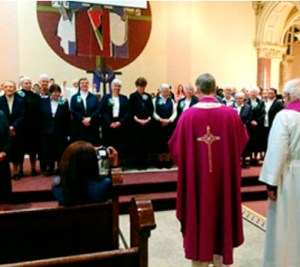
Father Emmet Nolan, C.M., blesses some of the Daughters of Charity who have served at St. John the Baptist parish in Bedford-Stuyvesant (courtesy Daughters of Charity Province of St. Louise, St. Louis, MO)
Brooklyn
News release, Daughters of Charity Province of St. Louise, June 4, 2014
The Daughters of Charity have been a staple in Brooklyn for over 40 years, but a call to serve elsewhere has them packing their bags to leave.
The traces of the Daughters’ work will still be present, as they’ve left an indelible mark on the borough of Kings, especially the Bedford-Stuyvesant community. Though they’ll be leaving Kings County, they will remain in the diocese in several locations in Queens: their residence and a nursing home in Bayside; Our Lady of the Blessed Sacrament Church, Bayside; and St. John’s University, Jamaica.
“The Daughters of Charity as a community are called to be mobile and available to go where the needs are,” said Sister Mary Beth Kubera, D.C., provincial councillor on the provincial leadership team for the Province of St. Louise, which stretches from Texas to the East Coast, including the location in Brooklyn.
“That’s been the case since the Daughters of Charity were founded in 1633, and we would like to continue to have our Sisters be mobile and available to go where they are needed and where they’re sent. We believe we are still sent to be missionaries wherever God wants us.”
Brooklyn Beginnings
Known as the Sisters of Charity of St. Joseph’s, the Daughters of Charity first arrived in Brooklyn in 1831 from Emmitsburg, Md., with the main purpose of teaching children at St. James Asylum and Free School.
Other ministries included serving at Cathedral Free School, St. Mary’s Institute, the Roman Catholic Orphan Asylum Society, St. Paul’s Asylum, St. Paul’s Industrial School, St. Philomena’s Academy and St. Joseph’s Asylum.
After establishing a strong presence, the Daughters left Brooklyn, but in 1971, they were called to return to Bedford-Stuyvesant, one of the poorest areas of the borough at that time. Five members of the Community–Sisters Beatrice Peck, D.C.; Mary Bernadette Szymczak, D.C.; Mary Josephine Hill, D.C.; Mary White, D.C.; and Mary Rose McGready, D.C.–were stationed at St. John the Baptist parish with the Vincentian priests who had served there for over 100 years.
At the parish, the Daughters served as catechists, ran the faith formation program, coordinated summer camps and donated whatever funds they had to the parish and parishioners.
In addition to these roles, they were active in Catholic Charities of Brooklyn; St. Anthony-St. Alphonsus parish, Greenpoint; the New Horizons adult education program; Holy Rosary School, Bedford-Stuyvesant; and New Beginnings Charter School, Bedford-Stuyvesant.
The Daughters were also instrumental in starting the St. John’s Bread and Life food pantry in 1982 at the parish. Despite its humble beginnings, the pantry now serves over 2,000 people per day and grew so large it was forced to upgrade to a more adequate space, now on Lexington Avenue in Bedford-Stuyvesant.
Over the years, many Sisters have served at St. John’s Church, currently a combined parish with Our Lady of Good Counsel. The last five Sisters to have lived there–Mary Ellen Thomas, D.C.; Maria Capobianco, D.C.; Kathleen Cevette, D.C.; Rose Marie Rizzo, D.C.; and Mary Ellen Lacy, D.C.–will all begin new ministries elsewhere this summer.
With the help of the Daughters, the Bedford-Stuyvesant neighborhood has undergone drastic changes. In addition to the thriving food pantry, the area has seen the development of many outreach programs that have aided in improving the quality of life.
“That’s why we came,” said Sister Mary Ellen, local superior of the Province of St. Louise who lived and ministered at the parish for the past 14 years.
“We were commissioned to reach out to the poor, the sick and the abandoned. There’s still a need, but it’s being addressed by our parishioners.”
Farewell Mass
On March 15, the parish hosted a farewell Mass for the Daughters, where the priests and parishioners had the chance to properly thank the Sisters for their years of dedicated service.
Father Emmett Nolan, C.M., pastor, celebrated the liturgy and said it was very emotional, since the parish would be losing a presence to which it had grown accustomed for so many years. However, he said the Mass was a celebration to show the parish’s great love for the Daughters of Charity.
Sister Mary Ellen said the Mass also allowed the Daughters to show their gratitude to the people they served during their time in Brooklyn.
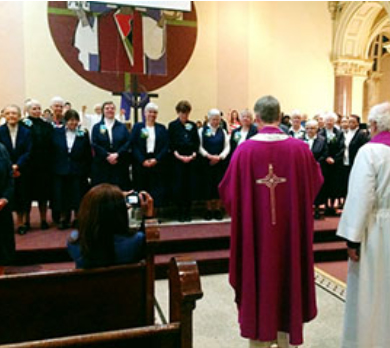
The parishioners prepared a video commemorating the service of the Daughters over the years. About 20 Daughters who had served at the parish returned for the Mass and received a special blessing from Father Nolan as they continued to live out the mission established by St. Vincent de Paul.
Brooklyn Legacy
Though the Sisters may no longer by physically present at the parish, the outreach work they began will continue under the direction of the parishioners, who were inspired by the Community’s work.
“The people said they were graced (by having the Daughters), but we were graced by the people,” said Sister Mary Ellen, who will soon move to St. Charles Lwanga Church in Downtown Detroit.
“It was a legacy of God’s presence, both in the parish and in the service that was part of the parish center for so many years.”
Sister Mary Beth said she hopes the Daughters always leave a legacy of love–no matter where they serve–in ministering with mercy and compassion.
“I hope we’ve left with them the idea, the value and the conviction that it’s really important to reach out to those who are on the margins of society, the most poor and vulnerable in our society,” she said.
“I think that’s what we leave behind. I’m very confident the people we have touched understand that, and hopefully they will pass it on.”
As for Father Nolan, he said he will miss the Sisters, whom he called the parish’s “Mothers,” but he’s eternally grateful for the impact they’ve had on the parish community.
“Simple, humble charity. That’s what it is,” he said. “They (Daughters) serve simply, humbly and they do unbelievable things. The Daughters are just the best.
“You almost never know they’re there, but they do incredible things and you hardly notice it because that is their charism. Simple, humble service.”
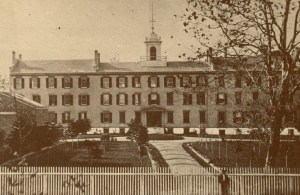
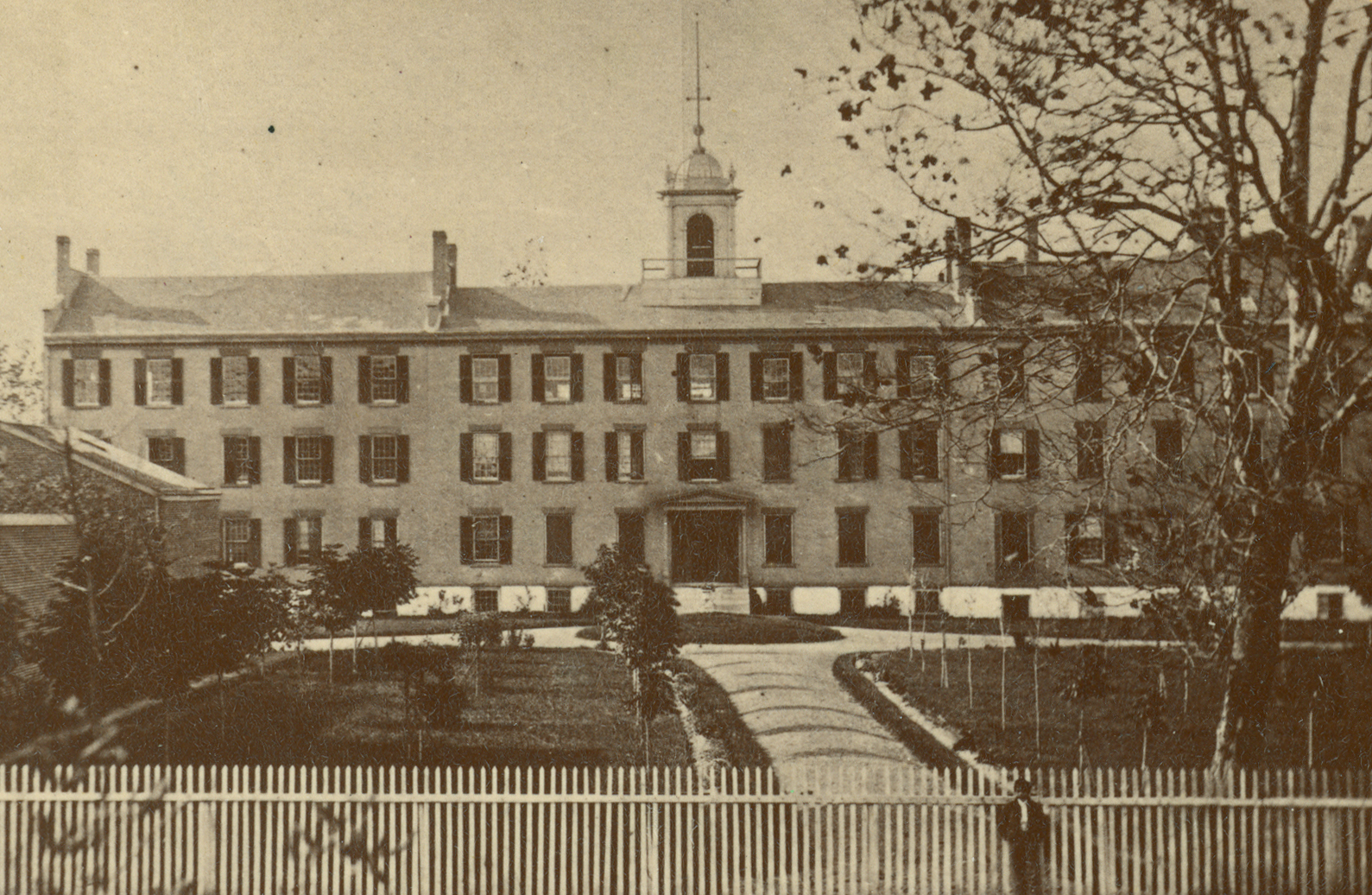
Buffalo Hospital of the Sisters of Charity, 1870 (used with permission of the Daughters of Charity Provincial Archives)
Buffalo’s tribute to Daughters of Charity
Vincentian Family News, June 8, 2014
Sister Mary Grace Higgins needed the cuddle this time around more than the newborn did.
After a few squirms, little Jackson Price – just 5 days old and a tad over 5 pounds – settled into Higgins’ arms and began to nod off.
A “cuddler” in the neonatal intensive care unit of Sisters of Charity Hospital on Main Street, the 86-year-old Higgins has comforted hundreds of newborns in need of a gentle hug when their mothers can’t be around.
But as Higgins and the hospital’s last few nuns on staff prepared for an emotional departure from the hospital, it seemed to be Jackson providing much of the comfort.
After 166 years, the sisters who started Sisters are walking away.
So begins a front page tribute in Buffalo’s premier newspaper The Buffalo News. The story continues…
Higgins is part of an order of Catholic nuns called the Daughters of Charity, which founded Buffalo’s oldest hospital in 1848 and provided health care to tens of thousands of area residents over the years.
Later this week, the Daughters of Charity, based in St. Louis, will begin sending Higgins and four other women religious who live and work at Sisters on to other ministries elsewhere. Bishop Richard Malone will celebrate a Mass this morning in St. Louis Catholic Church to commemorate the order’s lengthy tenure at Sisters Hospital.
Long after many orders of women religious removed themselves almost entirely from hospital work, the Daughters of Charity continued to provide at least a handful of sisters for its namesake hospital. (The Daughters of Charity were known previously as the Sisters of Charity.)
The upcoming departure is mostly symbolic at this point. Nuns haven’t worked in significant numbers in area Catholic hospitals for decades, and even the five women at Sisters, due to their age, served in recent years mostly in a part-time capacity. A sister hasn’t been president of Sisters since 1992.
Nonetheless, the withdrawal again highlights how rare nuns have become in a field where they once were omnipresent.
Just a smattering of women religious from various congregations will now be left doing local hospital work, as chaplains, nurses or volunteers.
It’s a far cry from when dozens of sisters roamed the corridors of Sisters, Mercy Hospital and other Catholic facilities as nurses, supervisors, pharmacists and in other roles.
“There was a time when every floor of the hospital had a sister as a charge nurse, for all three shifts,” said Sister Mary Anne Brawley, who after spending two years at Sisters will move to a hospital in Binghamton in July.
At the request of Bishop John Timon (a Vincentian), Buffalo’s first prelate, eight Sisters of Charity established Sisters of Charity Hospital on Pearl Place. They admitted their first patients, a group of six sailors, on Oct. 1, 1848.
More than 850 Daughters of Charity have served in Buffalo since then.
The lengthy tradition of service at Sisters made the decision to retreat difficult. But, as with most orders of women religious, the Daughters of Charity has seen a precipitous decline in numbers.
Nationwide, the number of Catholic nuns has fallen from 179,954 in 1965 to 51,247 last year, according to statistics from the CARA Research Center at Georgetown University. In the Buffalo Diocese, the number of sisters dropped from 3,520 in 1965 to 819 last year.
Stunning news
The Daughters of Charity, which founded or sponsored about 200 hospitals across the country over the past 191 years, determined last fall that it needed to pull out of several hospitals, including Sisters. Hospitals in Birmingham, Ala., Bridgeport, Conn., Nashville, Tenn., and Indianapolis also will be affected.
“It was stunning news,” admitted Peter U. Bergmann, president and chief executive officer of Sisters.
The Rev. Richard E. Zajac, longtime chaplain at Sisters, was equally astonished.
“They’ve been almost like family to me,” said Zajac, who was frequently invited to holiday dinners with the sisters in their residence on the fifth floor of the hospital. “It’s going to be tough to say goodbye.”
Bergmann said he doesn’t think the departure of the sisters will alter how the hospital provides care or treats patients.
The Daughters of Charity also will continue to be a sponsor of the hospital and have a presence on the Catholic Health system board of directors.
“We will still be led as a Catholic institution, as a Daughter of Charity hospital,” Bergmann said.
The Daughters created a wonderful legacy at Sisters Hospital that will be in good hands with lay people, said Sister Janet Keim, provincial councilor for the Daughters of Charity Province of St. Louise.
“It is a legacy that I think will continue and I think our spirit will be there,” she said.
The Daughters, she added, needed to bolster some other ministries. They also want to establish new ministries in places with “more materially poor people and where needs aren’t being met,” she said.
The Daughters of Charity will continue to maintain a presence in the Diocese of Buffalo, with five sisters living in Niagara Falls and serving in ministries there.
“Buffalo has a lot of women religious, and that figured in the mix,” Brawley said. “We’re supposed to go those most in need.”
Difficult to leave
Of course, the ideals of St. Louise de Marillac and St. Vincent de Paul, the two founders of the order, haven’t made the transition at Sisters any easier for the women who are leaving.
During her visit to the neonatal intensive care unit, Higgins took the opportunity to cuddle one more baby, even though Jackson wasn’t fussing and his mom, Cara George, of Strykersville, was in the room with him.
“I was on call. When they need you, they need you,” Higgins said about her work as a cuddler. “It’s very satisfying. They get to know my voice.”
Higgins will move to Albany later this week with Sister Ann Paul Chenard. Joining them will be Sister Sue O’Neill, who set up the hospital’s innovative massage therapy program about 12 years ago.
“When I started, it was just myself, and it was with a lot of resistance,” said O’Neill, 67, who will start a massage therapy program in Albany. “Now, it’s huge. It’s a whole wing of the hospital.”
Even at age 86, Higgins clearly knows how to handle babies. Jackson slept soundly for nearly 30 minutes in her arms, prompting George to joke: “Can I take you home with me?”
None of it was a surprise to Maria Koniarczyk, charge nurse in the neonatal intensive care unit, who said the babies benefit from as much cuddling as they can get. A nun from another order, the Franciscan sisters, also shows up regularly to cuddle infants.
“I have to tell you, the babies love their sisters,” Koniarczyk said.
Offering comfort
Chenard worked the other end of the life spectrum at Sisters, but like Higgins, she responded at just about any hour to the needs of staff and patients in the hospital’s long-term care facility.
While Higgins cuddled Jackson, Chenard, 85, was on a separate floor of the hospital, sharing memories and saying her goodbyes. Chenard provided spiritual care for 14 years in the nursing home, often sitting with dying patients as they took their last breaths.
“I don’t think anyone should die alone,” said Chenard, who plans to do similar ministry among aging sisters in the Daughters of Charity residence in Albany.
“She’s been our rock; she’s been our comfort,” said Debra Berdych, a licensed practical nurse.
Carolyn Adams, unit secretary, remembered Chenard’s caring concern for her mother, Martha Parker, who died seven years ago.
“You sat with my mother,” said Adams. “I’ll never forget it.”





 docarchivesblog.org