Category Archives: Louise de Marillac

Beatification of Louise de Marillac – DC pilgrimmage to Rome, May 1920 (part 2)

Louise de Marillac

Louise de Marillac, 1591-1660 (Image courtesy of Vincent de Paul Image Archive, DePaul University)

This is the second in our series of posts on the beatification of Louise de Marillac. The account, written by Sister Margaret O’Keefe and taken from the Provincial Annals, is used with permission of the Daughters of Charity Provincial Archives.

May 8. Saturday. Via Appia. Went to the Church Domine quo vadis! It is outside Rome on the way to the Coliseum, and on the spot where St. Peter met our Lord and asked him whither He was going. A large marble statue of our Lord with the cross, stands passing the door.

Saturday P. M. Most wonderful visit of all the Catacombs! The Trappists have charge, the monk who was our guide had been a patient in our Sisters’ Hospital, and took the trouble to show us everything. We had each a lighted taper, and as we went in single file thro those narrow passages lined with empty tombs, down in the bowels of the earth our souls were thrilled with various emotions – At St. Cecilia’s tomb there is a beautiful marble statue in the place where her boy lay, and near by an altar – nine Masses had been said there that morning. These were the Catacombs of St. Callixtus on the Appian Way.

Tomorrow our series will conclude with the account of Louise’s beatification ceremony.

1 Comment

Filed under Benedict XV, Church History, Louise de Marillac, Popes, Provincial Annals

Beatification of Louise de Marillac – DC pilgrimmage to Rome, May 1920 (part 1)

Louise de Marillac

Louise de Marillac, 1591-1660 (Image courtesy of Vincent de Paul Image Archive, DePaul University)

(Account of Sister Margaret O’Keefe taken from the Provincial Annals. Used with permission of Daughters of Charity Provincial Archives)

On May 9, 1920, Louise de Marillac, co-founder of the Daughters of Charity, was declared Blessed by Pope Benedict XV . Today’s is the first of three posts with accounts of Sister Margaret O’Keefe, then Visitatrix of the Emmitsburg Province, who traveled to Rome for the beatification ceremony.

May 6. Thursday. Went to St. Paul’s without the Walls. It is quite a long ride and we saw some of the old walls of Rome and other interesting things. The Church is magnificent and beautiful beyond expression. The Chapel of the Crucifix where St. Ignatius and his first companions made their first Vows, and where our Lord from His Cross spoke to St. Bridget of Sweden as she prayed before the crucifix. The magnificent Confessio where the relics of St. Paul and his disciples, Timothy are kept. The porphyry pillars in the Church were the gift of Mehemet Ali Viceroy of Egypt.

May 7. Friday. St. Mary Major. Our Lady of the Snow. Majestic and most beautiful 36 white marble pillars taken from a temple of Juno the beautiful paneled ceiling is richly decorated with the first gold brought from South America. The relics of Saint Matthew. The Borghese Chapel has precious marbles and is one of the richest in Rome. Above the beautiful altar is the Madonna painted by St. Luke. Sistine Chapel – in the center beneath the altar is the Chapel of the Manger in which are preserved some boards taken from the Manger in which our Lord was laid.

San Pietro in Vincoli. The chains which bound St. Peter in Jerusalem were brought from the Holy Land by the Empress Eudoxia and presented to Leo I. they are kept in a beautiful shrine under the high altar. It is enclosed by railings and marble steps lead down. A priest happened to come out of the confessional, and seeing us came and explained the different parts. Before opening the Shrine he put on a surplice and lighted two candles on the altar – turned a crank, and the doors of bronze and gold opened in the centre and slid back, revealing a beautiful gold shrine in which were the heavy iron chains so arranged that you could see them plainly, we knelt before them deeply impressed. We procured from the sacristy small chains blessed, that had touched this most precious relic. It was well worth climbing the three long flights of stone steps leading up to this hill.

Leave a comment

Filed under Benedict XV, Church History, Louise de Marillac, Popes, Provincial Annals

Feast of Annunciation, Vow Day for Daughters of Charity

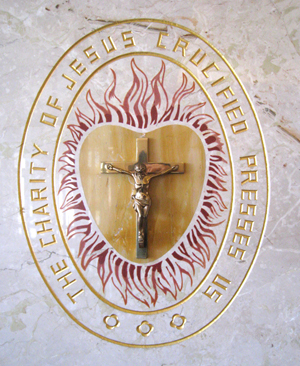
DC Community seal

Daughters of Charity Community Seal, seen in the entrance lobby of the Provincial Archives

(Text used with permission of Sister Mary Gilbart. Image used with permission of Daughters of Charity Provincial Archives)

On March 25th, feast of the Annunciation, over 17,000 Daughters of Charity in 91 countries all over the world will renew their vows.

This will not be simply a renewal of devotion,but, as their vows will have expired the night before, they will be free to choose to commit themselves to God by making them all over again.

Our vows differ from those of most religious in so far as they are annual, taken for one year at a time, and also we take a vow of service of persons who are poor as well as the usual vows of Chastity, Poverty and Obedience.

To understand these differences we must go back in history to the roots of our Company in 17th century France. At that time, there was great poverty, both in the cities and in the country areas which were ravaged by war and disease. St. Vincent de Paul felt urged to respond to the terrible needs he saw daily all around him. He had already organized some ladies into what became known as the Confraternities of Charity. In Paris many of the grand ladies were involved in ministering to the poor. This arrangement went well for a time, but then some ladies grew lax and sent their servants to replace them. This was not good enough for Vincent, and he and his collaborator, Louise de Marillac agonized seeking a solution. Divine Providence provided an answer. A good country girl, Marguerite Naseau, arrived in the capital and offered her services to help in caring for the sick.

Vincent was delighted, and soon other girls followed. At first they helped the Ladies in the parishes, and Louise kept in touch with them. The time came when she saw the need to gather them into a community for their protection and formation. After some initial reluctance Vincent agreed and in 1633 Louise took four girls into her house, and thus was born the Company of the Daughters of Charity.

Vincent and Louise wanted these girls to give their lives totally to God in order to serve Christ in the poor, but they avoided anything that would classify them as nuns. The reason for this was that, at that time religious women were cloistered, and this would prevent the girls being free to go into the hovels of the poor to care for the sick. For eight years there was no question of vows, though the girls lived a life of total dedication in imitation of Christ. Then Vincent tentatively mentioned the possibility to them, and a year later, on the feast of the Annunciation 1642, Louise and four others made perpetual vows of Chastity, Poverty and Service of the Poor. Vows were optional for many years. Louise, with her great devotion to Mary, chose this feast, and saw Mary as a model for her Daughters in her complete surrender to the call of God, and in dedicating her life completely to the person and mission of her Son. After 1660 it became standardized that all the Sisters made annual vows after five to seven years, and this practice has endured to the present day.

One might ask why continue this now, as many religious with perpetual vows are free to come and go. The answer is, I suppose that annual vows for the service of the poor has become part of our identity and is recognized by the Church. The Sisters look forward each year to the Feast of the Annunciation when they must choose to commit themselves all over again, and a great current of renewal sweeps through the entire Company, which is now established in 91 countries all over the world.

Leave a comment

Filed under Feast Days, Formation, Louise de Marillac, Vincent de Paul, Vows