
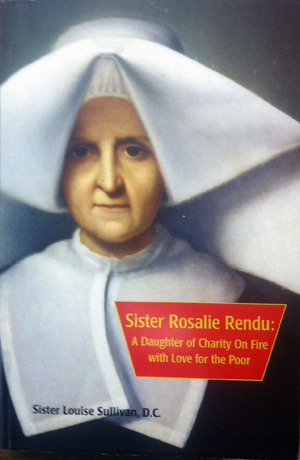
Sister Rosalie Rendu: A Daughter of Charity On Fire with Love for the Poor, by Sr. Louise Sullivan, available for research in the Provincial Archives.
by Sister Louise Sullivan, D.C.
February 7 is the feast day of Blessed Sister Rosalie Rendu. The text below is taken from chapters 1 and 2 of Sister Louise Sullivan, Sister Rosalie Rendu: A Daughter of Charity on Fire with Love for the Poor (Chicago: Vincentian Studies Institute, 2006). Additional text and illustrations can be found in this presentation from FAMVIN.
As with St. Vincent and St. Louise, or in studying the life of any saint, there is the danger of losing the person behind the actions, of being so dazzled by the magnitude of their achievements that the spiritual and human motor that drove them disappears. Such has often been the case with Sister Rosalie. Sister Rosalie, the woman, is far more and far less than the sum of her actions. If she has something to say to the men and women of today, it is precisely because of the person she became by the grace of God and by her response to that grace. Who was this simple country girl who became a symbol of Our Lord’s loving mercy toward those who are poor? What would move her to dedicate her life in service of others, in contradiction to the values of our world?
Jeanne-Marie spent her early years in a profoundly Christian atmosphere. However, this did not mean that she was an excessively pious child. Armand de Melun expands upon the portrait, describing his friend as a little girl who was “pretty… energetic… impulsive… and strong-willed… mischievous… born with a lively and impetuous temperament.” He tells us that she “tried to get into all the mischief she could so that there would not be any left for her when she reached the age of reason.” He added that she “teased her sisters, liked to throw their dolls into the neighboring garden, was more interested in butterflies than in books, and that in games she was neither the last nor the least aggressive.”
Oral tradition in the village, passed on by one of Sister Rosalie’s relatives, had it that the little girl was “lively, even mischievous, but that she was very devout, had a very kind heart and already, as a child, was moved to assist those who were poor.” In fact, Rosalie’s “extreme sensitivity” to the needs of those living in poverty, and in all other things for that matter, is considered by those who study her life as “unquestionably Sister Rosalie’s dominant character trait.” Her sensitivity manifested itself early and would remain all her life, sometimes causing her suffering. Yet this trait would eventually lead her to become “a resting place where the whole weary world could lay its burdens.”
While few biographers or witnesses during the Cause of Beatification speak explicitly of Sister Rosalie’s faith, it is evident that her love for those who were poor was rooted in faith and in the conviction that it was God whom she found in them. That faith was born in the rugged terrain of the Jura Mountains in a home where God was the center and where one had to be willing to risk all, even one’s life, to remain faithful.
As Mélanie pointed out, Jeanne-Marie was “highly intelligent” but her education was essentially practical. She could read and write but spelling was largely beyond her and her correspondence reflects this. She spelled phonetically while expressing herself clearly, forcefully, and even with a certain grace. This combination of example and practical training developed her innate “bon sens paysan” or common sense, as well as her good humor. These qualities of common sense and good humor had characterized Saint Vincent de Paul before her and, as in his case, would serve her well later on.
Shortly after Sister Rosalie’s death, her cousin, Eugene Rendu, wrote of her:
“Sister Rosalie’s principal character trait was her common sense, pushed to the point of genius. Those who did not have the honor of meeting her often could not appreciate her moral supremacy and, if I may say so, her ministry to souls, which the confidence that she evoked from all gave her. Persons came from far and wide seeking her advice.”
Later in life, Rosalie seemed able to deal with everyone (whether rich or poor) equally; she became well-known and won over many hearts, even those who were apathetic or anticlerical.
Jeanne-Marie Rendu left her village for the first time, at the age of thirteen or fourteen, to begin a journey that would eventually lead her to Paris. In perhaps the most miserable slum of the French capital she would devote fifty years of her life in the struggle to bring relief to a whole gamut of human suffering … As she left the Jura for the last time, Jeanne-Marie Rendu had within her those qualities that would one day make her the “Apostle of the Mouffetard area”.





 docarchivesblog.org